Whether you are a TMT Bars dealer or buyer, choosing the right TMT bars will be an important task.
Understanding how the steel bars perform under stress can make you an informed buyer. It comprises dry and technical terms like tensile strength, yield strength, ductility and elongation but it is necessary for engineered strength, flexibility and resilience. Anyway, these terms are not too complicated to understand, it is easy to understand how it works. Some of the key mechanical properties of TMT Bars include high yield/tensile strength (Fe 415 to Fe 600 grades), excellent elongation (bending without breaking), and superior earthquake/corrosion resistance. In this guide, we break down the concepts of TMT Bars’ mechanical properties to make it easily graspable.
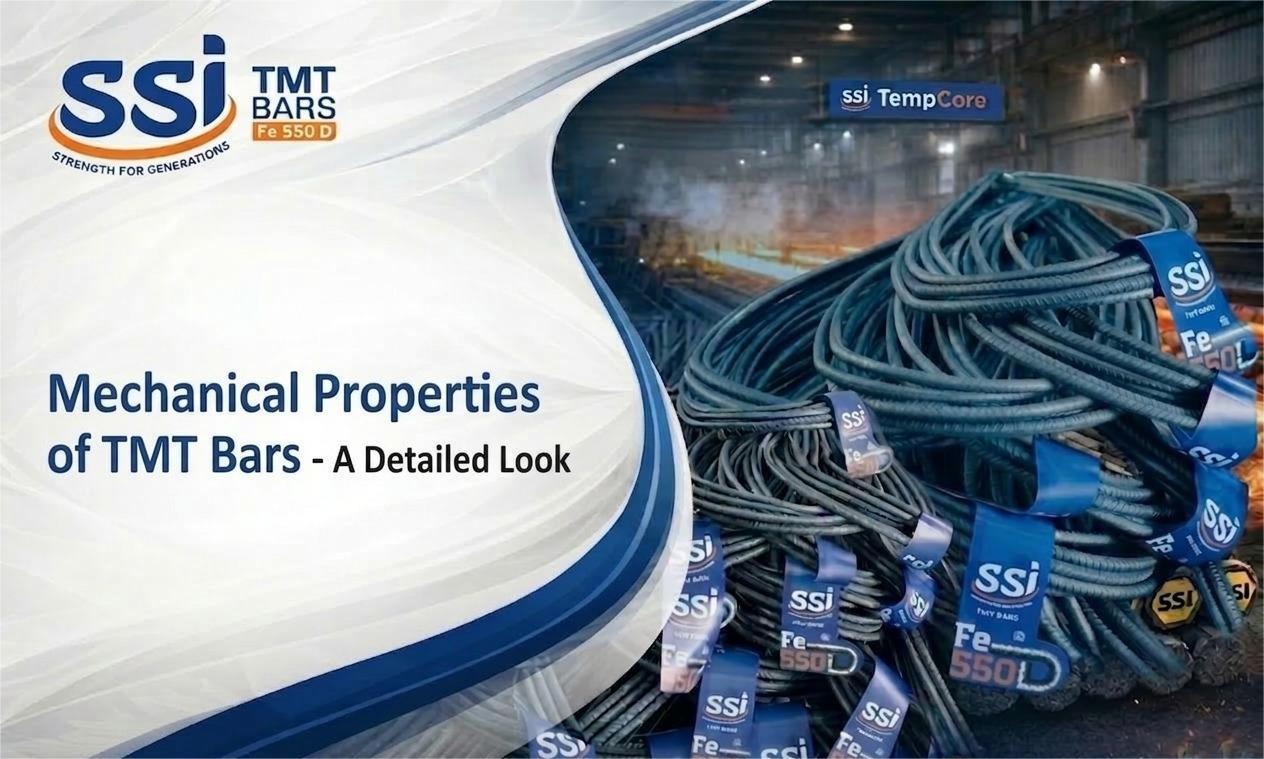
SSI TMT Bars manufactures BIS-Certified Fe 550D TMT Bars using the Belgian Tempcore Technology with superior mechanical specifications!
A Brief Look on Mechanical Properties of TMT Bars
TMT bars, or Thermo-Mechanically Treated bars, go through a carefully controlled manufacturing process that gives them a hard outer surface and a soft inner core. This combination is what makes them both strong and flexible, two qualities that are essential in construction.
The mechanical properties of TMT bars essentially describe how these bars respond when force, heat, or environmental stress is applied to them. Properties like tensile strength, yield strength, ductility, elongation, corrosion resistance, and thermal resistance are not just technical checkboxes, they directly determine whether a structure stands firm for decades or becomes a safety risk. Together, these properties make TMT bars the preferred choice for reinforced concrete construction in buildings, bridges, dams, and infrastructure projects.
Tensile Strength
Tensile strength is the maximum amount of pulling or stretching force a TMT bar can withstand before it breaks or fractures completely. Think of it as the bar’s ability to resist being torn apart under load. In construction, structural elements like beams and slabs are constantly subjected to tensile forces, especially when loads are applied from above or when the ground shifts. A TMT bar with high tensile strength ensures that the reinforcement holds the structure together without snapping. For example, in a reinforced concrete beam supporting the floor of a building, the TMT bars embedded within the concrete absorb the tensile stress that concrete alone cannot handle.
Yield Strength
Yield strength refers to the amount of stress a TMT bar can absorb before it begins to deform permanently, that is, before it stops returning to its original shape once the force is removed. It marks the boundary between elastic behavior (where the bar bounces back) and plastic behavior (where it stays bent). This is a critical property because in structural design, engineers ensure that the bars operate well within the yield point during normal conditions.
Ductility
Ductility is the ability of a TMT bar to undergo significant deformation or bending without cracking or breaking. It is the property that allows steel to be shaped, bent, and worked with on-site without losing its structural integrity. In simpler terms, a ductile bar can be bent into hooks or stirrups during construction without developing fractures at the bend. This is particularly important in earthquake-prone regions, where structures need to absorb and dissipate seismic energy rather than crack and collapse. For example, during an earthquake, a ductile TMT bar will bend and flex with the movement of the structure, preventing sudden brittle failure. The soft ferrite-pearlite core of TMT bars is specifically engineered to provide this ductility, while the hardened outer layer provides strength.
Elongation
Elongation refers to the percentage increase in the length of a TMT bar before it fractures when subjected to a tensile load. It is a measurable indicator of ductility and gives engineers a quantified understanding of how much a bar can stretch under stress. Higher elongation values indicate a more flexible bar that can absorb greater deformation – a desirable quality in dynamic load conditions.
Corrosion resistance
Corrosion resistance is the ability of a TMT bar to withstand rust and chemical degradation when exposed to moisture, oxygen, salts, and other environmental agents. Corrosion is one of the leading causes of structural deterioration, when the steel inside concrete rusts, it expands, causing the surrounding concrete to crack and spall, which weakens the entire structure over time. CRS TMT bars are manufactured with a controlled chemical composition, typically with low carbon content and the addition of elements like copper, chromium, and phosphorus, that significantly improves their resistance to corrosion.
Thermal resistance
Thermal resistance refers to the ability of TMT bars to retain their structural strength and stability when exposed to elevated temperatures, such as those experienced during a fire. While all steel softens at very high temperatures, TMT bars are designed to maintain their load-bearing capacity for a longer duration compared to conventional steel bars, giving occupants and emergency responders more time in the event of a fire. The thermo-mechanical treatment process refines the grain structure of the steel, which contributes to better performance under heat.
Learn more: How to choose the right TMT Bars for your construction purposes?
Mechanical Specification: BIS Standard Vs SSI TMT
| Properties | Fe 550D Grade | |
| IS:1786–2008 | SSI TMT | |
| Yield Stress – N/mm² (Min.) | 550 | 570 |
| Tensile Strength – N/mm² (Min.) | 600 | 640 |
| TS/YS Ratio (Min.) | 1.08 | 1.11 |
| Elongation % (Min.) | 14.5 | 17 |
| Total Elongation % (Min.) | 5 | 6 |
Choose the Strong TMT Bars for Strong Buildings!
The talk of modernity must be expressed in our buildings and constructions. It must be expressed in the TMT Bars having the superior tensile strength, higher yield strength, excellent ductility with corrosion and fire resistance. SSI TMT Bars’ mechanical specification details clearly shows its strength in holding the building life-long. And, to add further our TMT Bars utilized in the range of projects, like Chennai Metro rail projects, NHAI Projects, Tamilnadu Housing Board and more.
Speak to our team and make your buildings stronger with SSI TMT Bars!
FAQs
1. What are the key mechanical properties of TMT bars?
The key mechanical properties of TMT (Thermo-Mechanically Treated) bars include tensile strength, yield strength, ductility, elongation, corrosion resistance, and thermal resistance. These properties determine how the bar performs under stress, heat, and environmental conditions, ensuring strength, flexibility, and long-term durability in construction.
2. What is tensile strength in TMT bars and why is it important?
Tensile strength refers to the maximum pulling force a TMT bar can withstand before breaking. In reinforced concrete structures like beams and slabs, TMT bars absorb tensile stress that concrete alone cannot handle. Higher tensile strength ensures structural safety and load-bearing capacity.
3. What does yield strength mean in TMT bars?
Yield strength is the stress level at which a TMT bar begins to deform permanently. Before reaching the yield point, the bar returns to its original shape once the load is removed. Engineers design structures so that TMT bars operate well within this limit to maintain structural integrity and safety.
4. Why are ductility and elongation important in TMT bars?
Ductility is the ability of a TMT bar to bend without cracking or breaking, while elongation measures how much it can stretch before fracturing. These properties are especially important in earthquake-prone areas because they allow structures to absorb and dissipate seismic energy without sudden failure.
5. How do TMT bars resist corrosion and high temperatures?
TMT bars are manufactured with a controlled chemical composition that enhances corrosion resistance against moisture, salts, and environmental exposure. Additionally, the thermo-mechanical treatment process improves thermal resistance, helping the bars retain strength for longer durations during high-temperature situations like fire.
6. How do SSI TMT Bars differ from standard Fe 550D TMT bars?
SSI TMT Bars are BIS-certified Fe 550D grade bars manufactured using Belgian Tempcore Technology. Compared to standard IS 1786–2008 specifications, SSI TMT Bars offer higher yield strength (570 N/mm² vs 550 N/mm²), higher tensile strength (640 N/mm² vs 600 N/mm²), better elongation (17% vs 14.5%), and improved TS/YS ratio. These superior mechanical specifications make SSI TMT Bars a stronger and more reliable choice for long-lasting construction projects.