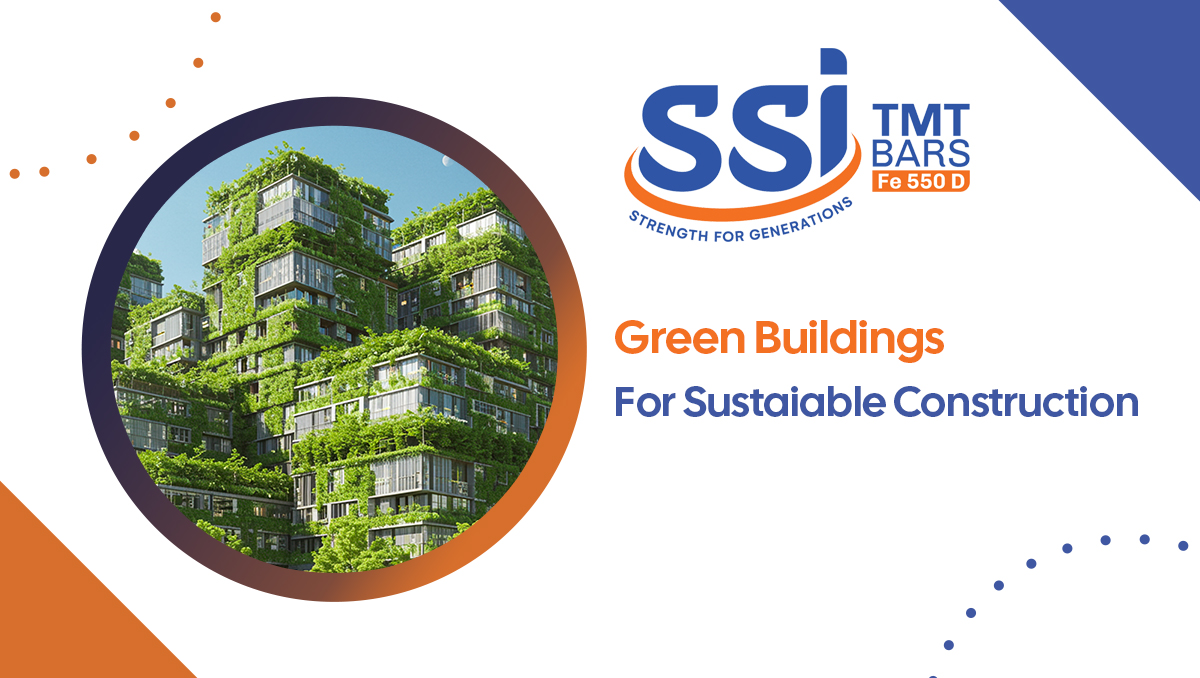
India’s construction sector accounts for approximately 22% of the country’s total energy consumption and nearly 40% of its solid waste generation. As urbanisation accelerates with over 500 million people expected to live in Indian cities by 2050, the built environment must shift from resource-intensive to resource-responsible. Green building is that shift. It redefines how structures are designed, built, and operated across their entire lifecycle reducing environmental impact while delivering measurable economic returns to developers, occupants, and investors. Choosing the sustainable materials is important for constructing the green buildings. In this blog, we are providing detailed information on green building, its characteristics, advantages and other key details.
What is a Green Building?
A green building is a structure designed, constructed, and operated to minimise resource consumption, reduce environmental impact, and improve occupant health across its entire lifecycle – material sourcing and construction to operation, maintenance, and eventual demolition.
Green buildings integrate energy efficiency, water conservation, sustainable materials, indoor environmental quality, and site optimisation into a single performance-driven framework. Unlike conventional buildings, green buildings are evaluated against benchmarks set by recognised certification bodies and aligned with global sustainability standards.
Green building is a core enabler of SDG 11 (Sustainable Cities and Communities), which calls for inclusive, safe, resilient, and sustainable urban environments by 2030. It directly supports SDG 7 (Affordable and Clean Energy) through energy efficiency mandates, SDG 13 (Climate Action) through carbon footprint reduction, and SDG 12 (Responsible Consumption and Production) through sustainable material selection.
Characteristics of Green Building
Green buildings share a defined set of performance characteristics that distinguish them from standard construction. These characteristics function as design mandates not optional enhancements.
- Energy efficiency: Green buildings consume 30–50% less energy than conventional structures through passive design, high-performance insulation, LED systems, and Building Energy Management Systems (BEMS).
- Water conservation: Low-flow fixtures, greywater recycling, and on-site rainwater harvesting reduce potable water demand by up to 40%.
- Sustainable material selection: Green buildings prioritise materials with low embodied carbon, recycled content, regional sourcing, and third-party environmental certifications such as GreenPro.
- Site sustainability: Green buildings minimise site disruption, manage stormwater runoff, and maximise green cover and permeable surfaces.
- Waste reduction: Construction waste management plans divert at least 75% of demolition and construction debris from landfills.
- Structural durability: Long-lasting structural materials reduce the frequency of repairs, replacements, and associated carbon emissions over the building’s lifecycle.
Advantages of Green Building
Green buildings generate returns that extend well beyond environmental compliance. For developers, investors, and occupants in India, the business case for green construction is measurable and growing.
- Operating cost reduction: Green buildings report 25–35% lower energy costs and 30–40% lower water costs compared to conventional buildings of equivalent size.
- Higher asset valuation: IGBC and LEED-certified buildings command rental premiums of 5–10% and sale price premiums of 7–10% in major Indian markets including Mumbai, Bengaluru, and Hyderabad.
- Regulatory compliance readiness: SEBI’s BRSR (Business Responsibility and Sustainability Reporting) framework, mandatory for India’s top 1,000 listed companies since FY 2022–23, requires disclosure of building energy and water consumption.
- Occupant health and productivity: Studies published by the World Green Building Council indicate that improved IEQ in green buildings increases worker productivity by 8–11% and reduces absenteeism by up to 39%.
- Carbon footprint reduction: A green building reduces lifecycle carbon emissions by 34–50% compared to a conventional structure, supporting corporate Scope 1 and Scope 2 emissions targets under GRI Standards and TCFD disclosures.
- Longer structural lifespan: Buildings constructed with durable, certified materials require fewer structural interventions over a 50–100-year lifecycle, reducing total embodied carbon.
Also read: Chemical Composition of TMT Bars
Green Building Certification in India
India operates one of the most active green building certification ecosystems in the world. The Indian Green Building Council (IGBC), established in 2001 under the Confederation of Indian Industry (CII), administers the most widely adopted certification framework in the country. IGBC-certified buildings cover over 10.58 billion square feet of built-up area as of 2024, making India the second-largest green building market globally.
In Tamil Nadu, the Tamil Nadu Green Building Policy and CMDA norms encourage green-rated construction in Chennai and Tier-2 cities through incentive-based approval systems. Builders and developers operating in Tamil Nadu who pursue IGBC or GRIHA ratings gain both compliance advantages and market differentiation.
The Key Feature of Green Building: Sustainable Materials
Material selection defines the environmental performance of any green building. Structural materials account for the largest share of a building’s embodied carbon – the carbon emitted during extraction, manufacturing, transport, and construction. Choosing certified, low-carbon structural materials is not an optional upgrade; it is a defining feature of genuine green construction. One of the primary elements of any structure is TMT Bars – a skeleton of buildings.
SSI TMT Bars – IGBC Certified and GreenPro Certified
SSI TMT Bars carry both IGBC certification and GreenPro certification – two of the most rigorous environmental product endorsements available in the Indian construction market. TMT bars produced by the SSI TMT Bars are approved by both State and Central authorities; this strong validation ensures safety and strength of buildings built with SSI TMT Bars.
For developers in Tamil Nadu and across South India building commercial complexes, residential towers, industrial facilities, or infrastructure projects under green rating frameworks.
SSI TMT Bars deliver structural integrity and certification-ready sustainability in a single product specification.
FAQs
1. What is a green building?
A green building is a structure designed to reduce energy use, save water, and minimize environmental impact while providing a healthier space for people to live or work.
2. Why are green buildings important today?
Green buildings help reduce pollution, save natural resources, and lower energy costs, making cities more sustainable as urban populations continue to grow.
3. What are the main features of a green building?
Key features include energy efficiency, water conservation, use of sustainable materials, waste reduction, and long-lasting structural durability.
4. What are the benefits of green buildings?
Green buildings reduce electricity and water bills, increase property value, improve indoor air quality, and lower carbon emissions.
5. Why are SSI TMT Bars suitable for green buildings?
SSI TMT Bars are IGBC and GreenPro certified, making them a sustainable structural material that provides strength, safety, and support for green building construction.