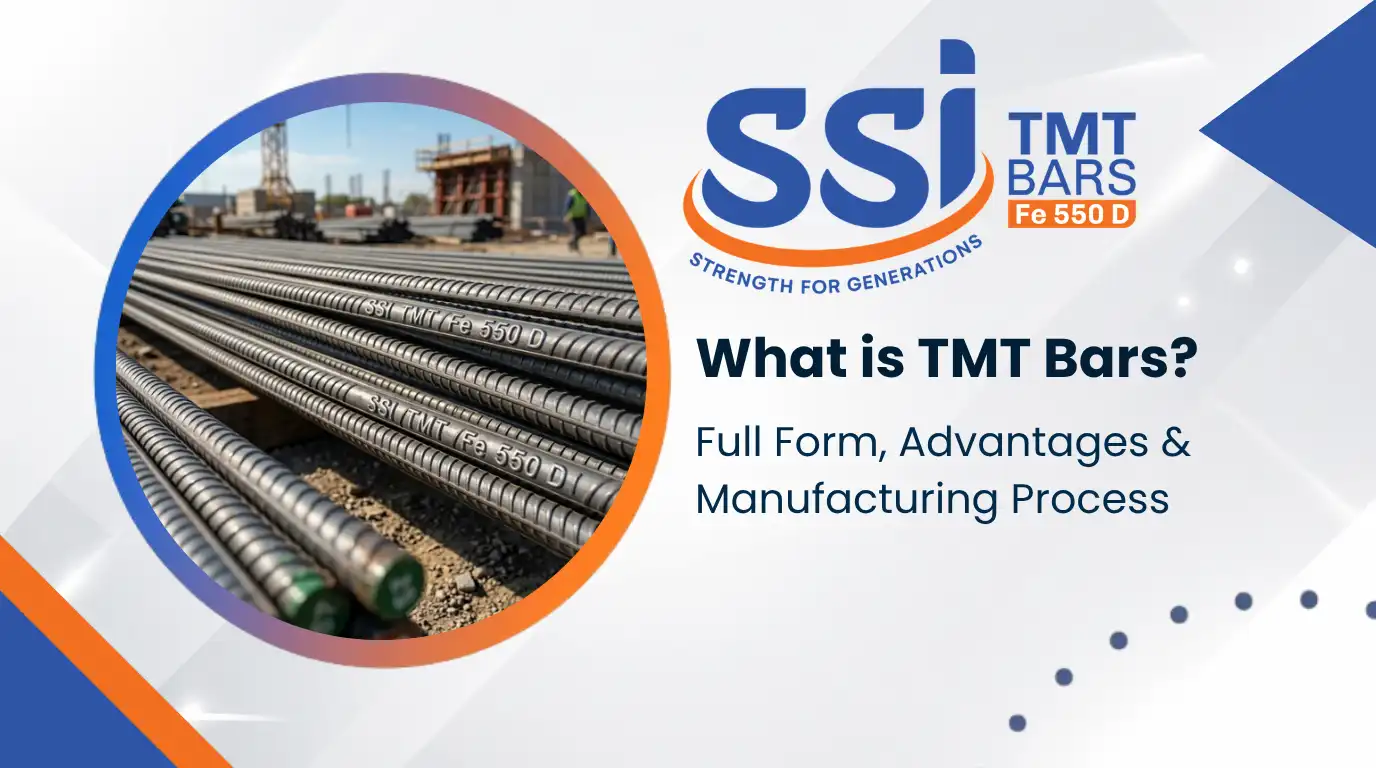
TMT bars (Thermo-Mechanically Treated bars) are recognized as high-strength steel reinforcement bars used in different sorts of construction – homes, bridges, towers and dams. It is known for its tough exterior and soft flexible core as it is manufactured with a special heat and rapid cooling process (quenching). This unique structure allows it to have a superior strength, ductility (flexibility), and resistance to earthquakes, corrosion, and fire. It offeres better safety and performance compared to traditional bars.
In this blog, we provide comprehensive information regarding what is TMT bar, advantages, manufacturing process and key applications.
Looking for BIS-certified TMT Bars manufactured with advanced technology?
Key Points on TMT Bars
- TMT bar full form is Thermo Mechanically Treated bars used for concrete reinforcement.
- The HSN code for TMT bars is 7214 with subcategory 72142090 commonly used for classification.
- The GST rate applicable on TMT bars under HSN code 7214 is 18%.
- These bars feature a hard outer layer and soft inner core for optimal strength and ductility. The ribbed surface design ensures superior bonding with concrete.
- The manufacturing process involves controlled heating, rapid cooling, and self-tempering.
- TMT bars offer superior corrosion resistance compared to traditional steel bars.
- Widely used in residential, commercial, and infrastructure construction projects.
What are TMT Bars - Full Form & Definition
TMT stands for Thermo Mechanically Treated, is a high-strength steel reinforcement bar manufactured with specialized manufacturing process. The process creates a unique microstructure with three distinct layers.
- The outer layer consists of tempered martensite that provides high strength.
- The middle layer contains a mixture of martensite and bainite for balanced properties.
- The core remains soft with a ferrite-pearlite structure that ensures excellent ductility.
This composite structure makes TMT bars superior to conventional mild steel bars and cold-twisted deformed bars, allows structures to withstand heavy loads while absorbing seismic energy during earthquakes.
What are the Major Characteristics of TMT Bars?
TMT bars possess unique properties that make them ideal for modern construction requirements.
- High Tensile Strength: TMT bars offer exceptional load-bearing capacity ranging from 415 MPa to 600 MPa depending on the grade. The hardened outer layer provides this remarkable strength without making the bar brittle.
- Superior Ductility: The soft ferrite-pearlite core gives TMT bars excellent elongation properties. This allows the bars to bend significantly without breaking under stress.
- Excellent Bonding with Concrete: The ribbed surface pattern on TMT bars creates mechanical interlocking with concrete. This superior bond prevents slippage and ensures effective load transfer between steel and concrete.
- Corrosion Resistance: The manufacturing process creates a protective oxide layer on the surface. Unlike cold-twisted bars that develop surface cracks during production, TMT bars remain free from stress-induced defects. This makes them highly resistant to rust even in humid and coastal environments.
- Fire Resistance: TMT bars maintain their structural integrity at temperatures up to 600°C. The tempered martensitic layer retains its strength during fire incidents. This gives structures more time to resist collapse during emergencies.
- Earthquake Resistance: The combination of high strength and excellent ductility makes TMT bars ideal for seismic zones. They can absorb and dissipate earthquake energy through elastic deformation without sudden failure.
- Weldability: TMT bars contain low carbon content, typically less than 0.30%. This makes them easy to weld without losing strength or causing brittleness at weld joints.
- Cost Effectiveness: The high strength of TMT bars reduces the quantity of steel required in construction. This leads to significant cost savings in material and labor.
What are the Advantages of TMT Bars for Constructions?
TMT bars offer numerous benefits that make them superior to traditional reinforcement materials.
- Enhanced Structural Safety: The unique microstructure of TMT bars provides consistent performance under various load conditions. Structures built with TMT bars can withstand extreme weather events, seismic activities, and heavy loads without compromising safety.
- Longer Service Life: The corrosion-resistant properties of TMT bars significantly extend the lifespan of concrete structures. Buildings and infrastructure in coastal areas benefit most from this advantage as the bars resist rust formation even in saltwater environments.
- Reduced Maintenance Costs: Structures reinforced with TMT bars require less maintenance over their lifetime. The resistance to corrosion and degradation eliminates the need for frequent repairs and protective treatments.
- Material Savings: The high tensile strength allows engineers to use fewer bars to achieve the same structural capacity. This reduction in steel consumption directly lowers construction costs. In large projects, the savings can be substantial.
- Faster Construction: TMT bars are easy to handle, cut, and bend on-site. Their excellent weldability speeds up the fabrication process. The ribbed surface ensures quick bonding with concrete, allowing for faster construction schedules.
- Design Flexibility: The superior ductility enables architects and engineers to create complex and innovative designs. TMT bars can be bent into various shapes without cracking or losing strength. This is particularly valuable for curved structures and irregular geometries.
- Environmental Benefits: The energy-efficient manufacturing process of TMT bars produces less carbon emissions compared to older methods. The longer lifespan of structures means fewer resources needed for repairs and replacements.
- Compliance with Standards: TMT bars manufactured according to IS 1786 standards ensure quality and reliability. They meet stringent requirements for yield strength, elongation, and chemical composition. This gives engineers confidence in their structural calculations.
Get to know about the high-strength TMT bars suitable for all kinds of construction projects.
What is the Manufacturing Process Used to Make and Produce TMT Bars?
The production of TMT bars involves a sophisticated multi-stage process that creates their unique properties.
- Billet Preparation: The process begins with high-quality steel billets produced through continuous casting. Raw materials including sponge iron and scrap are melted in an induction furnace at approximately 1650°C. The molten metal undergoes chemical composition testing before being cast into billets. A ladle refining furnace removes impurities and ensures low sulfur and phosphorus content.
- Reheating: Steel billets are placed in a reheating furnace and heated to temperatures between 1100°C and 1250°C. This intense heat transforms the steel into an austenitic phase. The uniform heating ensures consistent properties throughout the bar. The high temperature makes the steel malleable and ready for rolling.
- Hot Rolling: The heated billets pass through a series of rolling stands. Each stand progressively reduces the cross-sectional area and elongates the billet. The rolling process shapes the steel into bars of the desired diameter. The ribbed pattern is imprinted onto the surface during rolling. This pattern provides mechanical bonding with concrete.
- Quenching: Immediately after leaving the final rolling stand, the hot bars enter the quenching system. High-pressure water jets rapidly cool the surface of the bars. This sudden cooling transforms the outer layer into hard martensite while keeping the core hot and austenitic. The quenching time is precisely controlled based on bar diameter.
- Self-Tempering: After quenching, the bars undergo atmospheric cooling on a cooling bed. The residual heat from the hot core transfers outward to the hardened surface. This self-tempering process relieves internal stresses in the martensitic layer. The heat from the core tempers the hard outer layer, improving its toughness. This stage gives Tempcore technology its name – the martensitic layer is tempered by the heat left in the core.
- Core Transformation: During slow cooling on the cooling bed, the austenitic core gradually transforms. It develops into a ductile ferrite-pearlite structure. This soft core provides the excellent elongation properties of TMT bars. The final product has three concentric zones with different microstructures working together.
- Finishing Operations: The cooled bars undergo straightening to remove any bends or warps. They are then cut to standard lengths using automatic shears. Each bar is marked with manufacturer identification and grade specifications. Weight tolerance is carefully controlled to ensure accurate material estimation.
- Quality Testing: Samples from each batch undergo rigorous testing. Tensile tests verify yield strength and ultimate tensile strength. Bend tests confirm ductility and check for surface cracks. Chemical analysis ensures compliance with composition standards. Ultrasonic testing detects any internal defects.
Apart from the Belgian Tempcore Technology for manufacturing TMT bars, SSI TMT Bars focused on other advantages as well for the builders and dealers.
What are the Key Applications of TMT Bars?
TMT bars find extensive use across all types of construction projects.
- Residential Construction: TMT bars form the structural framework of homes, apartments, and housing complexes. They reinforce foundations, columns, beams, slabs, and stairways. The corrosion resistance ensures homes remain safe for decades.
- Commercial Buildings: Office towers, shopping malls, hotels, and hospitals rely on TMT bars for structural support. High-grade TMT bars enable the construction of tall buildings with large spans. The fire resistance provides crucial safety in commercial structures.
- Bridges and Flyovers: Long-span bridges require exceptional strength and durability. TMT bars provide the load-bearing capacity needed for heavy traffic. The corrosion resistance is vital for bridges exposed to weather elements. Urban flyovers depend on TMT reinforcement to support continuous vehicle movement.
- Industrial Structures: Factories, warehouses, and manufacturing plants need robust structural frames. TMT bars support heavy machinery and equipment loads. Industrial buildings often require large column-free spaces that TMT bars can provide.
- Infrastructure Projects: Dams, water treatment plants, and power stations use TMT bars for critical structural components. The bars withstand extreme conditions and chemical exposure. Metro systems and railway stations benefit from the earthquake resistance of TMT bars.
- High-Rise Buildings: Skyscrapers face enormous vertical loads and significant wind forces. High-grade TMT bars like Fe 550 provide the required strength. The ductility allows tall buildings to sway during strong winds without structural damage.
- Seismic Zone Construction: Buildings in earthquake-prone areas require materials that can absorb seismic energy. TMT bars with their excellent elongation properties prevent catastrophic failure. They allow structures to deform elastically and return to their original shape.
- Marine Structures: Ports, harbors, and offshore platforms operate in highly corrosive saltwater environments. The superior corrosion resistance of TMT bars makes them ideal for marine applications. Coastal buildings also benefit from this protection against salt-laden air.
- Roads and Highways: Concrete pavements and road reinforcement use TMT bars for durability. Expressways and airport runways require bars that can withstand heavy loads and thermal expansion. TMT bars provide the necessary strength and longevity for transportation infrastructure.
Which TMT Bar is Best? Choose High-Standard Ones That Never Breaks Your Trust
SSI TMT Bars is a best BIS-certified Fe 550D TMT Bars Manufacturer and Supplier in Tamil Nadu, known for uncompromising quality, strength, and reliability. Manufactured in advanced plants, our TMT Bars are produced using Belgian Tempcore technology and fully automated hot rolling processes. With strict adherence to BIS standards and rigorous quality checks at every stage, SSI delivers precision-engineered TMT bars designed for long-lasting performance, safety, and cost efficiency.
Why Choose SSI TMT Bars?
- BIS Certified Quality (IS 1786:2008): Every batch is tested for chemical composition, mechanical strength, elongation, and dimensional accuracy, ensuring consistent and verified performance.
- Advanced Belgian Tempcore Technology: Globally proven quenching technology delivers the ideal balance of high strength and flexibility through superior microstructural consistency.
- Superior Earthquake Resistance: High ductility and bendability make SSI TMT Bars ideal for seismic zones 3, 4, and 5, helping structures absorb seismic energy safely.
- Enhanced Corrosion Resistance: Low sulfur and phosphorus content with a protective outer layer ensures durability even in coastal and humid environments.
- Strong Distribution Network: Trusted distributor partnerships across Tamil Nadu guarantee timely delivery, availability, and technical support.
- Cost-Effective Construction: Higher strength means less steel consumption, lower construction costs, and minimal maintenance over the structure’s lifetime.
- Proven Trust & Legacy: Trusted by engineers, contractors, and builders nationwide, SSI stands for reliability, safety, and long-term value.
FAQs
What are TMT bars?
TMT bars are Thermo Mechanically Treated steel reinforcement bars used extensively in construction for reinforced concrete structures. They are manufactured through a controlled heating and cooling process that gives them high tensile strength, superior ductility, durability, and earthquake resistance, making them ideal for residential, commercial, and infrastructure projects.
What is the TMT bar full form?
The TMT bar full form is Thermo Mechanically Treated bar. The name comes from the advanced thermo-mechanical process used to enhance the strength and flexibility of the steel bars.
What is the TMT bar HSN code?
The TMT bar HSN code is 7214, which falls under the classification of hot-rolled deformed steel bars. In most cases, HSN code 72142090 is used for billing and GST purposes. TMT bars under this HSN attract 18% GST in India.
Which TMT bar is best?
The best TMT bar is one that strictly follows IS 1786 standards, uses advanced manufacturing technology, and maintains consistent quality. SSI TMT Bars stand out as a reliable choice, manufactured using high-quality raw materials and advanced Belgian Tempcore technology, offering superior strength, ductility, and long-term durability. SSI also produces Fe 550D grade TMT bars, suitable for demanding construction requirements.
Which TMT bar is best for house construction?
The best TMT bar for house construction is generally Fe 500 or Fe 500D grade, as these grades provide the ideal balance of strength, flexibility, and earthquake resistance for residential buildings. For enhanced safety and longevity, many builders prefer SSI TMT Fe 550D Bars due to their superior ductility and quality consistency.
Which TMT bar is good for construction?
A good TMT bar for construction should comply with IS 1786, have controlled chemical composition, high yield strength, excellent bendability, and strong bonding with concrete. TMT bars manufactured using modern quenching and self-tempering processes, like SSI TMT Bars, ensure structural safety across all types of construction projects.
How to calculate TMT bar weight?
To calculate TMT bar weight, use the standard formula:
Weight (kg) = D² / 162 × Length (in meters)
Where D is the diameter of the TMT bar in millimeters.
This formula helps engineers and builders accurately estimate steel quantity and construction costs.
What is the IS code for TMT bars?
The IS code for TMT bars is IS 1786, which specifies the requirements for high-strength deformed steel bars and wires used for concrete reinforcement. It defines standards for yield strength, elongation, chemical composition, and mechanical properties.
What properties do TMT bars have?
TMT bars possess several critical properties, including:
- High tensile and yield strength
- Excellent ductility and elongation
- Superior earthquake resistance
- Good weldability
- Enhanced corrosion resistance
- Strong bonding with concrete
These properties make TMT bars ideal for safe, long-lasting construction.
Which TMT bar is best in India?
The best TMT bar in India is one that consistently meets IS 1786 standards, uses advanced manufacturing technology, and delivers proven performance in real-world conditions. SSI TMT Bars, produced with strict quality control and modern processes, are widely trusted by engineers, contractors, and builders across the country.
How are TMT bars made?
TMT bars are made through a thermo-mechanical treatment process involving hot rolling, rapid water quenching, self-tempering, and controlled cooling. This process creates a hard outer layer for strength and a soft inner core for ductility, resulting in bars that can withstand heavy loads and seismic forces.
SSI TMT Bars are manufactured using advanced Belgian Tempcore technology, ensuring consistent microstructure, superior mechanical properties, and long-term durability.