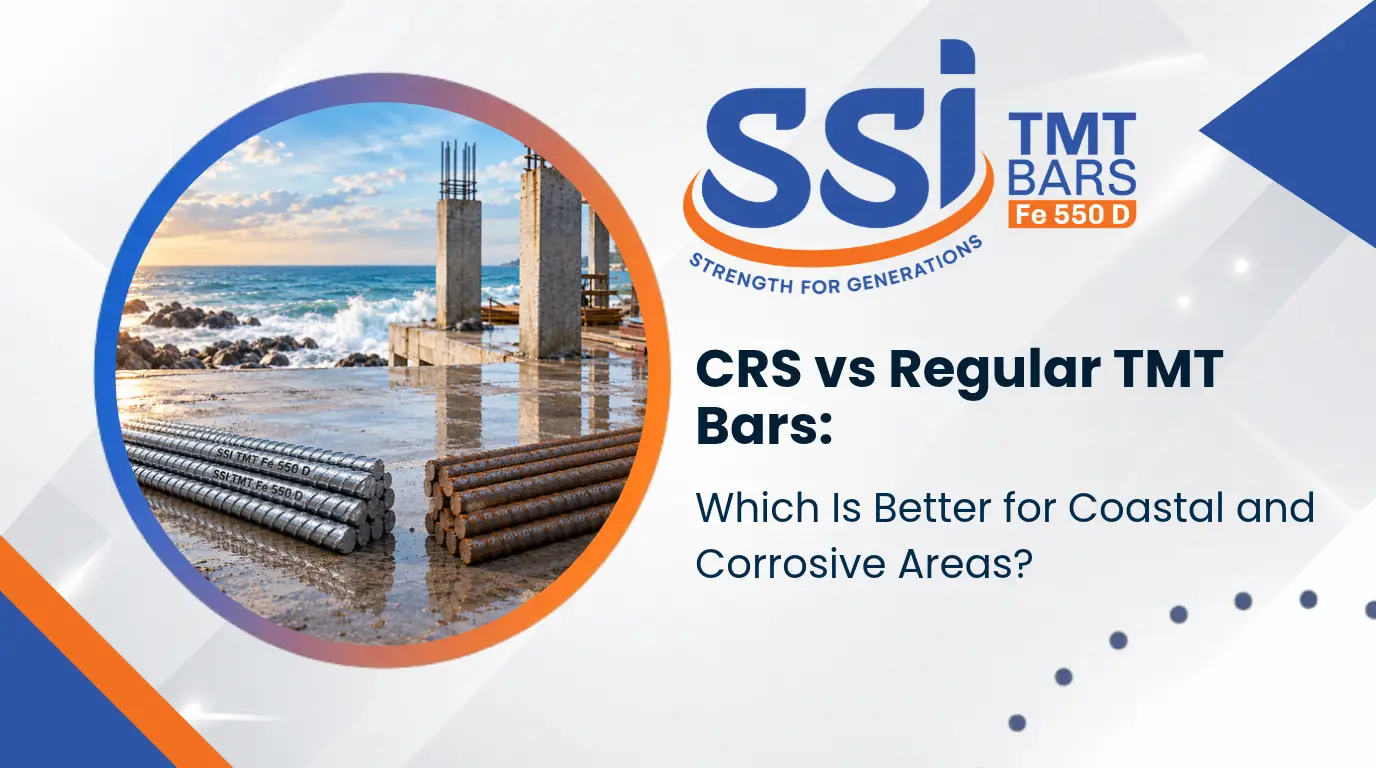
TMT bars are an important part of building construction. They are used to provide reinforcement and strength to concrete structures such as houses, apartments, bridges, columns, beams and slabs.
But every construction site has different conditions.
A building near the sea faces more moisture and salt exposure than a building in an inland area. Similarly, some industrial areas may expose buildings to conditions that can increase the risk of corrosion.
In such places, CRS TMT bars can be a useful choice.
But what is CRS TMT? How is it different from regular TMT bars? And why are CRS TMT bars especially useful in coastal areas?
Let us understand it in simple terms.
What Is CRS TMT?
CRS stands for Corrosion Resistant Steel.
CRS TMT bars are designed to provide better resistance to corrosion than conventional TMT reinforcement.
Corrosion can happen when steel is exposed to moisture, salts and other aggressive conditions. Over time, corrosion can affect the reinforcement and the surrounding concrete.
This is an important concern for structures exposed to marine environments and other corrosive conditions.
What Are Regular TMT Bars?
Regular TMT bars are widely used for normal reinforced concrete construction.
They are commonly used in:
- Houses
- Apartments
- Commercial buildings
- Schools
- Factories
- Foundations
- Beams
- Columns
- Slabs
- Roads and infrastructure
Regular TMT bars can be suitable for many construction projects where the environmental conditions do not create a high corrosion risk.
The correct TMT grade and size should always be selected based on the structural design.
CRS vs Regular TMT Bars: What Is the Main Difference?
The main difference is corrosion resistance.
Regular TMT bars are suitable for many normal construction conditions.
CRS TMT bars are designed to provide better resistance to corrosion and can be considered when the structure is exposed to conditions where corrosion is a bigger concern.
Feature | CRS TMT Bars | Regular TMT Bars |
Corrosion resistance | Better suited for corrosion-prone conditions | Suitable for normal conditions |
Coastal areas | Highly relevant where specified | May require other corrosion protection measures |
High-moisture areas | Can be considered | Depends on exposure conditions |
Industrial areas | Can be considered based on exposure | Depends on site conditions |
Initial cost | May be higher | Generally lower |
Long-term use | Useful where corrosion resistance is important | Suitable for general construction |
Why Is Corrosion a Problem?
Steel reinforcement is placed inside concrete. Normally, the concrete helps protect the steel.
However, moisture, chloride salts and other harmful substances can reach the reinforcement under certain conditions.
This can start the corrosion process.
As corrosion develops, it can affect the steel and may lead to:
- Cracks in concrete
- Damage to the concrete surface
- Reduction in durability
- Higher maintenance requirements
- Shorter service life if the problem becomes severe
This is why corrosion protection is especially important for buildings and structures exposed to harsh environments.
Why Are CRS TMT Bars Useful in Coastal Areas?
Coastal areas are one of the most important applications to consider for corrosion-resistant reinforcement.
Buildings near the sea can be exposed to salt, moisture and chloride-rich environments. These conditions can increase the risk of corrosion of steel reinforcement.
BIS specifically notes the risk of chloride-induced corrosion in reinforced concrete structures in marine areas.
This is where CRS TMT bars can offer an advantage.
Benefits of CRS TMT Bars in Coastal Construction
- Better corrosion resistance
CRS TMT bars are designed to provide improved resistance to corrosion.
- Better suited to marine environments
They can be considered for buildings and structures exposed to coastal and marine conditions.
- Supports long-term durability
Reducing the impact of corrosion can support the long-term durability of a reinforced concrete structure.
- Helps reduce corrosion-related maintenance
Where corrosion is a major concern, using suitable corrosion-resistant reinforcement can be part of a wider durability strategy.
However, CRS TMT bars should be used along with proper concrete quality, adequate concrete cover and good construction practices.
Where Else Can CRS TMT Bars Be Used?
CRS TMT bars are not only for coastal buildings.
They can also be considered in other locations where corrosion is a concern.
1. Coastal Cities and Towns
Buildings near the sea can face high exposure to salt and moisture.
Examples include construction in coastal parts of Tamil Nadu, Kerala, Andhra Pradesh, Karnataka, Maharashtra, Odisha and West Bengal.
The exact reinforcement requirement should depend on the project’s exposure conditions and structural design.
2. Bridges
Bridges can be exposed to rain, moisture and other environmental conditions.
For projects where corrosion is a concern, corrosion-resistant reinforcement can be considered.
3. Industrial Areas
Some industrial environments can have conditions that increase corrosion risk.
The type of reinforcement should be selected according to the actual environment and project specifications.
4. Water-Related Structures
Structures exposed to water need careful attention to durability.
CRS TMT bars can be considered where corrosion resistance is an important requirement.
5. Marine Structures
Structures close to seawater or exposed to marine conditions can have a higher corrosion risk.
In such projects, corrosion-resistant reinforcement can be considered as part of the overall durability plan.
6. High-Humidity Areas
High humidity alone does not mean CRS TMT is required for every project.
However, when high humidity is combined with moisture, salts or other aggressive exposure, corrosion protection becomes more important.
Why Can CRS TMT Be Better for Coastal Construction?
For a normal building in a normal environment, regular TMT bars may be perfectly suitable.
But coastal construction is different.
The combination of salt + moisture + exposure can create a greater corrosion concern.
In such projects, using corrosion-resistant reinforcement can provide an additional layer of protection.
This does not mean CRS TMT bars remove the need for proper concrete design and construction. Concrete quality, adequate cover, curing and proper workmanship are also important for protecting reinforcement.
Can CRS TMT Bars Be Used in Green Buildings?
Yes, CRS TMT bars can be considered as part of a sustainable construction approach when they are suitable for the project.
Durable materials can help support longer-lasting structures and may reduce the need for major repairs or replacement.
However, using CRS TMT bars alone does not make a building a green building.
A green building also considers:
- Energy efficiency
- Water conservation
- Waste reduction
- Sustainable materials
- Efficient building design
- Responsible use of resources
How to Choose Between CRS and Regular TMT Bars?
Before choosing your TMT bars, check the following:
1. Check the Location
Is the project near the sea?
Is it in a high-humidity area?
Is it exposed to water or salts?
2. Check the Environmental Conditions
Understand the actual exposure conditions of the project.
A coastal building and an inland residential building may have very different corrosion risks.
3. Check the Structural Design
The structural engineer should specify the required grade, size and type of reinforcement.
4. Check Quality and Standards
Choose TMT bars that meet the applicable standards and project requirements. BIS lists IS 1786 as the standard for high-strength deformed steel bars and wires used for concrete reinforcement.
5. Think About Long-Term Durability
Do not look only at the initial cost.
For corrosion-prone locations, consider the long-term durability and maintenance requirements of the structure.
CRS vs Regular TMT Bars: Simple Comparison
If you want a quick answer:
Regular TMT bars
Suitable for many normal construction projects where corrosion risk is not high.
CRS TMT bars
Designed for improved corrosion resistance and can be considered for coastal, marine, high-moisture and other corrosive environments.
The right choice depends on the project.
Conclusion
Choosing the right TMT bars is an important decision in construction.
Regular TMT bars are widely used and can be suitable for many normal building projects.
But in coastal areas, marine environments, high-moisture locations and some industrial areas, corrosion can become a bigger concern.
In these situations, CRS TMT bars can provide better corrosion resistance and can be considered as part of a long-term durability strategy.
CRS TMT bars do not replace good concrete quality or proper construction practices. The complete structure needs to be designed and built correctly.
For your next project, consider the location, environmental conditions, structural requirements and long-term durability before selecting the right TMT bars.
FAQs
What does CRS mean in TMT bars?
CRS means Corrosion Resistant Steel. CRS TMT bars are designed to provide improved resistance to corrosion.
Why are CRS TMT bars useful in coastal areas?
Coastal areas can expose buildings to salt, moisture and chlorides, which can increase the risk of corrosion. CRS TMT bars can be considered where improved corrosion resistance is required.
Can CRS TMT bars be used in normal buildings?
Yes. They can be used when specified for the project. However, they may not be necessary for every building.
Are CRS TMT bars more expensive?
CRS TMT bars may have a higher initial cost than regular TMT bars. For corrosion-prone projects, long-term durability and maintenance should also be considered.
Can CRS TMT bars prevent corrosion completely?
No. CRS TMT bars provide improved corrosion resistance, but no reinforcement should be considered completely free from corrosion risk. Concrete quality, proper cover, curing and construction practices are also important.
Are CRS TMT bars good for houses near the sea?
They can be considered for houses and other buildings in coastal areas where corrosion resistance is an important requirement. The final selection should be based on the project’s exposure conditions and structural design.
What other places can use CRS TMT bars?
CRS TMT bars can be considered for coastal buildings, marine structures, bridges, water-related structures, high-moisture locations and some industrial environments where corrosion is a concern.