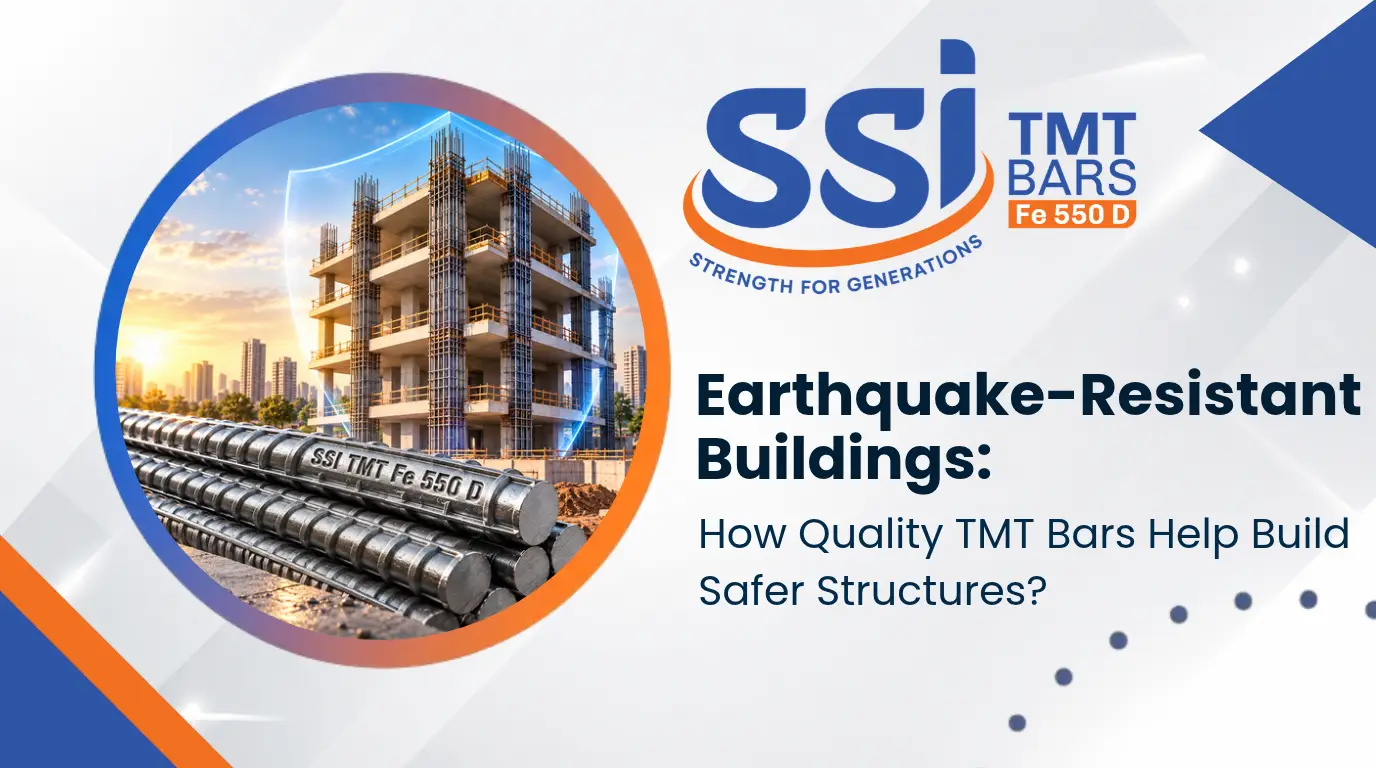
An earthquake can shake a building within seconds, but the way a structure is designed and constructed determines how it responds. While earthquakes cannot be prevented, proper structural design, quality materials and good construction practices can help buildings withstand seismic forces more effectively.
TMT bars are an important part of reinforced concrete construction. They provide tensile strength and ductility to structural members such as beams, columns, slabs and foundations.
In this guide, we explain earthquake-resistant building design, the role of TMT bars, construction practices and how to choose the best TMT bars for earthquake areas for safer, stronger buildings.
What Is Earthquake-Resistant Building Design?
Earthquake-resistant design aims to help a building withstand the forces created by ground movement and respond to them in a controlled manner.
During an earthquake, structural members may experience:
- Bending and tension
- Shear forces
- Repeated loading
- Movement at beam-column joints
- Cracking and deformation
- Stress on concrete and reinforcement
The goal is not simply to make every component stronger. Instead, the building should be designed and detailed to resist expected forces and accommodate controlled deformation without sudden structural failure.
In India, seismic design and detailing are addressed through standards such as IS 1893 for earthquake-resistant design and IS 13920 for ductile design and detailing of reinforced concrete structures subjected to seismic forces.
Also Read: Bureau of Indian Standards – Earthquake Engineering Standards
Role of TMT Bars in Earthquake-Resistant Structures
Concrete performs well under compression but requires reinforcement to resist tensile stresses. TMT bars provide this reinforcement in:
- Columns
- Beams
- Slabs
- Foundations
- Structural walls
For earthquake-resistant construction, the reinforcement needs to have the mechanical properties, grade and dimensions specified for the project.
Quality TMT bars should meet the applicable requirements and work together with properly designed concrete members.
Strength and Ductility
Two important properties of reinforcement are strength and ductility.
Strength helps reinforcement resist the loads and stresses for which it is designed.
Ductility refers to the ability of a material to undergo deformation before failure. During strong seismic activity, controlled deformation can allow the structural system to absorb and dissipate energy rather than experiencing sudden brittle failure.
This is why seismic design considers ductility alongside strength.
Important Properties of TMT Bars
When selecting reinforcement, factors beyond the Fe grade should be considered, including:
- Yield/proof stress
- Tensile strength
- Elongation
- Ductility
- Bend and re-bend performance
- Bond with concrete
- Rib/deformation characteristics
- Chemical composition
- Manufacturing consistency
IS 1786 specifies requirements for high-strength deformed steel bars and wires used for concrete reinforcement, including grades such as Fe 500, Fe 500D, Fe 550 and Fe 550D.
Why Reinforcement Detailing Matters
Choosing a quality TMT bar is only one part of earthquake-resistant construction.
The reinforcement must be placed and detailed according to the approved structural drawings. Particular attention is required in areas such as beam-column joints, where seismic forces can be significant.
Important detailing considerations include:
- Bar diameter and spacing
- Anchorage
- Development length
- Lap locations
- Hooks and bends
- Confinement
- Concrete cover
- Reinforcement placement
Proper detailing helps ensure that reinforcement and concrete work together as intended.
Earthquake-Resistant Construction: Key Steps
Creating a safer structure requires coordination between design, materials and construction.
1. Assess the Site and Soil
Soil conditions can influence how earthquake forces affect a building. A suitable site investigation and geotechnical assessment can help engineers understand ground conditions and determine appropriate foundation requirements.
2. Follow Seismic Structural Design
A qualified structural engineer should design the building according to applicable structural and seismic requirements.
The design may consider:
- Building configuration
- Structural system
- Expected loads
- Seismic forces
- Soil conditions
- Foundation requirements
3. Select the Specified TMT Grade
The TMT grade should be selected according to the structural drawings and project specifications.
Fe 500D or Fe 550D should not be selected simply because they have a higher strength value. The appropriate grade depends on the structural design and applicable requirements.
4. Follow Proper Reinforcement Detailing
Bars should be cut, bent and placed according to the structural drawings. Critical areas such as beam-column joints require particular attention where seismic detailing is specified.
5. Maintain Concrete Quality
TMT bars work together with concrete. Proper mixing, placement, compaction, curing and concrete cover are important for the performance and durability of reinforced concrete.
6. Maintain Construction Quality
Material testing, inspection, proper storage and traceability can help ensure that the reinforcement supplied and installed matches the approved specifications.
How TMT Bars Support Earthquake-Resistant Construction
TMT reinforcement contributes to structural performance in several ways.
Strength
The Fe grade indicates the specified minimum yield/proof stress. For example, Fe 500 has a specified minimum yield/proof stress of 500 N/mm², while Fe 550 has 550 N/mm² under the relevant standard.
However, strength is only one factor in reinforcement selection.
Ductility and Elongation
Ductility allows reinforcement to deform before failure. Elongation indicates how much a steel specimen can deform under tensile loading before fracture.
D-grade reinforcement, such as Fe 500D and Fe 550D, has enhanced specified minimum elongation requirements compared with the corresponding non-D grades under IS 1786.
Learn more about how TMT bars handle earthquake, fire and rust and the factors that can affect their performance in different conditions.
Bond With Concrete
The ribs on TMT bars help create mechanical interaction with surrounding concrete. This bond allows forces to transfer between the reinforcement and concrete.
Bend and Re-Bend Performance
Reinforcement is often bent during fabrication and placement. Applicable standards specify requirements for bend and re-bend performance to help ensure that the bars maintain the required characteristics.
Fe 500D vs Fe 550D for Earthquake-Resistant Construction
Fe 500D and Fe 550D are both reinforcement grades covered by IS 1786.
Property | Fe 500D | Fe 550D |
Specified minimum yield/proof stress | 500 N/mm² | 550 N/mm² |
D designation | Enhanced elongation category | Enhanced elongation category |
Strength level | High | Higher |
Selection | Based on structural design | Based on structural design |
Seismic application | Subject to applicable requirements | Subject to applicable requirements |
Higher strength does not automatically mean better earthquake performance.
The structural engineer should select the appropriate grade based on the building design, reinforcement requirements, applicable seismic provisions and project specifications.
Earthquake-Resistant House Design
Residential buildings can differ significantly in size, layout, materials and construction methods. Therefore, earthquake-resistant house design should focus on the complete structural system, rather than relying on a particular TMT grade.
Important considerations include:
Suitable Foundation
The foundation should be designed according to the site’s soil conditions and structural requirements.
Appropriate Building Configuration
Irregular building layouts can result in complex structural behaviour during seismic activity. Building configuration should therefore be considered during structural design.
Properly Designed Beams and Columns
Beams and columns form important parts of many reinforced concrete structures. Their reinforcement should follow the structural design, including the required bar sizes, spacing, anchorage and confinement.
Appropriate Reinforce ment
The selected TMT grade should meet the structural specification and applicable standards.
Seismic Detailing
Where applicable, reinforced concrete structures subjected to seismic forces should follow the relevant ductile detailing requirements.
A quality TMT bar cannot compensate for poor structural design, unsuitable foundations, poor concrete quality or incorrect reinforcement detailing.
How to Choose Quality TMT Bars
Before purchasing reinforcement steel, consider the following:
Check the applicable standard: Ensure the product meets the relevant requirements of IS 1786 and the project specification.
Check the grade: Confirm that the supplied grade matches the structural engineer’s specification.
Review mechanical properties: Consider yield/proof stress, tensile strength, elongation, bend and re-bend performance.
Check bar markings: Verify manufacturer identification and grade markings.
Review test certificates: Check the available material test certificates and product documentation.
Inspect dimensions and ribs: Look for consistent dimensions and deformation characteristics.
Buy from a reliable source: Choose an established manufacturer or authorised dealer to support product traceability.
Can TMT Bars Make a Building Earthquake-Proof?
No.
TMT bars cannot independently make a building earthquake-proof.
The earthquake performance of a building depends on several factors, including:
- Structural design
- Seismic detailing
- Soil and foundation conditions
- Building configuration
- Concrete quality
- Reinforcement quality
- Construction workmanship
- Quality control
- Applicable building and seismic standards
TMT reinforcement is an important component, but it must be used as part of a properly designed and constructed structural system.
Why Quality Matters When Choosing TMT Bars
A TMT bar should not be judged only by its Fe grade.
Important considerations include:
Strength + ductility + elongation + bond + dimensional consistency + testing + manufacturing quality + compliance
For seismic applications, these properties should meet the applicable standards and project requirements.
Why Choose SSI TMT?
When selecting reinforcement steel, builders and contractors need products that meet the required specifications and are supported by appropriate quality-control practices.
SSI TMT offers reinforcement steel for construction applications where strength, quality and consistency are important.
Before selecting any reinforcement product, the applicable grade, specifications, certifications and project requirements should be reviewed with the structural engineer or construction professional.
FAQs
What is an earthquake-resistant building?
An earthquake-resistant building is designed and detailed to withstand expected seismic forces and respond to earthquake-induced movement in a controlled manner. Its performance depends on structural design, materials, detailing, foundation conditions and construction quality.
Which TMT bar is best for earthquake-resistant construction?
There is no single TMT grade suitable for every building. The appropriate grade should be selected according to the structural design, seismic requirements, project specifications and applicable Indian Standards.
Is Fe 500D suitable for earthquake-resistant buildings?
Fe 500D may be specified for seismic construction when it meets the structural design and applicable requirements. The final reinforcement grade should be determined by the structural engineer.
Is Fe 550D better than Fe 500D for earthquake resistance?
Fe 550D has a higher specified minimum yield/proof stress than Fe 500D. However, higher strength alone does not determine earthquake performance. The appropriate grade depends on the structural design and applicable requirements.
What does the "D" mean in Fe 500D?
The D designation identifies a category with enhanced specified minimum elongation compared with the corresponding non-D grade under IS 1786.
Which IS code is used for TMT bars?
IS 1786:2008 covers high-strength deformed steel bars and wires for concrete reinforcement. It includes requirements relating to grades, chemical composition, mechanical properties, dimensions, deformation characteristics and testing.
Conclusion
Earthquake-resistant construction requires more than simply choosing a high-strength TMT bar. Structural design, seismic detailing, concrete quality, foundation conditions and construction workmanship all contribute to how a building responds to earthquake forces.
Quality TMT bars are an important part of this system because they provide the required reinforcement properties for concrete structural members. Grades such as Fe 500D and Fe 550D should be selected based on the structural design, project requirements and applicable standards.
For safer construction, the focus should be on using quality reinforcement as part of a properly designed and well-built structure.