Steel is the backbone of every construction project, but it also carries a significant carbon footprint globally, steelmaking accounts for roughly 7–9% of all human-caused CO₂ emissions. As India works towards its net-zero target for 2070, the Ministry of Steel has introduced a formal Green Steel taxonomy, along with clear green steel standards India-wide, to measure, verify, and recognise low-emission steel production across the country.This shift is not just a policy exercise. Developers, architects, and government bodies are increasingly expected to demonstrate the environmental impact of the materials they use. Green building certifications, ESG disclosures, and public procurement norms are all starting to factor in embodied carbon, and steel is one of the biggest contributors to that number.For a TMT bar brand, this changes the conversation from “is this steel strong enough” to “is this steel strong, compliant, and sustainable.” Understanding the green steel certification process and the broader green steel requirements India has set gives builders, engineers, and homeowners a verified way to answer that question.
It’s also worth separating this from the green steel vs BIS certification question, since the two get confused often. BIS certification verifies mechanical and quality standards yield strength, ductility, and chemical composition. Green Steel Certification verifies the emission intensity of the manufacturing process. A TMT bar needs BIS certification to be sold in India at all; Green Steel Certification is a separate, additional layer that speaks specifically to sustainable steel manufacturing practices, not structural performance. The two are complementary, not interchangeable, and a serious buyer should expect both on a quality product.
The headline figure here is the emission intensity: at 0.19 tCO₂e/tfs, SSI TMT’s TMT bars aren’t just clearing the green steel bar, they’re doing it with room to spare, over 11 times lower than the maximum threshold allows for certification. That gap is what pushes the greenness score above 91% and secures the top 5-Star band, rather than a lower 3- or 4-Star rating that still technically qualifies as “green.”
Understanding India’s Green Steel Certification
What is Green Steel ?
Under the Government of India’s Green Steel taxonomy, a steel product is classified as “green” when its steel emission intensity is below 2.2 tCO₂e per tonne of finished steel. This threshold applies across product categories, including TMT bars, and is measured using Scope 1 and Scope 2 emissions, with limited Scope 3 emissions, up to the point of finished steel production.The Star Rating System
Within that green threshold, certified steel is further classified by a green steel star rating based on how far below 2.2 tCO₂e/tfs the actual emission intensity falls:- 3-Star: Meets the green steel threshold with moderate emission reduction
- 4-Star: Demonstrates a stronger reduction in emission intensity, reflecting more efficient processes
- 5-Star: Represents the lowest emission intensity band, typically achieved through highly optimised manufacturing, responsible raw material sourcing, and strong process controls
How Green Steel Is Actually Made
The “green” in green steel isn’t a separate product line, it’s a result of how the steel is manufactured. Two things drive down emission intensity at the plant level:- Production route: Steel made through the blast furnace–basic oxygen furnace (BF-BOF) route, which relies heavily on coking coal, tends to have a much higher carbon footprint than steel made through the electric arc furnace (EAF) or induction furnace (IF) route, which melts recycled scrap using electricity. Most Indian secondary steel producers, including TMT bar manufacturers, run on the induction furnace route, which gives them a structural head start on emission intensity compared to primary, coal-based steelmaking.
- Energy source and scrap ratio: Within the induction furnace route, emission intensity drops further as plants increase the share of recycled scrap in their metal mix, source cleaner or renewable power for melting, and tighten process efficiency to cut fuel and power wastage per tonne of output. This is exactly the fuel, power.
NISST’s Role as the Nodal Agency
The National Institute of Secondary Steel Technology (NISST), established by the Ministry of Steel and based in Mandi Gobindgarh, is the nodal agency responsible for the entire Green Steel Certification process. It manages plant registration, oversees Measurement, Reporting and Verification (MRV), coordinates third-party audits, and issues the final certificate along with the star rating. Every Green Steel certificate carries a unique certificate number and a QR code that can be used to verify its authenticity online.How Steel Plants Get Certified
The NISST certification process is structured and multi-step, not a self-declaration:- Registration: The steel plant registers on the Green Steel portal maintained by NISST, submitting production and facility details.
- MRV data collection: The plant compiles fuel consumption, power usage, and production output data for the relevant financial year, converted into product-level emission metrics aligned with NISST’s methodology.
- Third-party verification: An accredited verification agency (ACVA), along with BEE-empanelled verifiers, independently audits the submitted data to confirm its accuracy.
- Certificate and star rating issuance: Once verification is complete, NISST reviews the dossier and issues a formal green steel certificate India-wide, specifying the product, tonnage produced, emission intensity, greenness percentage, and star rating, along with a validity period.
Green Steel vs Conventional Steel: What Actually Changes
The green steel vs conventional steel comparison isn’t about strength or finish a certified TMT bar meets the same IS 1786 mechanical requirements as any other. What differs is the process behind it and the data that backs it up:| Aspect | Conventional Steel | Certified Green Steel |
| Emission intensity | No mandatory disclosure; typically well above 2.2 tCO₂e/tfs | Verified below 2.2 tCO₂e/tfs, with a published star rating |
| Raw material mix | Variable scrap-to-virgin material ratio | Higher recycled scrap share is one of the levers used to lower emission intensity |
| Verification | Manufacturer’s own claims | Independently audited via NISST’s MRV process and ACVA verification |
| Documentation for green projects | Not usable as certified data | Directly citable in IGBC/GRIHA/LEED submissions and ESG reporting |
| Mechanical performance (yield, tensile, elongation) | Same IS 1786 standard | Same IS 1786 standard |
Why Green Steel Matters for Builders and Homeowners
Choosing certified low-carbon TMT bars has practical, measurable benefits beyond sustainability optics. As green steel for construction becomes more mainstream, sustainable TMT bars are shifting from a nice-to-have to a documented project requirement:- Lower embodied carbon: Since steel is a major contributor to a building’s embodied carbon, tracking TMT carbon footprint through certified emission-intensity data directly reduces the environmental footprint of the structure.
- Green building rating support: Projects pursuing IGBC, GRIHA, or LEED certification can use verified emission-intensity data from green steel certificates as supporting documentation for materials credits making certified steel a practical choice for green steel for buildings targeting these ratings.
- Government tenders and ESG alignment: Public infrastructure projects and ESG-conscious developers are increasingly favouring suppliers who can show verifiable sustainability data, making certified steel a differentiator in bids and pitches.
- Future-readiness: As carbon disclosure norms tighten, having a documented emission baseline for the steel used in a project reduces compliance risk down the line.
SSI TMT’s Commitment to Low-Carbon TMT Bars
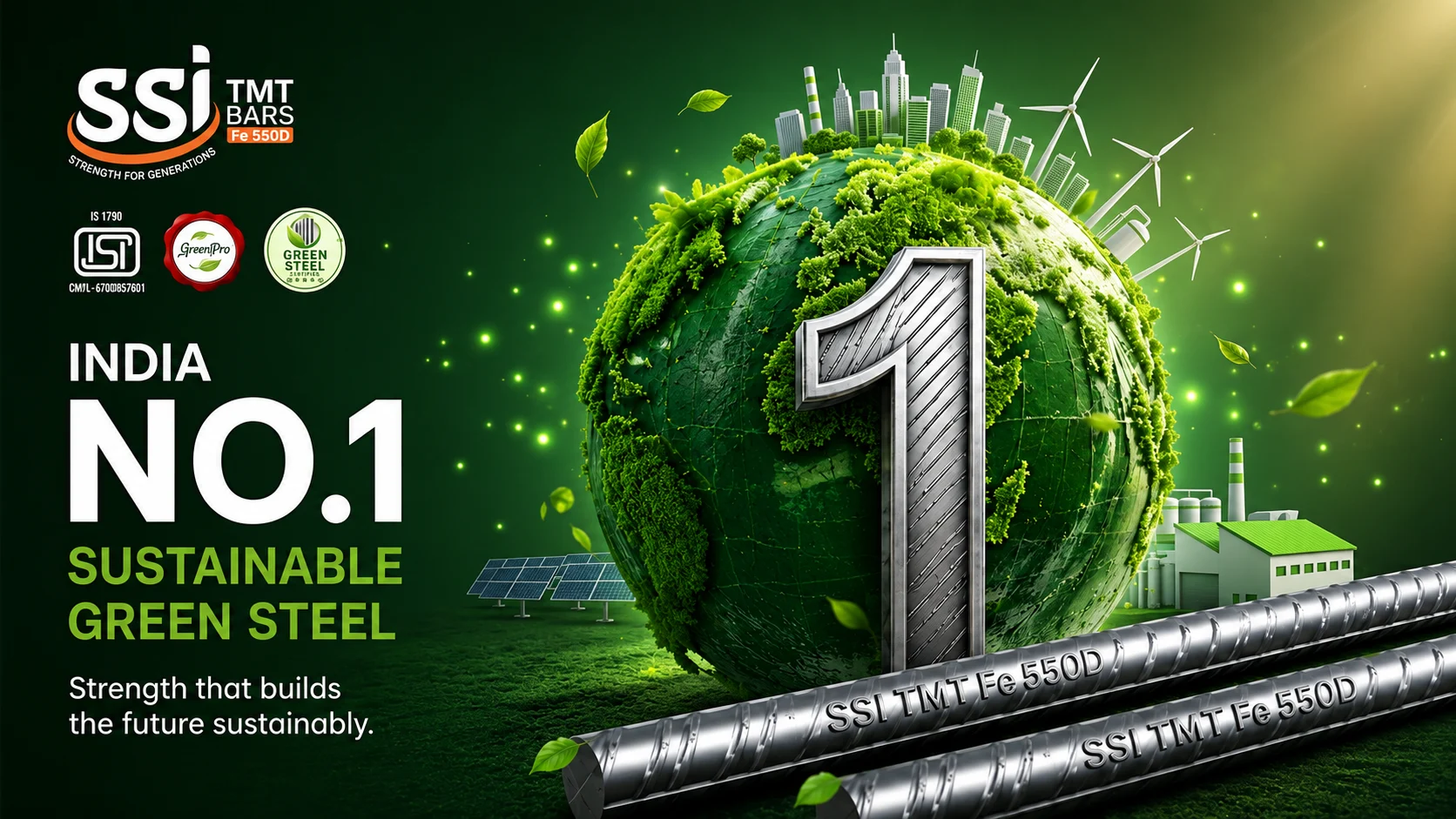
SSI TMT has always built its reputation on strength, ductility, and BIS/ISI-compliant manufacturing. Green Steel Certification is a natural extension of that same discipline, applied to emissions rather than just mechanical performance, part of a broader shift towards sustainable steel manufacturing across the industry, and SSI TMT’s own contribution to low-carbon steel India.Our manufacturing approach focuses on:- Energy-efficient production processes that reduce fuel and power intensity per tonne of finished steel
- Responsible raw material sourcing, including greater use of iron ore in the steelmaking process
- Continuous process optimisation across melting, rolling, and finishing stages to cut avoidable emissions
Existing Certifications at SSI TMT
SSI TMT bars are manufactured to meet BIS certification standards, ensuring consistent Fe grade performance, ductility, and seismic resistance across every batch. These quality certifications have long formed the foundation of trust with dealers, engineers, and contractors, and they now sit alongside emission-intensity data as part of a broader sustainability and quality profile.Steps SSI TMT Is Taking Towards Green Steel Certification
SSI TMT’s production has been assessed under the NISST Green Steel framework, with fuel, power, and production data verified through the MRV process described above. The result places SSI TMT’s TMT bar production well within the top green steel band, reflecting the impact of energy-efficient manufacturing and responsible sourcing practices already built into daily operations. This certified data now forms the baseline SSI TMT will continue to track and improve as it works towards deeper decarbonisation across future production cycles.What SSI TMT’s Green Steel Certificate Actually ShowsSSI TMT’s TMT bar production has been certified by NISST for FY 2025-26, and the numbers are worth calling out on their own:| Metric/Detail | Value |
|---|---|
| Production Volume | 92,467 tonnes |
| Average Emission Intensity | 0.19 tCO₂e/tfs |
| Star Rating | 5.0-Star |
| Greenness Score | 91.36% |
| Certificate Number | GS0163/05082026/001 |
| Issue Date | 05-08-2026 |
| Validity | Up to 31-03-2027 |
Where Certification Fits Among Other Green Steel Credentials
Green Steel Certificate isn’t the only sustainability credential steel buyers may come across. It helps to know how it relates to a few others that occasionally appear on industry websites and certificates:- Environmental Product Declarations (EPD): An EPD is an independently verified report that discloses a product’s environmental impact across its lifecycle, not just its emission intensity at the point of production. Some Indian steel producers have pursued EPDs alongside or ahead of NISST certification, since the two measures are related but not identical.
- ISO 14001: This is a general environmental management system certification, confirming that a plant has structured processes for managing its environmental impact, rather than a product-level emission rating.
- IGBC-linked recognition: Some manufacturers hold direct recognition from the Indian Green Building Council for their products, which is separate from, but complementary to, using NISST’s certified data as supporting evidence in an IGBC project submission.
What SSI’s Sustainable Certification Means for Your Project
For dealers, engineers, and contractors working with SSI TMT, the Green Steel Certificate is a usable, verifiable document, not just a badge:- In BOQs: Emission-intensity and star-rating figures can be cited alongside standard technical specifications when documenting material sourcing.
- In client pitches: Contractors can use the certificate to demonstrate a verified sustainability commitment when competing for ESG-conscious or government-linked projects.
- In green building documentation: Architects and consultants pursuing IGBC, GRIHA, or LEED credits can reference the certified emission data as part of their materials submissions.
- In verification: Every certificate carries a QR code and certificate number that can be checked online, so the data can be independently confirmed rather than taken on faith.