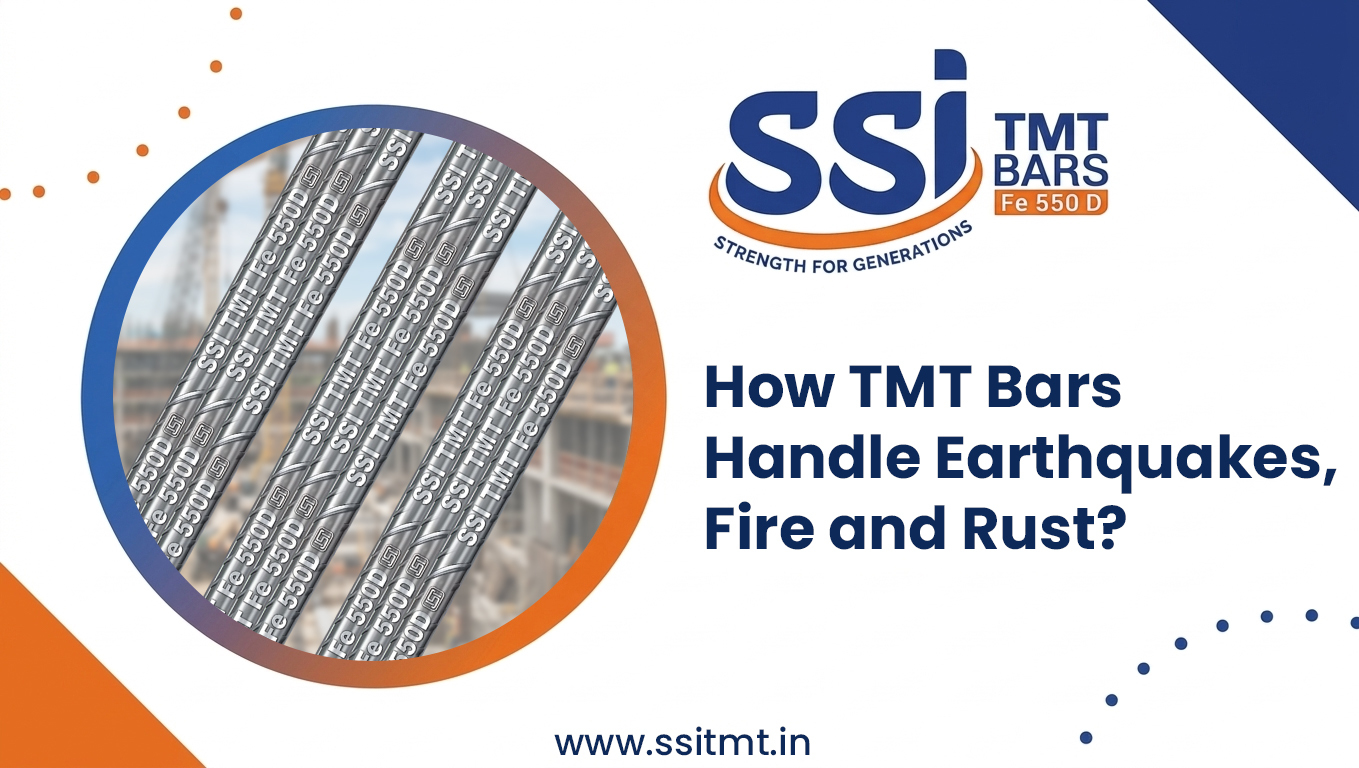
When it comes to building safe and long-lasting structures, the materials you choose make all the difference. TMT bars – short for Thermo-Mechanically Treated bars – are one of the most trusted reinforcement materials in modern construction. They are specially designed to handle some of the most extreme conditions a building can face: powerful earthquakes, intense fires, and long-term rust and corrosion. Understanding how TMT bars work can help builders, architects, and homeowners make smarter choices for safer structures.
What Makes TMT Bars Strong and Durable?
TMT bars are produced using a specialised manufacturing process called Thermo Mechanical
Treatment. In this process, hot steel bars are rapidly quenched in water immediately after rolling. This quick cooling forms a hard outer layer called tempered martensite, while the core remains relatively soft and flexible.
This unique combination – a tough outer layer with a softer inner core – gives TMT bars two properties that most materials cannot offer together: high tensile strength and excellent ductility. The result is a bar that is strong enough to bear heavy loads yet flexible enough to absorb shock and stress without snapping. This is why TMT bars have become the go-to choice for reinforced concrete construction across the world.
Understand what is TMT bars and its benefits to gain a complete knowledge of the steel bars!
How TMT Bars Resist Earthquakes
Earthquakes generate sudden, powerful forces that can tear through buildings in seconds. TMT bars are engineered to handle these forces in ways that ordinary steel bars simply cannot.
High ductility for seismic resistance
Ductility is a material’s ability to deform under stress without breaking suddenly. TMT bars have exceptionally high ductility, which means they can stretch and bend under seismic loads rather than snapping without warning. Grades like Fe-500D and Fe-550D are specifically designed for use in seismic zones, offering the right balance of strength and flexibility to keep structures standing during a tremor.
Flexibility without breaking
During an earthquake, a building is subjected to rapid back-and-forth movement. TMT bars can absorb and dissipate this energy through elastic deformation – bending when needed without causing a brittle fracture. The low carbon content in TMT bars plays a key role here, improving bendability and elongation so the bars can flex under dynamic loads without giving way.
Better load distribution
The ribbed surface pattern on TMT bars is not just for grip – it also helps distribute seismic loads evenly across the structure. This uniform microstructure improves fatigue resistance, meaning the bars can handle repeated shocks and cyclic loading over time without weakening. By spreading the load rather than concentrating it at weak points, TMT bars help prevent localised failure during an earthquake.
Strong bonding with concrete
A reinforced concrete structure is only as strong as the bond between its steel and concrete components. The ribbed design of TMT bars provides excellent grip with the surrounding concrete, reducing the risk of slippage during seismic vibrations. This strong bonding minimises structural cracks and helps the entire system behave as one unit, significantly improving the building’s ability to survive an earthquake intact.
How TMT Bars Withstand Fire
Fire is one of the greatest threats to any building. Intense heat weakens steel rapidly, which can lead to sudden structural collapse. TMT bars are built to hold their ground far longer than conventional steel during a fire emergency.
High thermal resistance
The tempered martensite outer layer formed during the TMT manufacturing process is highly resistant to thermal weakening. Even as temperatures inside a burning building rise sharply, the outer surface of a TMT bar resists softening and maintains its structural properties. This thermal resistance gives the building critical extra time before any structural compromise occurs.
Maintains structural strength at high temperatures
TMT bars can maintain their structural integrity at temperatures of up to around 600°C – significantly higher than what ordinary steel can withstand. This means that reinforced concrete structures built with TMT bars are far less likely to collapse suddenly during a fire, providing more time for evacuation and firefighting efforts. This makes them especially important in high-rise buildings and industrial structures.
Low thermal conductivity
Compared to conventional cold-twisted steel bars, TMT bars have lower thermal conductivity and slower thermal expansion. This means that heat travels through them more slowly, reducing the speed at which a fire can compromise the structural core. The concrete around the bars also benefits, as the slower heat transfer helps maintain the bonding strength between the bar and concrete for longer.
Reduced structural damage
Because TMT bars resist thermal weakening more effectively, the overall structural damage caused by fire is greatly reduced. Even after a fire incident, buildings reinforced with TMT bars are more likely to retain enough structural integrity to be repaired rather than demolished. The low carbon content also reduces the risk of brittle fracture when the structure is exposed to heat, further protecting the building’s long-term safety.
How TMT Bars Prevent Rust and Corrosion
Rust is the silent enemy of any steel structure. Over time, corrosion weakens reinforcement bars, causes concrete to crack and spall, and dramatically shortens the life of a building. TMT bars are designed from the ground up to resist this threat.
Anti-corrosion properties
The rapid quenching process used in TMT manufacturing creates a protective oxide layer on the surface of the bar. This layer acts as a natural barrier against moisture and chemical attack. Additionally, the absence of coarse carbides in the microstructure – which are common in ordinary steel – means there are far fewer weak points where corrosion can take hold and spread.
Uniform microstructure
Unlike cold-twisted bars, which develop internal stress cracks during manufacturing, TMT bars have a uniform and dense microstructure. This uniformity reduces the chances of stress-induced corrosion, where cracks in the material create pathways for moisture and oxygen to reach the interior of the bar. A denser outer layer also means lower permeability, giving rust very little opportunity to penetrate the surface.
Resistant to moisture and humidity
TMT bars perform extremely well in high-moisture environments. Whether it is a building near a river, a structure in a humid tropical climate, or a foundation exposed to groundwater, TMT bars hold up far better than conventional steel. The protective surface formed during manufacturing resists chloride attack and moisture penetration, both of which are common causes of corrosion in damp conditions.
Longer life of structure
Because TMT bars resist corrosion so effectively, they maintain their bonding strength with concrete over decades of use. This translates directly into a longer service life for the entire structure. Buildings reinforced with high-quality TMT bars require less frequent maintenance, are less prone to unexpected structural deterioration, and ultimately deliver far greater value over their lifetime.
Why Rust-Resistant TMT Bars Are Important in Coastal Areas
Coastal environments are among the most challenging conditions for any construction material. Salt-laden sea air, high humidity, and the constant presence of chlorides in the atmosphere accelerate corrosion dramatically. Structures near the coast can deteriorate two to three times faster than inland buildings if ordinary steel is used. Rust-resistant TMT bars – especially special corrosion-resistant grades available for harsh environments – are the recommended choice for coastal construction. They resist chloride attack and moisture penetration, ensuring that buildings, bridges, and infrastructure near the sea remain safe and structurally sound for decades.
Find the best tmt bars for every type of construction to ease your decision making process when it comes to choosing the steel
How to Choose the Right TMT Bars for Safety
Not all TMT bars are created equal. Choosing the right product is essential to ensure your structure can withstand the challenges it will face over its lifetime. Here are the key things to look for when selecting TMT bars for your construction project:
- Check the grade – Fe 500 and Fe 550 are standard for most construction; Fe 500D and Fe 550D are recommended for seismic zones
- Look for relevant certifications such as BIS (Bureau of Indian Standards) to ensure the product meets safety standards
- Check corrosion resistance, especially if building in coastal, humid, or chemically aggressive environments
- Choose a trusted and reputable brand with a consistent track record in quality manufacturing
- Verify quality standards by requesting mill test certificates and checking the bar markings for grade and manufacturer details
Get detailed guide for how to choose the right TMT bars for your construction purposes
Buy SSI Fe 550D TMT Bars for Disaster-Resistant Construction
Build with confidence using SSI Fe 550D TMT Bars – engineered to deliver superior strength and safety in every structure. Designed for disaster-resistant construction, these bars ensure stability even under extreme conditions like earthquakes, fire and rust. With advanced manufacturing and rigorous quality testing, SSI TMT Bars offer reliability that lasts for decades.
Features of SSI TMT Bars
- Earthquake resistant
- Fire resistant
- Corrosion resistant
- High ductility
- Better strength
- Long service life
- Cost effective
- Strong bonding with concrete
FAQs
1. Are TMT bars earthquake resistant?
Yes, TMT bars are highly earthquake resistant. Their unique combination of a hard outer layer and a ductile inner core allows them to absorb and dissipate seismic energy without sudden fracture. Grades like Fe-500D and Fe-550D are specifically designed for seismic zones and can handle the cyclic loading and dynamic forces that earthquakes produce.
2. Are TMT bars fire resistant?
Yes. TMT bars can maintain their structural strength at temperatures of up to around 600°C, making them significantly more fire resistant than conventional steel bars. The tempered martensite outer layer resists thermal weakening, giving buildings reinforced with TMT bars more time to withstand a fire before any structural compromise occurs.
3. Do TMT bars rust?
TMT bars are far more resistant to rust than ordinary steel bars. The rapid quenching process forms a protective oxide layer on the surface, and the absence of coarse carbides reduces corrosion formation. While no steel bar is completely rust-proof, high-quality TMT bars can withstand moisture, humidity, and even chloride-rich coastal environments for decades when properly used in reinforced concrete construction.
4. Which TMT bar is best for coastal areas?
For coastal areas, specially formulated corrosion-resistant TMT bars are the best choice. These bars are designed to resist chloride attack and moisture penetration – the two primary causes of accelerated corrosion in marine environments. Look for products specifically labelled as corrosion-resistant or marine-grade, and always verify they meet relevant quality certifications.
5. Why are TMT bars used in construction?
TMT bars are widely used in construction because they offer an outstanding combination of properties in a single product: high tensile strength, excellent ductility, resistance to earthquakes and fire, and long-term protection against rust and corrosion. They bond strongly with concrete, have a long service life, and are cost-effective over the full lifespan of a structure – making them the preferred choice for everything from residential homes to large infrastructure projects.