
“Whether you are estimating steel for a house or planning a larger construction project, knowing the weight, price and applications of 12mm TMT bars can make material planning easier.”
Before placing an order, it is important to understand how much a 12mm TMT bar weighs, how many bars are available in a ton and how its price is calculated. These details can help homeowners, contractors and builders estimate steel requirements more accurately.
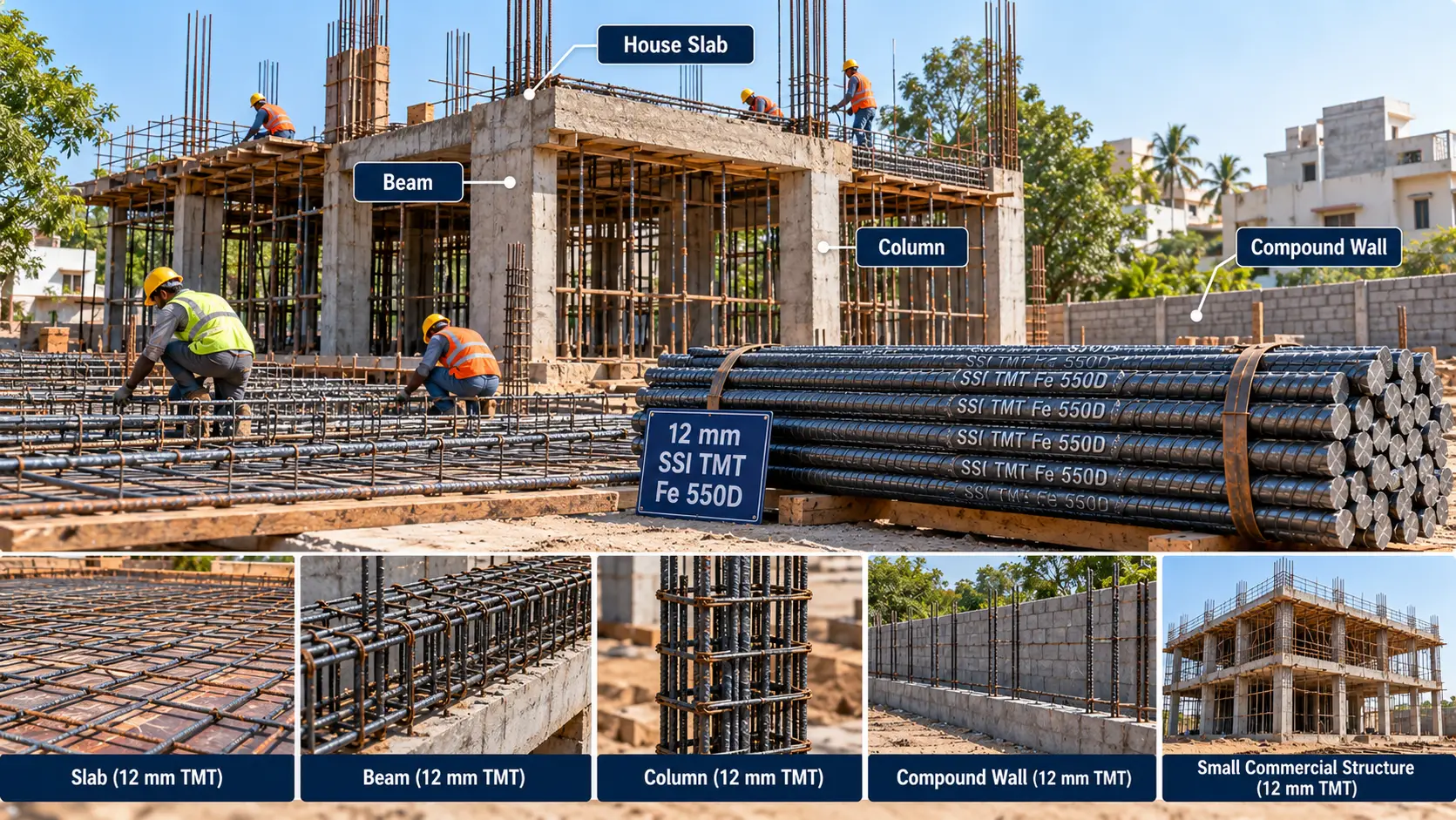
12mm TMT bars are commonly used in reinforced concrete construction and may be specified for slabs, beams, columns, staircases and other structural elements based on the project design.
This guide explains 12mm TMT bar weight, size, dimensions, bars per ton, price, uses, grades and important factors to consider before buying.
What Is a 12mm TMT Bar?
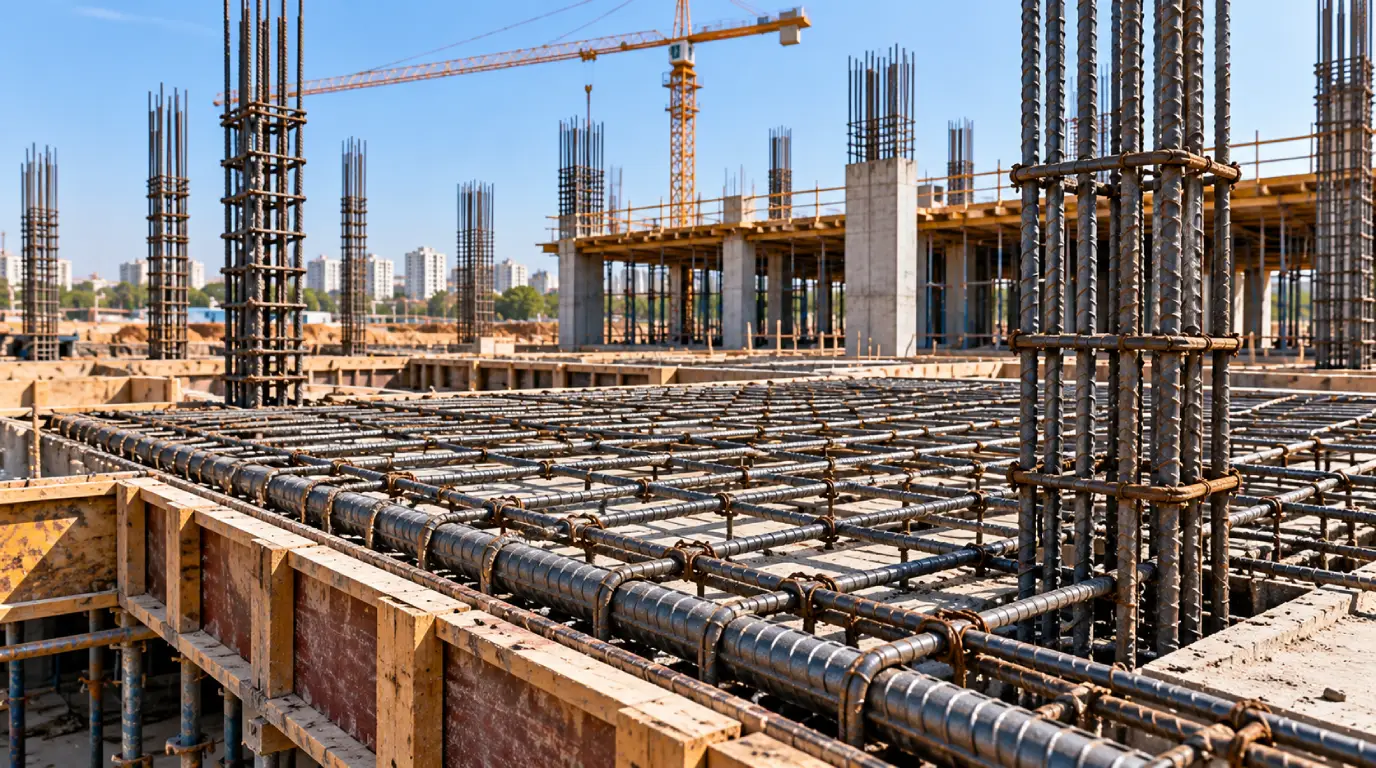
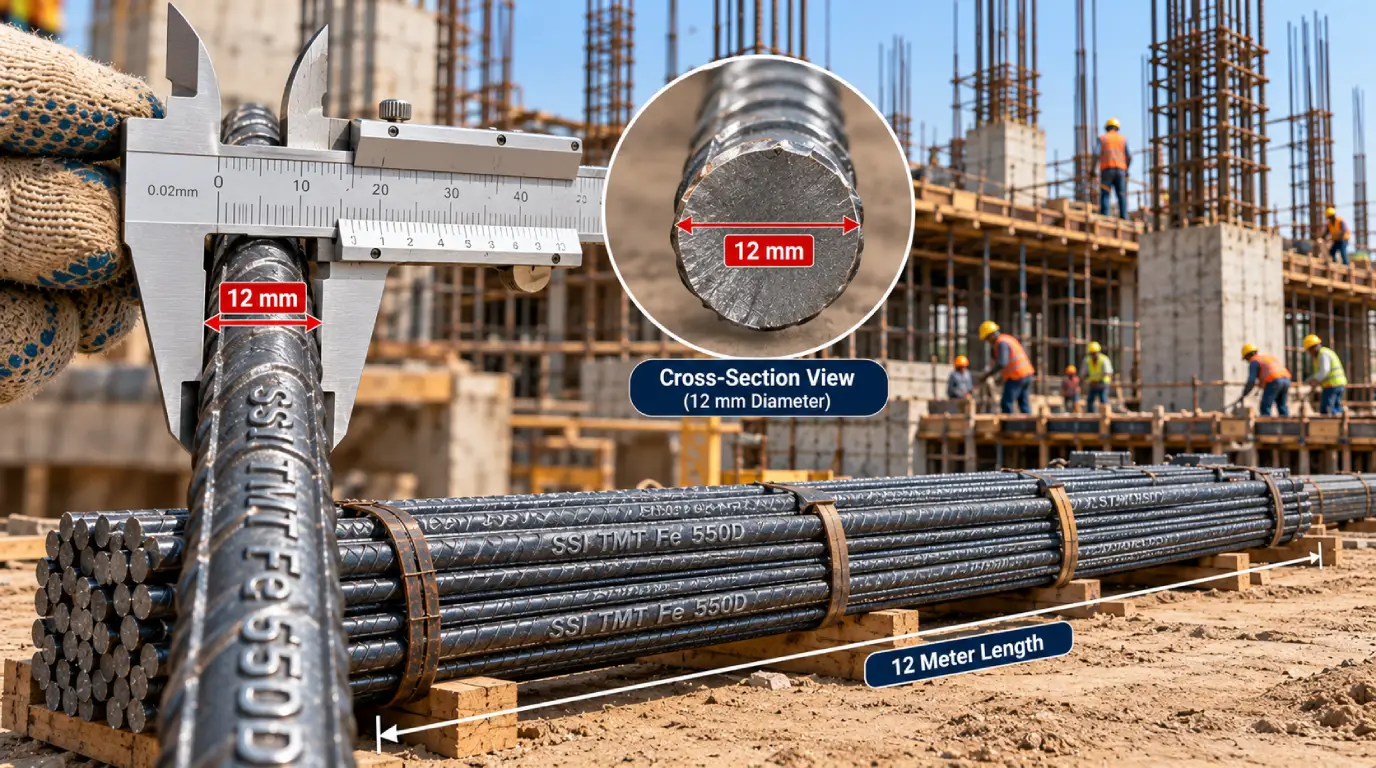
A 12mm TMT bar is a Thermo-Mechanically Treated reinforcement bar with a nominal diameter of 12 mm. During manufacturing, the hot-rolled bar is rapidly cooled with water, then allowed to self-temper. This gives it a hard outer layer and a tougher, more ductile core.
The ribs rolled onto the surface help the bar grip the concrete, so the two materials work together under load.
Within the usual size range of 8mm to 25mm, the 12mm bar is a mid-range size. It is thick enough to act as main reinforcement in many slabs and beams, yet light enough to cut and bend easily on site. That balance explains its popularity in houses, small apartments and light commercial buildings.
12mm TMT Bar Weight Per Meter
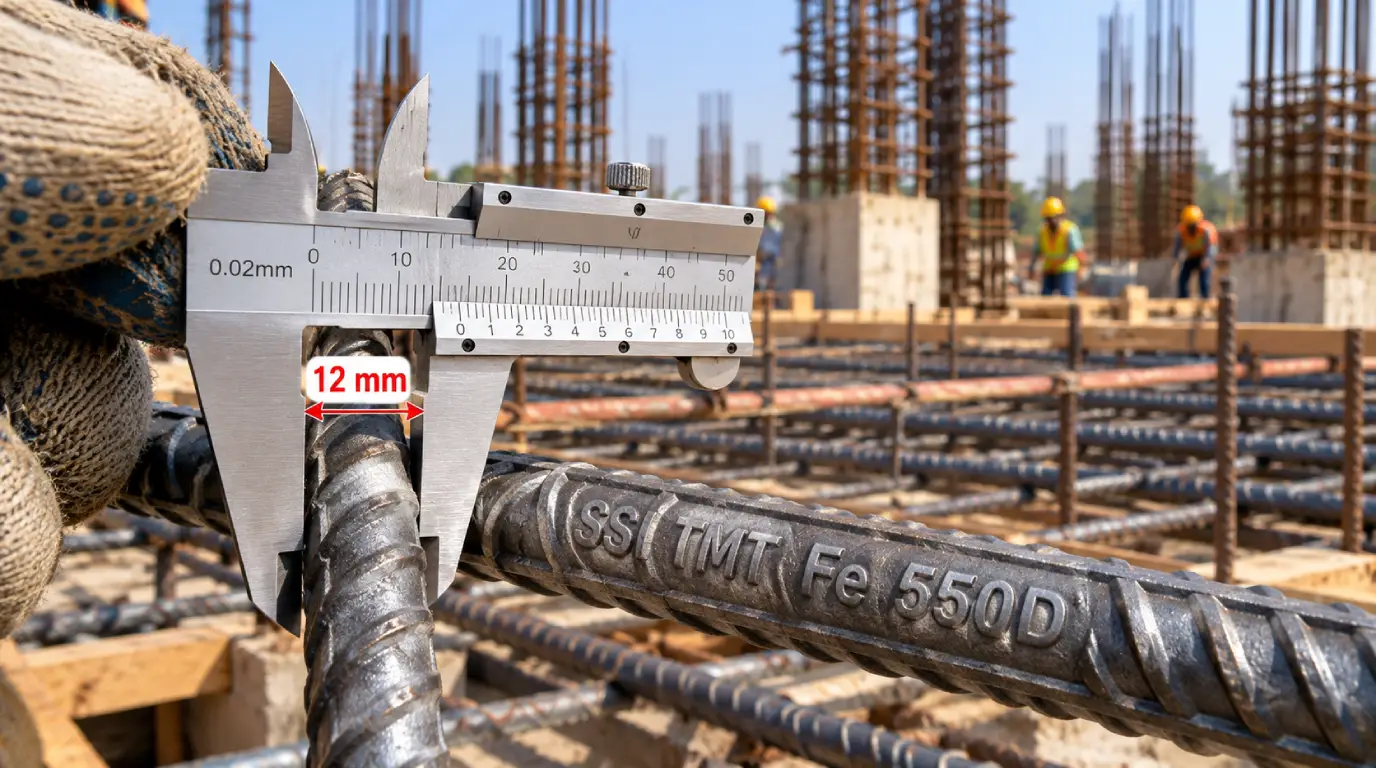
A 12mm TMT bar weighs approximately 0.888 kg per meter.
At the standard length of 12 meters, one bar weighs about 10.66 kg. That is roughly 44% more than a 10mm bar of the same length (7.40 kg), because weight rises with the square of the diameter.
IS 1786 allows a permitted variation in mass, so real bars can be slightly heavier or lighter than the theoretical figure. Check the supplier’s weighment and invoice.
Also Read Complete Weight Guide
12mm TMT Bar Weight Chart
Bar Length | Approx. Weight (kg) |
1 meter | 0.888 |
3 meters | 2.66 |
6 meters | 5.33 |
9 meters | 7.99 |
12 meters | 10.66 |
Most dealers stock 12 m lengths. Shorter lengths are usually cut from these or supplied in special order.
12mm TMT Bar Weight Per Piece
Because the bar is sold mostly as 12 m pieces, weight per piece helps you convert quickly between a bar count and a billing weight.
Number of 12 m Bars | Approx. Total Weight (kg) |
1 | 10.66 |
10 | 106.6 |
50 | 533 |
100 | 1,066 |
For a cut length, multiply the length in meters by 0.888. For example, a 4.5 m piece weighs about 4.0 kg.
How to Calculate 12mm TMT Bar Weight?
The standard formula for ribbed steel bars is:
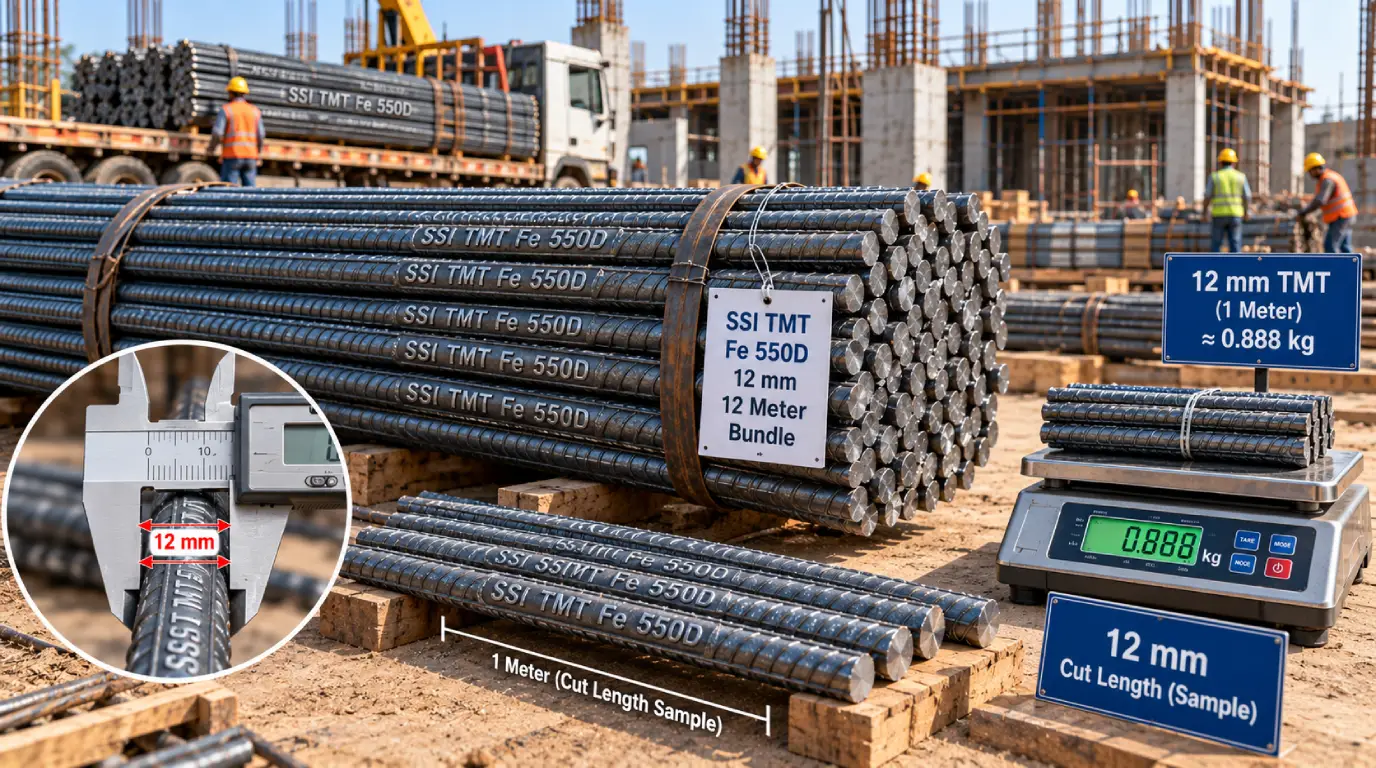
Weight per meter (kg) = D² ÷ 162
where D is the nominal diameter in mm.
Step by step for 12mm:
- Square the diameter: 12 × 12 = 144
- Divide by 162: 144 ÷ 162 = 0.888 kg per meter
- Multiply by length: 0.888 × 12 = 10.66 kg
The 162 comes from the density of steel (about 7,850 kg/m³) combined with the circular cross-section. It gives a theoretical weight. Use it for estimates, and use the actual weighment for billing.
How Many 12mm TMT Bars Are There in One Ton?
Divide 1,000 kg by the weight of one bar:
Bar Length | Approx. Bars per Ton |
12 meters (10.66 kg) | about 94 bars |
9 meters (7.99 kg) | about 125 bars |
6 meters (5.33 kg) | about 188 bars |
In running length, one ton of 12mm bar gives about 1,126 meters of steel.
Treat these as planning figures. The real count shifts with mass tolerance.
12mm TMT Bar Size and Dimensions
Specification | Detail |
Nominal diameter | 12 mm |
Approx. cross-sectional area | 113.1 mm² |
Approx. weight per meter | 0.888 kg |
Standard bar length | 12 m (commonly) |
Surface | Ribbed / deformed |
Applicable standard | IS 1786 |
Cross-sectional area matters to designers because it determines how much tensile force the bar can carry. One 12mm bar has about 2.25 times the area of one 8mm bar.
12mm TMT Bar Price in India (2026)
TMT prices are quoted per kg or per ton and move with raw material costs, city, brand and demand. A fixed price printed in a blog goes out of date quickly, so get a written quotation before ordering.
As an indicative guide, 2026 market rates have mostly been around ₹60–₹72 per kg (roughly ₹60,000–₹72,000 per ton). Premium brands typically price higher than secondary mills.
To convert a rate into a cost per bar:
Cost = Weight × Rate per kg
The table below uses indicative rates for a 12 m bar of 10.66 kg. They are not live market prices.
Rate (₹/kg) | Cost of One 12 m Bar (approx.) | Cost of 1 Ton |
₹60 | ₹640 | ₹60,000 |
₹65 | ₹693 | ₹65,000 |
₹70 | ₹746 | ₹70,000 |
₹72 | ₹768 | ₹72,000 |
A ₹5 change in the per-kg rate changes the cost of one 12 m bar by roughly ₹53, and the cost of a ton by ₹5,000. For large orders, this is why comparing rates matters.
Factors Affecting 12mm TMT Bar Price
- Raw material cost: Prices of iron ore, scrap, sponge iron and billets feed into the finished bar price.
- Grade: Fe 550D can be priced differently from Fe 500 or Fe 500D.
- Brand and quality control: Consistent mass, test records and process control can affect the rate.
- Order size: Larger orders may get better pricing than a few bars.
- Location and freight: Distance from the plant and local demand change the delivered price.
- GST: Bars of iron or non-alloy steel attract 18% GST, added to the base price. See our [TMT Bar HSN Code guide].
- Season and demand: Prices often rise in the post-monsoon construction season (October to March) and move with supply conditions.
Where Are 12mm TMT Bars Commonly Used?
- Independent houses and villas: Slabs, beams and columns.
- Low-rise apartments: Slabs, beams and columns, depending on the design.
- Shops and small offices: Light commercial framing.
- Compound walls: Columns and tie beams.
- Water tanks and sumps: Small tanks where the design specifies this size.
- Sheds and farm structures: Footings and plinth work.
Taller buildings, long spans or heavy loads usually need 16mm, 20mm or 25mm bars in the main members.
12mm TMT Bar Grades: Fe 500, Fe 500D, Fe 550 and Fe 550D
IS 1786 defines the grades. The number after “Fe” is the minimum specified yield or proof stress in N/mm². The letter “D” marks higher elongation requirements, meaning the bar can deform more before failing.
Grade | What It Means |
Fe 500 | Minimum yield stress 500 N/mm² |
Fe 500D | Fe 500 with enhanced ductility |
Fe 550 | Minimum yield stress 550 N/mm² |
Fe 550D | Fe 550 with enhanced ductility |
A 12mm bar of any grade has the same diameter and the same theoretical weight. What changes is strength and ductility. Higher strength can allow the designer to use less steel for the same capacity, and ductility helps structures cope with stress such as seismic movement.
The choice is a design decision. See SSI TMT’s [Fe 550D TMT Bars].
12mm TMT Bar vs 10mm and 16mm TMT Bars
Feature | 10mm | 12mm | 16mm |
Weight per meter | 0.617 kg | 0.888 kg | 1.578 kg |
Weight of 12 m bar | 7.40 kg | 10.66 kg | 18.94 kg |
Approx. bars per ton (12 m) | about 135 | about 94 | about 53 |
Cross-sectional area | 78.5 mm² | 113.1 mm² | 201.1 mm² |
Typical use | Slabs, lintels, ties | Slabs, beams, columns | Beams, columns, footings |
Going from 10mm to 12mm adds about 44% to the weight per meter. Going from 12mm to 16mm adds about 78%. Swapping one size for another changes both the cost and the structural capacity, so never substitute a size without the engineer’s approval. See our [TMT Bar Weight Guide] for other sizes.
How to Choose the Right 12mm TMT Bar for Your Project?
- Start with the drawing. Diameter, spacing and grade are specified by the structural engineer.
- Match the grade. Use Fe 500, Fe 500D, Fe 550 or Fe 550D as specified. Don’t downgrade to save cost.
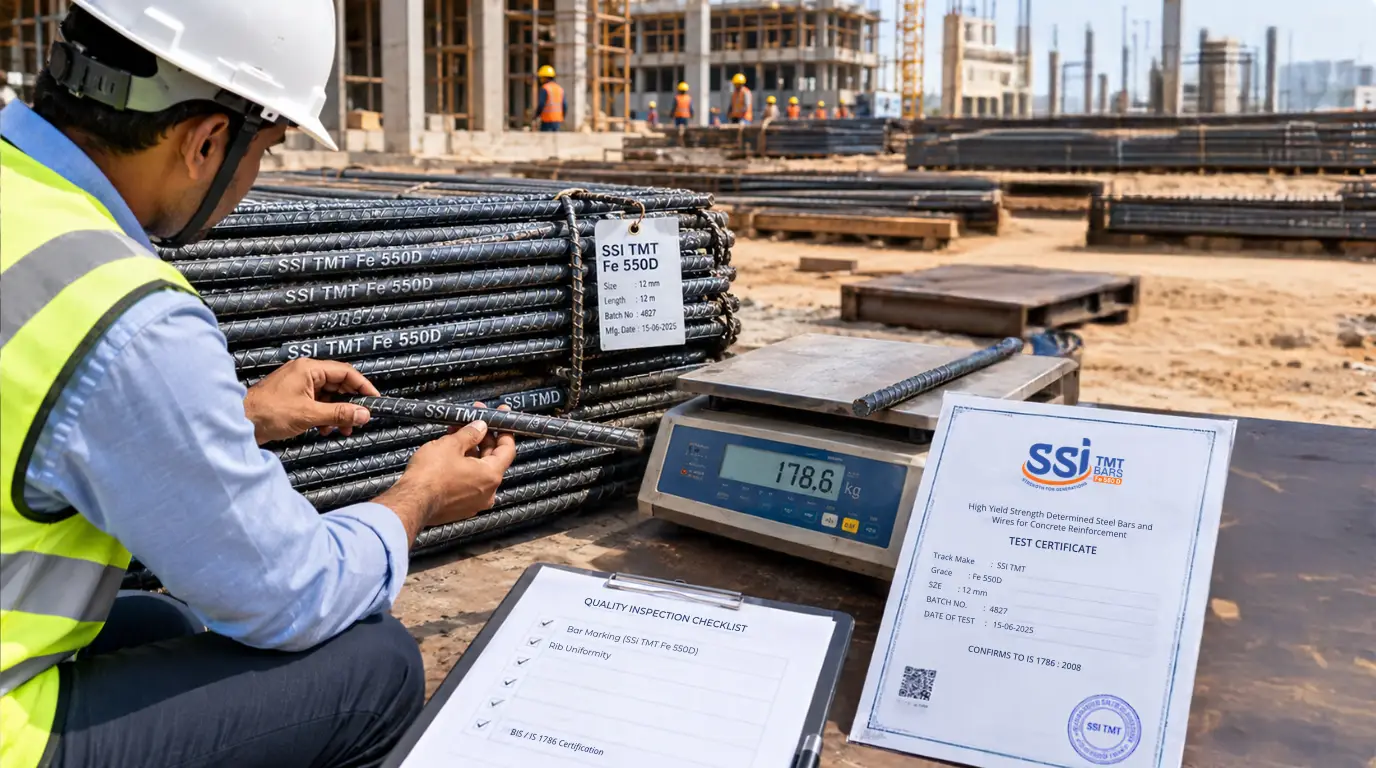
- Check IS 1786 and BIS marking. Look for the brand and grade rolled onto the bar.
- Inspect the surface. Ribs should be uniform. Avoid bars with cracks, bends or heavy flaking rust.
- Ask for test certificates. Batch-wise mechanical test reports show the grade is genuine.
- Weigh a sample. Compare a bar’s actual weight with 10.66 kg for a 12 m length.
- Estimate quantity. Use the weight chart and the slab estimate above, then add allowance for laps and wastage.
- Verify the invoice. Description, grade, size, quantity, HSN code, GST and GSTIN should all be correct.
Build With the Right Reinforcement Steel
A strong construction project starts with the right material selection. 12mm TMT bar size, weight, grade, quality and performance should be considered together when planning reinforcement requirements.
For construction projects requiring dependable Fe 550D TMT bars, explore SSI TMT and discover reinforcement steel solutions designed for a wide range of applications.