
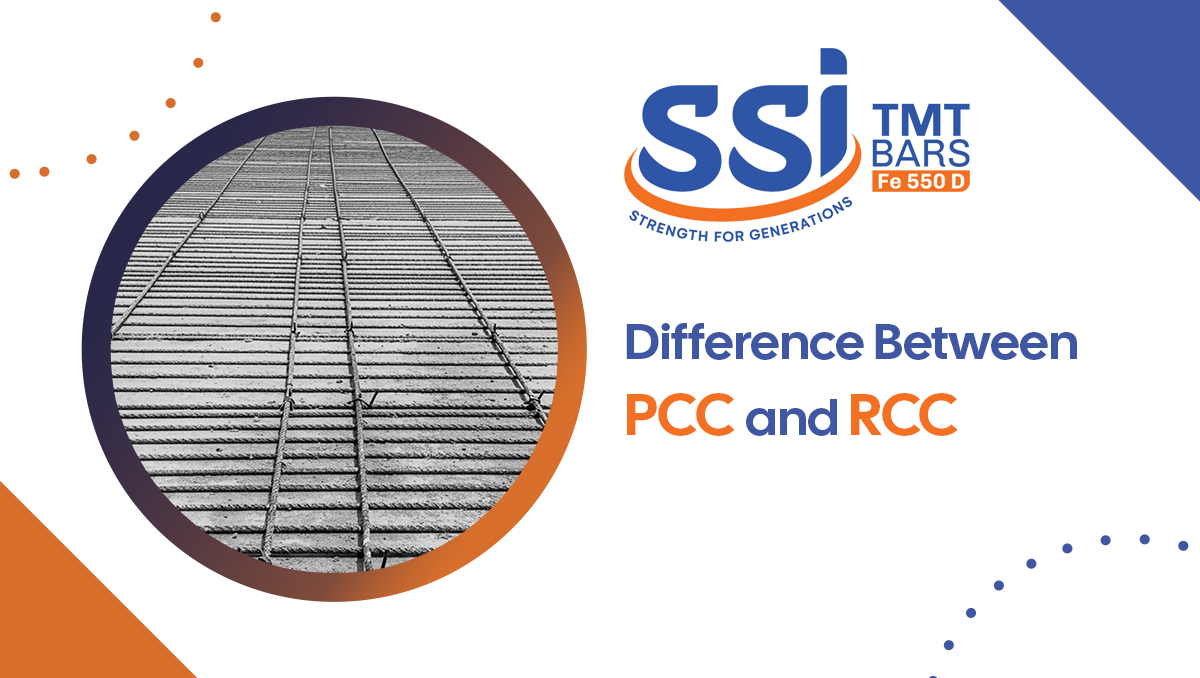
In construction engineering, concrete is the most widely used structural material in the world, but not all concrete is created equal. The two most fundamental types are Plain Cement Concrete (PCC) and Reinforced Cement Concrete (RCC). While both share the same base ingredients – cement, sand, aggregate, and water – they differ fundamentally in their composition, structural behaviour, and application.
PCC relies solely on the compressive strength of the concrete matrix, making it ideal for non-structural, load-bearing base layers. RCC, on the other hand, incorporates steel reinforcement to overcome concrete’s inherent weakness in tension, enabling it to carry complex structural loads in beams, columns, slabs, and bridges. Understanding the difference between PCC and RCC is essential for every civil engineer, architect, and construction professional to make informed decisions about material selection, cost planning, and structural safety.
PCC – Plain Cement Concrete
Plain Cement Concrete (PCC) is a construction material composed of cement, fine aggregate (sand), coarse aggregate (gravel or crushed stone), and water. It does not contain any steel reinforcement. PCC is known for its high compressive strength, which makes it ideal as a base or sub-base material in construction. However, because it lacks tensile reinforcement, it is not suitable for structural members that are subject to bending, tension, or dynamic loads.
PCC is typically used in mass concrete applications where controlled placement of a firm, level base is required before structural work begins. Its mix ratio varies from 1:2:4 (lean mix) to 1:3:6 depending on the structural requirement and application.
Key Applications of PCC
PCC is the foundation of foundations – it forms the first protective layer between soil and structural concrete.
- Foundation bed (blinding layer) to prevent soil from absorbing water from RCC
- Flooring in warehouses, pavements, and industrial areas
- Road sub-bases and runway pavements
- Canal lining and retaining structures with no tensile stress
- Leveling courses beneath footings and rafts
- Mass concrete work such as dams, gravity walls, and fill areas
RCC – Reinforced Cement Concrete
Reinforced Cement Concrete (RCC) is an enhanced form of concrete in which steel bars (rebars), rods, or mesh are embedded within the concrete mix to improve its tensile strength. While plain concrete is strong in compression, it is weak in tension. Steel, on the other hand, has high tensile strength. By combining the two materials, RCC becomes capable of withstanding both compressive and tensile forces.
The steel and concrete in RCC work together due to a compatible coefficient of thermal expansion and a strong bond between them. RCC is the backbone of modern construction and is used in virtually every structural element of a building, bridge, or infrastructure project.
Key Applications of RCC
RCC is the material of modern infrastructure, wherever loads combine tension and compression, RCC is the answer.
- Beams and girders transferring loads across spans
- Columns and piers supporting vertical and lateral loads
- Slabs (flat, ribbed, post-tensioned) for floors and roofs
- Bridges, flyovers, and elevated roads
- Retaining walls resisting lateral earth pressure
- Foundations: isolated, raft, pile caps, and combined footings
- Water tanks, swimming pools, and underground structures
- Staircases, lintels, and canopy projections
Comparison Table: Differences Between PCC and RCC
A side-by-side comparison of PCC and RCC across key structural, material, and application parameters.
| Feature / Parameter | PCC | RCC |
| Full Form | Plain Cement Concrete | Reinforced Cement Concrete |
| Steel Reinforcement | Absent | Present (rebars/mesh) |
| Tensile Strength | Low | High |
| Compressive Strength | High | Very High |
| Load Bearing | Compressive loads only | Both tensile and compressive |
| Cost | Lower | Higher |
| Durability | Moderate | High |
| Mix Components | Cement + Sand + Aggregate + Water | Cement + Sand + Aggregate + Water + Steel |
| Applications | Leveling, flooring, mass concrete | Beams, columns, slabs, bridges |
| Flexibility | Brittle under tension | Ductile and flexible |
| Construction Time | Faster (no steel fixing) | Longer (steel placement needed) |
| Maintenance | Low | Moderate (prevent corrosion) |
Learn more: How to Choose the Right TMT bars for Construction Purposes?
Conclusion
PCC and RCC are both fundamental to construction but serve very different structural purposes. PCC, with its simple composition of cement, sand, and aggregate, excels in compressive applications such as flooring, leveling, and non-structural fills. Its simplicity makes it cost-effective and quick to deploy where tensile stress is not a concern.
RCC, by incorporating steel reinforcement, dramatically extends the capabilities of concrete, enabling the construction of beams, columns, slabs, and entire structural frameworks that must resist complex, multi-directional loads. The synergy between steel and concrete in RCC is one of the most successful material partnerships in engineering history.
Choosing between PCC and RCC is not a matter of preference but of structural necessity. Engineers specify PCC where mass and compressive resistance are sufficient, and RCC where tensile and flexural strength are required. Together, they form the complete toolkit of modern concrete construction.
Planning to build homes, industrial structures, or high-rise buildings? Choose SSI TMT Bars today and thank yourself in the future for making the right decision.
FAQs
1. What is the main difference between PCC and RCC?
The primary difference is the presence of steel reinforcement. PCC contains no steel and resists only compressive forces. RCC embeds steel bars within the concrete, enabling it to resist both tensile and compressive stresses, making it suitable for structural elements.
2. Can PCC be used instead of RCC?
No – PCC cannot substitute for RCC in structural members like beams, columns, or slabs. PCC is appropriate only where there is no tensile stress, such as leveling courses, rigid pavements, or mass concrete fills. Using PCC in place of RCC in structural contexts would be unsafe and against engineering standards.
3. What is the typical mix ratio for PCC?
Common PCC mix ratios are 1:2:4 (cement:sand:aggregate) for general work and 1:3:6 for lean mix applications. In designed mixes, the ratio is determined by target strength requirements following IS or ACI codes.
4. Why is steel used in RCC instead of other materials?
Steel is used because it has a tensile strength approximately 10 times greater than concrete’s compressive strength, and its coefficient of thermal expansion nearly matches that of concrete (~12 × 10⁻⁶/°C). This thermal compatibility prevents differential cracking. Steel is also widely available, cost-effective, and bonds strongly with the concrete matrix.
5. Is RCC waterproof?
Standard RCC is not inherently waterproof. However, with the addition of waterproofing admixtures, surface coatings, or post-tensioning, RCC structures (such as water tanks, basements, and swimming pools) can be made highly water-resistant. PCC is similarly not waterproof unless treated.
6. What is the minimum thickness of PCC used in foundations?
The minimum thickness of PCC used as a blinding or leveling layer beneath RCC foundations is typically 75 mm (3 inches). This layer protects the reinforcement from direct contact with soil and provides a clean surface for placing rebar and formwork.