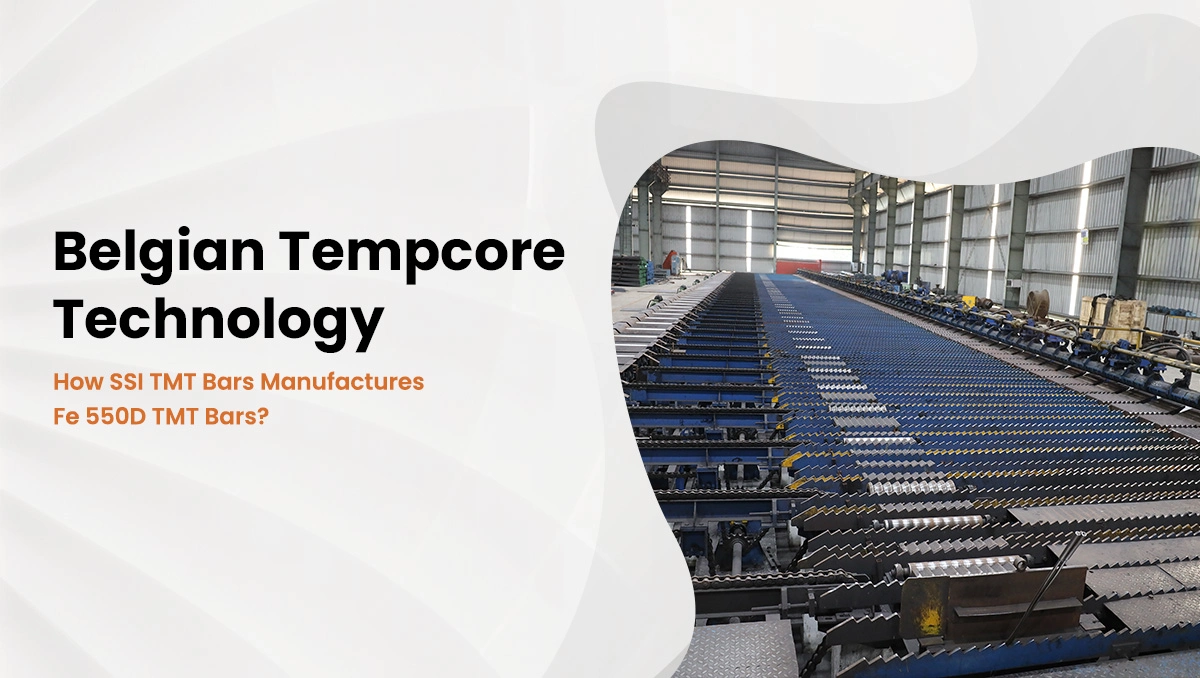
What distinguishes TMT bars from other steel bars? Its manufacturing process. TMT (Thermo Mechanically Treated) Bars are manufactured using the Tempcore technology process, which is developed in Belgium to produce high-strength, ductile, and weldable TMT bars. It involves three stage processes – quenching, self-tempering and atmospheric cooling – designed to eliminate the need for expensive alloying elements. With this process, TMT bars can be made strong with a precise water-quenching method, instead of relying on the chemicals. Using the same Belgian tempcore technology, SSI TMT bars produce high-quality Fe 550D TMT bars suitable for every construction project. In this blog, we have explained the belgian tempcore technology process used to manufacture TMT bars.
Belgian Tempcore Technology - A Brief Overview
Belgian Tempcore Technology developed in the 1970s by the Centre de Recherches Métallurgiques (CRM) in Liège, Belgium. This process manufactures construction steel without expensive micro-alloying elements like Vanadium, Niobium, or Titanium. This process begins with passing the red-hot steel through a high-pressure water quenching chamber, creating a hardened outer layer of martensite and inner core hot and ductile. While the bar leaves the water, a residual heat from the core migrates outward transforming the brittle exterior into a tough, tempered skin. It results in a “composite” bar combining the high yield strength, superior weldability, and the high ductility with exceptional balance.
Benefits of Manufacturing TMT Bars with Belgian Tempcore Technology
Below, we have given benefits of TMT steel bars manufactured by the Belgian Tempcore process, or simply the list of benefits of SSI TMT Bars:
- High Ductility: Since the core of TMT bars manufactured with Belgian Tempcore technology remains soft, it can bend without snapping into pieces. This is important for the buildings planned to be built in earth-quake prone regions.
- Superior Weldability: As the strength of TMT bars comes from the cooling process rather than added carbon or alloys, these steel bars are easier to weld and tailored to various service requirements.
- Corrosion Resistance: Compared to older cold-twisted bars, TMT bars with uniform tempered martensite layer provides better protection against rust.
- Cost-efficiency: As the TMT Bars are manufactured with this superior process with equal proportion of bendability and strength, it can last longer, meaning reducing the repair costs.
- Better Safety: TMT bars will be used in different construction projects from residential to commercial, where many people shelter. These steel bars are the safer option since they offer fatigue resistance and bond strength to concrete.
Process of Belgian Tempcore Technology (or) How SSI TMT Bars Manufactures Fe 550D Bars
In the following, we have details out the SSI TMT Bars’ manufacturing process combined with Belgian Tempcore Technology for producing high-quality Fe 550D TMT Bars:
1. Raw Materials Extraction
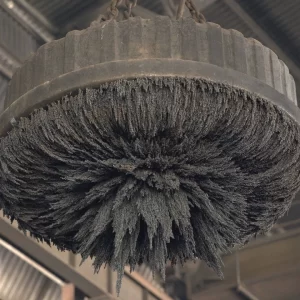
The manufacturing of high-quality TMT bars begins with the careful selection and extraction of premium raw materials. SSI TMT Bars sourcing the raw materials from the earth extracting the iron ore that has low sulphur and phosphorus, categorized as sponge iron along with the alloying agents.
2. Melting Process

The selected raw materials are fed into induction furnaces where they undergo intense heating. The induction furnace operates at temperatures reaching approximately 1650°C, which is well above the melting point of iron and steel. At this extreme temperature, the raw materials transform into molten liquid metal. This process ensures complete homogenization of the metal composition, with all alloying elements uniformly distributed throughout the liquid steel. The controlled melting environment allows for precise temperature management and chemical composition adjustment, which is critical for achieving consistent quality in the final product.
3. CCM (Continuous Casting Machine)

Once the steel reaches the desired temperature and composition in the furnace, it is transferred to the Continuous Casting Machine (CCM). This sophisticated equipment converts the liquid metal into semi-finished solid forms called billets. The CCM operates continuously, pouring the molten steel into water-cooled molds where it begins to solidify. The billets produced through this process serve as the intermediate product that will be further processed into TMT bars. This continuous casting method ensures uniform quality, minimal waste, and efficient production rates.
4. Hot Rolling Process
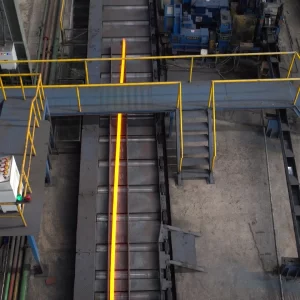
After the billets are produced, it is transferred through hot-rolling mill spans to three-stage process:
Stage 1: Roughing Stand
The billets produced by the CCM are then fed into the hot rolling mill. In the first stage, known as the roughing stand, high-quality billets undergo initial deformation. These billets are heated to maintain their malleability and then passed through a series of rolls that begin to shape them into elongated forms. The roughing stand reduces the cross-sectional area of the billet while increasing its length, preparing it for the subsequent finishing stages.
Stage 2: Intermediate Stand
Following the roughing stand, the material enters the intermediate stand where it undergoes further reduction and shaping. This stage involves passing the partially formed bars through additional sets of rolls with progressively smaller gaps. The intermediate stand refines the dimensions and improves the surface quality of the emerging TMT bars.
Stage 3: Finishing Stand
After this, the three stages of the Belgian Tempcore Technology process were implemented to produce superior-grade Fe 550D TMT Bars.
5. Quenching Process
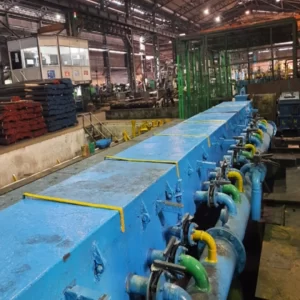
The quenching process is the heart of TMT bar production and what gives these bars their unique properties. As the red-hot TMT bars (at temperatures around 1050°C or higher) exit the finishing stand of the rolling mill, they immediately enter a specially designed quenching box.
Inside the quenching box, the bars are subjected to rapid cooling through a controlled water spray system. This rapid quenching process creates a dramatic temperature differential between the outer surface and the inner core of the bar. The sudden cooling of the outer layer causes it to transform into a hard, martensitic structure, while the core remains hot and austenitic. This creates a tough outer shell that provides high strength and wear resistance. T
The Tempcore technology employed by SSI TMT Bars ensures precise control over this critical phase, optimizing the balance between strength and ductility.
After the rapid quenching phase, the TMT bars undergo a self-tempering process, where the heat retained in the inner core of the bar gradually migrates outward to the cooled surface layer. This natural heat flow causes the hard martensitic outer layer to temper, transforming it into a tempered martensitic structure. It enhances the ductility of the bar while maintaining its strength, resulting in a product that combines high tensile strength with excellent bendability.
6. Cooling Bed
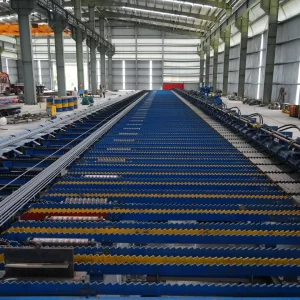
After completing the heat treatment processes, the TMT bars are transferred to the cooling bed where they undergo controlled atmospheric cooling. The cooling bed allows the bars to cool gradually and uniformly to room temperature in ambient air conditions. This stage is crucial for stabilizing the microstructure developed during quenching and tempering. The bars are laid out systematically on the cooling bed, where they achieve thermal equilibrium.
During this phase, the TMT bars transform through different metallurgical stages: the outer zone becomes tempered martensite (providing strength), the middle zone develops into a combination of bainite and ferrite (offering a balance of properties), and the inner core transforms into ferrite-pearlite (providing ductility). This controlled cooling ensures that internal stresses are minimized and the final product achieves dimensional stability.
7. Quality Testing
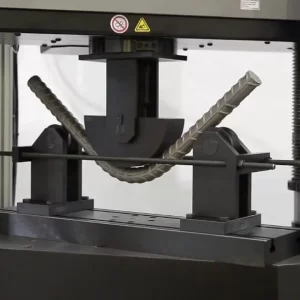
After the production of TMT bars, SSI TMT Bars use the five-level testing process to check the strength and ductility. Here is the brief explaining each method for testing the TMT Bars:
- Tensile Test: Measures the maximum load the TMT bar can withstand before breaking to ensure high tensile strength.
- Bend/Rebend Test: Checks the bar’s flexibility by bending and rebending it to confirm it does not crack or fracture.
- Yield Stress Testing: Determines the stress level at which the bar begins to permanently deform under load.
- Visual Inspection Test: Examines the surface quality, rib pattern, and overall finish to detect any visible defects.
- Chemical Composition Analysis: Verifies the correct proportion of elements in the steel to ensure strength, durability, and corrosion resistance.
8. Material Dispatch
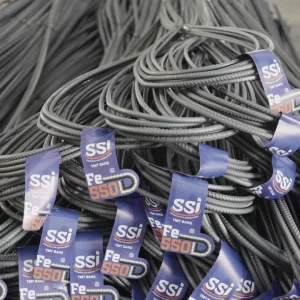
Upon successful completion of all quality tests, the Fe 550D TMT bars are prepared for dispatch to customers. The bars are carefully bundled, tagged with proper identification including grade, size, batch number, and test certificates. The dispatch process ensures that customers receive products on-time in perfect condition.
SSI TMT Bars manufacturing process combines advanced Belgian Tempcore technology with stringent quality control to produce Fe 550D TMT bars that meet the highest standards of strength, ductility, and durability, ideal for modern construction applications.
Also read: How to Choose the Right TMT Bars for Your Construction Purposes
Planning to Buy Quality TMT Bars?
SSI TMT Bars recognized as the best TMT bars manufacturers in Tamilnadu follow this exact Belgian tempcore technology process to produce Fe 550D TMT Bars. As it is manufactured with superior metallurgical process, our TMT Bars have many advantages – high ductility, excellent strength, superior weldability, and corrosion resistance. We are having two advanced plants – one in Kuppam, Andhra Pradesh and another one in Uthiramerur, Kanchipuram – producing an installed capacity of 30,000 metric tonnes. Whether you want TMT bars for residential, commercial or even government projects, SSI TMT Bars offer superior steel bars and last the buildings longer.
Are you confused about choosing the right TMT Bars for your construction project? Talk with our team and clear your confusion immediately!
FAQs
1. What is Belgian Tempcore Technology in TMT bar manufacturing?
Belgian Tempcore Technology is a specialized thermo-mechanical treatment process developed in Belgium to manufacture high-strength and ductile TMT bars. This process involves quenching, self-tempering, and atmospheric cooling to produce superior-grade steel bars without expensive alloying elements.
2. How does SSI TMT Bars manufacture Fe 550D TMT Bars?
SSI TMT Bars manufacture Fe 550D TMT Bars by combining advanced hot rolling processes with Belgian Tempcore technology. The process includes controlled quenching, self-tempering, and atmospheric cooling to achieve the perfect balance of strength and ductility.
3. Why are Fe 550D TMT Bars suitable for earthquake-prone regions?
Fe 550D TMT Bars manufactured using Belgian Tempcore technology have a soft and ductile inner core that allows them to bend without breaking. This high ductility makes them ideal for construction projects in earthquake-prone areas.
4. What makes SSI TMT Bars different from ordinary steel bars?
Unlike ordinary steel bars that rely on high carbon or alloy content, SSI TMT Bars gain their strength from a precise water-quenching and tempering process. This ensures superior weldability, corrosion resistance, and long-lasting durability.
5. How does the quenching process improve the strength of TMT bars?
During the quenching process, red-hot bars are rapidly cooled in a controlled water chamber, forming a hard outer martensitic layer while keeping the core ductile. This creates a composite structure that enhances both strength and flexibility.
6. Why should you choose SSI TMT Bars for your construction project?
SSI TMT Bars follow stringent quality testing and advanced Belgian Tempcore technology to produce Fe 550D TMT Bars with high tensile strength, excellent bendability, and corrosion resistance. This ensures safer and longer-lasting buildings for residential, commercial, and government projects.