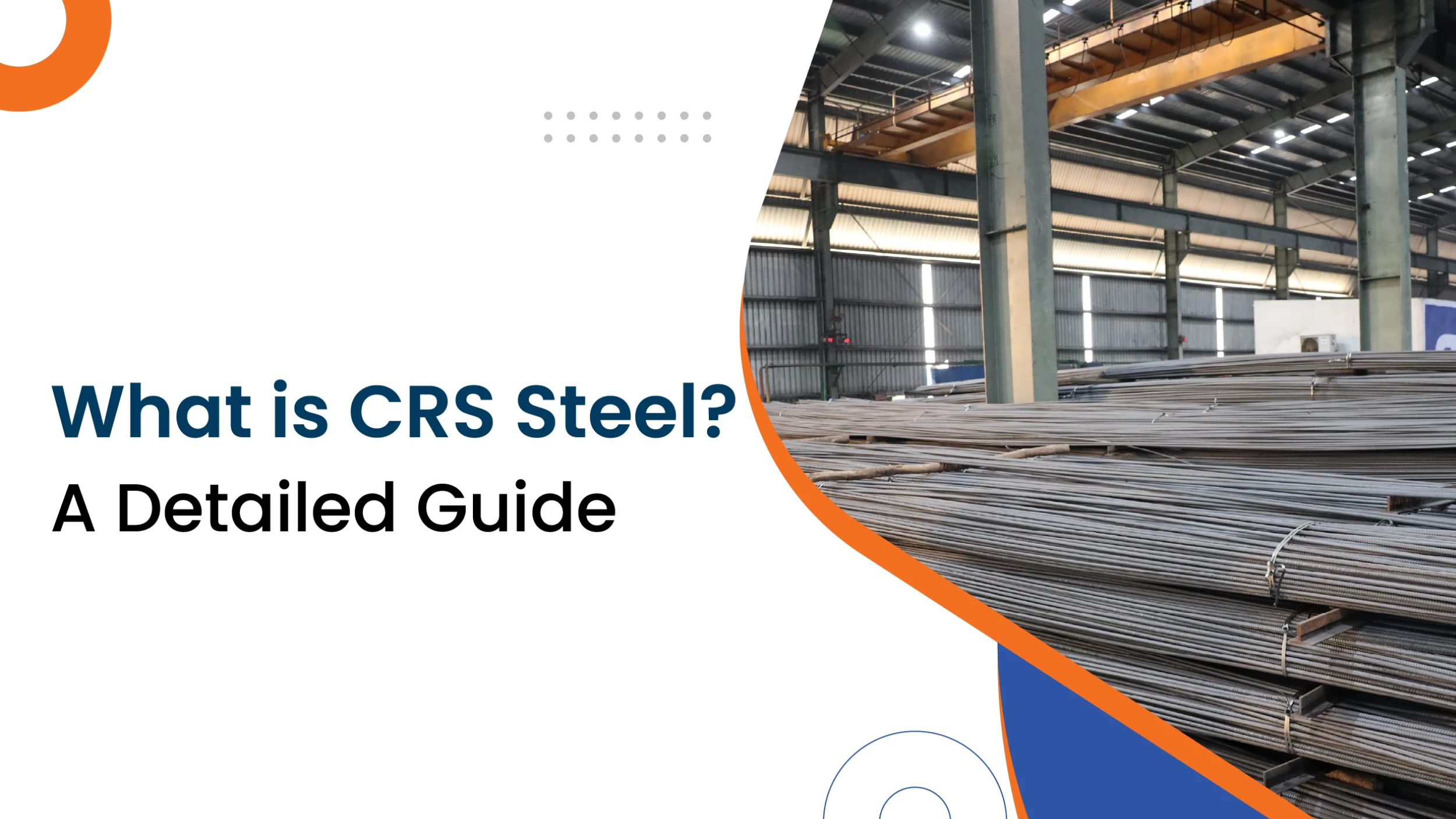
Steel is the essential material for buildings since it holds due to the high strength, ductile and durable nature. However, there is one main challenge and problem reducing the value of steel bars, which is corrosion. Corrosion is the natural degradation of materials due to the electrochemical process where the iron in the metal oxidises. It creates structural weaknesses in the buildings and increases maintenance costs. To prevent this, TMT bars manufacturers add several elements – chromium, copper and phosphorus – to make CRS steel bars that prevent rust and increase the strength. In this blog, we are going to understand the CRS steel in detail, its full form, chemical composition, benefits, and applications for the end-users.
CRS Steel - Full Form and Overview
The full form of the CRS steel is Corrosion Resistant Steel. It is a specialised reinforcement bar designed with a controlled chemical composition that includes elements such as chromium, copper, and phosphorus. This composition enhances resistance to corrosion, making CRS steel particularly suitable for coastal, industrial, high-moisture environments, and regions with high water salinity.
The addition of chromium and copper enables the formation of a dense protective oxide layer on the steel surface. This layer acts as a barrier, preventing rust formation and protecting the underlying metal, thereby significantly improving durability and service life.
CRS TMT bars also offer superior strength and high ductility, ensuring long-term structural performance. The lower carbon content, typically below 0.25%, further enhances weldability while contributing to improved corrosion resistance.
Due to these properties, CRS steel is ideal for infrastructure projects such as bridges, coastal buildings, tunnels, sewage treatment plants, and residential developments in coastal regions.
Specifications of CRS Steel TMT Bars
Here are the few points characterizes the specifications of CRS TMT Bars:
- Chemical Composition: Compared to standard TMT Bars, CRS Steel bars have higher concentration of specific anti-corrosive elements. As per IS 1786, the combined content of these elements – Copper, Chromium, Phosphorus – must be typically at least 0.40% to be corrosion-resistence steel bars.
- Mechanical Specifications: CRS steel bars follow the same strength categories of standard TMT bars, but it moderates the alloying to not make the steel brittle.
- Life Expectancy: Structures built with CRS steel bars in the coastal region can last more years compared to the structures with regular TMT bars.
- Pitting Resistance: The addition of the chromium in the CRS steel prevents pitting – localized corrosion leads to random cracks and holes in TMT bars.
Benefits of Using CRS TMT Bars for Constructions
The longevity of a reinforced concrete structure is directly proportional to the integrity of its internal reinforcement. In environments characterized by high salinity or industrial pollutants, Corrosion Resistant Steel (CRS) serves as a critical barrier against structural degradation.
- Enhanced Structural Durability: CRS bars possess a significantly higher Corrosion Resistance Index (CRI) compared to standard reinforcement, effectively doubling the service life of structures in aggressive environments.
- Cost-Efficiency Over Life Cycle: Although the procurement cost is higher than mild steel, the reduction in maintenance, repair, and rehabilitation expenses ensures a lower total cost of ownership.
- Consistent Mechanical Integrity: CRS bars maintain their high yield strength and ductility even under prolonged exposure to corrosive agents, ensuring the structure remains seismically resilient.
- Reliable Bond Strength: Unlike epoxy-coated bars which can lose their grip if the coating is nicked, CRS protection is intrinsic to the metal, ensuring a permanent bond with concrete.
- Environmental Resilience: These bars are specifically engineered to withstand “concrete cancer” (spalling) caused by the expansion of rust within the reinforcement.
How the CRS TMT Bars Are Manufactured?
While the TMT Bars are manufactured, a specified quantity of chromium, copper and phosphorus will be added to prevent the rust and increase the quality of the steel. Chromium presented in the TMT bars interacts with the oxygen to form Chromium oxide, a thin and invisible layer. This dense and non-porous layer prevents the oxygen and water from damaging the underlying material. Copper fills the pores, otherwise the moisture and oxygen penetrates into the microscopic pores and creates rust. Precisely controlled phosphorus acts as an inhibitor and prevents the pitting corrosion in the coastal areas.
In the regular TMT bars, these elements contains as an trace amount of impurities, but in the CRS TMT bars,
Difference Between Regular Steel and CRS Steel
Below, we have given the points emphasizing the difference between regular steel and CRS steel:
| Feature | Regular TMT Steel | CRS Steel |
|---|---|---|
| Alloying Elements | Standard Carbon and Manganese | Elevated Chromium, Copper, and Phosphorus |
| Oxidation Profile | Forms loose, porous rust that expands and cracks concrete | Forms a thin, dense, and protective “patina” layer |
| Coastal Suitability | Poor; requires additional protective coatings | Excellent; naturally resistant to salt-laden air |
| Pitting Resistance | Low; susceptible to localized deep corrosion | High; prevents localized chemical attacks |
| Maintenance Cycle | Frequent inspections and potential early repairs | Significantly extended maintenance intervals |
| Service Life | Standard (20–30 years in humid zones) | Enhanced (50+ years in humid zones) |
| Applications | Interior structures or low-stress environments | Ideal for bridges, marine plants, buildings in coastal regions, and sewage treatment plants |
SSI TMT Bars: The Ideal Solution for the Problem of Corrosion
SSI TMT bars are engineered to provide superior durability in environments prone to moisture and salinity. By incorporating precise amounts of chromium and copper, these high-strength TMT bars develop a natural defense against rust. The chromium creates a microscopic, protective layer that blocks oxygen and water from reaching the steel, while the copper effectively seals pores to prevent deep corrosion. This metallurgical enhancement ensures that the bars maintain their strength and integrity over time, providing a long-lasting and reliable foundation for any construction project.
SSI TMT Standard
This table outlines the weight standards and bundle configurations for various sizes of TMT bars.
| Size | Std. Wt. (Kg/Mtr.) Min | Std. Wt. (Kg/Mtr.) Max | Piece Wt. (12.200 Mtr.) Min | Piece Wt. (12.200 Mtr.) Max | Bundle Wt. Min | Bundle Wt. Max | Pieces in Bundle |
|---|---|---|---|---|---|---|---|
| 8 | 0.37 | 0.39 | 4.514 | 4.758 | 45.14 | 47.58 | 10 |
| 10 | 0.58 | 0.61 | 7.076 | 7.442 | 49.532 | 52.094 | 7 |
| 12 | 0.85 | 0.88 | 10.37 | 10.736 | 51.85 | 53.68 | 5 |
| 16 | 1.52 | 1.56 | 18.544 | 19.032 | 55.632 | 57.096 | 3 |
| 20 | 2.43 | 2.46 | 29.646 | 30.012 | 59.292 | 60.024 | 2 |
| 25 | 3.78 | 3.84 | 46.116 | 46.848 | 46.116 | 46.848 | 1 |
| 28 | 4.7 | 4.81 | 57.34 | 58.682 | 57.34 | 58.682 | 1 |
| 32 | 6.2 | 6.3 | 75.64 | 76.86 | 75.64 | 76.86 | 1 |
Mechanical Specification: BIS Standard vs SSI TMT
| Properties | IS:1786–2008 | SSI TMT |
|---|---|---|
| Yield Stress – N/mm² (Min.) | 550 | 570 |
| Tensile Strength – N/mm² (Min.) | 600 | 640 |
| TS/YS Ratio (Min.) | 1.08 | 1.11 |
| Elongation % (Min.) | 14.5 | 17 |
| Total Elongation % (Min.) | 5 | 6 |
Chemical Specification: BIS Standard vs SSI TMT
| Properties (Constituent %) | IS:1786–2008 | SSI TMT |
|---|---|---|
| Carbon (Max) | 0.25 | 0.23 |
| Sulphur (Max) | 0.04 | 0.035 |
| Phosphorus (Max) | 0.04 | 0.035 |
| S&P (Max) | 0.075 | 0.06 |
FAQs
What is CRS steel?
CRS steel (Corrosion Resistant Steel) is a high-performance reinforcement bar alloyed with elements like Chromium, Copper, and Phosphorus. These additives form a protective, self-healing oxide layer that prevents moisture and salt from damaging the steel core.
What is the difference between TMT and CRS?
TMT refers to the quenching process used to give steel strength, whereas CRS refers to the chemical metallurgy. While all CRS bars undergo TMT processing, they contain extra alloys to provide 1.5 to 2 times more rust resistance than standard TMT bars.
What is the difference between HCR and CRS steel?
HCR (High Corrosion Resistant) and CRS are largely similar, but HCR often refers to bars with a higher Corrosion Resistance Index (CRI). CRS is the standard metallurgical term, while HCR is frequently used as a brand-specific designation for heavy-duty industrial environments.
What is the difference between CRS and stainless steel?
Stainless steel contains over 10.5% Chromium, making it highly rust-proof but significantly more expensive. CRS steel is a more cost-effective “low-alloy” alternative that provides the necessary protection for concrete reinforcement at a fraction of the price.
What is CRS used for?
CRS is primarily used for structures in coastal regions, marine environments (jetties and bridges), and industrial zones with chemical exposure. It is also the ideal choice for underground facilities where high groundwater salinity can cause “concrete cancer.”
What is CRS material?
The CRS material is a low-carbon steel integrated with Chromium (for passivation), Copper (for pore-sealing), and Phosphorus (as a corrosion inhibitor). This unique blend ensures the steel remains ductile while forming a dense, protective “patina” against oxidation.
Which is better 550 or 550D?
550D is the superior choice because the “D” stands for Ductility. While both grades offer high strength, the 550D variant has a higher elongation percentage, making it much safer for earthquake-prone zones and heavy structural loads.
Which steel brand is best in India?
SSI TMT is widely considered the best brand in India for specialized construction needs. By combining Belgian Tempcore technology with superior CRS properties, SSI TMT delivers bars that are not only earthquake-resistant but also specifically engineered to outlast the harshest corrosive environments.