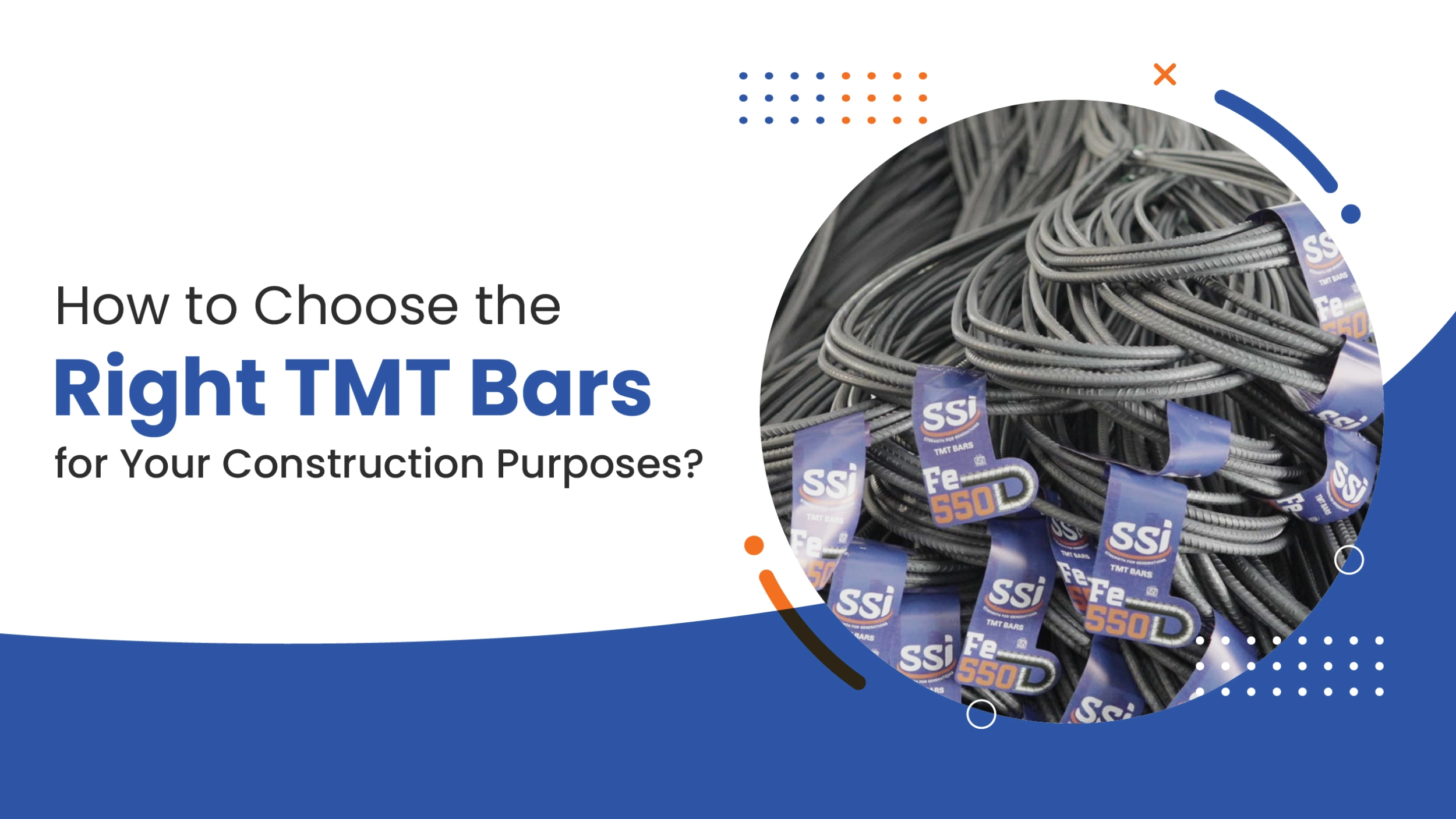
Choosing the right TMT bars is the fundamental step in building the robust and long-standing constructions. If you are starting a new construction project, you must ensure all the key factors defining the TMT bars are checked off. Whether you are building a small house, high-rise apartments, multiplexes, bridges or flyovers, its strength depends on the quality of the steel builders choose.
Some of the key factors on choosing the right TMT bars are evaluation of the grade to check the flexibility and strength, BIS-certification, corrosion/ seismic resistance, strong rib patterns, and even selecting the premier who succeeded a mile. So, you can understand the importance of TMT bars as it is significant for the stability of the buildings. In this blog, you will get the detailed information on how to choose the right TMT bars along with the checklist.
TMT Bars - A Brief Overview
TMT Bars (Thermo-mechanically treated bars) are the combination of high-strength and ductile steel to build stronger modern constructions. It features a tough outer layer and soft inner core due to special quenching and special tempering process, making the TMT Bars strong, flexible and corrosion resistant. These steel bars are ideal for residential buildings, flyovers, bridges, and complexes as it has superior bonding and structural integrity. It offers significant advantages compared to traditional bars, since it withstands fire, earth-quake resistance, and is cost-effective in the long run. In the name of TMT Bars, many materials might come with bad manufacturing, so it is necessary to choose the right TMT bars.
8 Factors to Consider When Choosing the TMT Bars
Below, we have given the 8 factors that should be considered when choosing the TMT bars for the construction purposes:
Factor 1: Grade Level of TMT Bars
The grade level of TMT bars specify its strength and ductility. Its power is measured in MPa (megapascals). Based on the project type, you can pick the TMT bars. In the following, we are matching the TMT bars grade to the construction types and suggesting the grade applicable to all the modern constructions.
- Fe 415: Preferred for single-family houses and simple residential buildings. It is highly malleable, suitable for light and moderate load-bearing structures.
- Fe 500: It can be used for offices, shops and any buildings that fall between small to average-sized.
- Fe 550: It is highly suitable for skyscrapers and heavy load-bearing building structures.
- Fe 550D: It is a highly specialized reinforcement bar, adding the high ductility along with the strength. It can be used for critical infrastructures like bridges, flyovers, dams and metro rails.
For all types of modern constructions, Fe 550D TMT Bars can be the better option since it provides both strength and flexibility, which can bear heavy loads and is resistant to seismic zones.
Factor 2: BIS Certification
Ensure to purchase only the certified steel bars for your construction. BIS (Bureau of Indian Standards) sets the national standards in quality, safety, and reliability for products and services to ensure consumer protection. So, choose the TMT bars that are aligned with the BIS standards to make your building stronger and reliable in the long run.
Factor 3: High-Ductility and Bendability
Ductility implies the power of bars that can bend without breaking. It is an important feature especially in the earthquake zones, where it can absorb shaking preventing the damages for buildings. This factor makes sure the construction is stable and can withstand seismic activities. Fe 550D TMT bars are the most commonly used in the great buildings, whether it is residential or commercial, which is durable in the midst of shaky earth.
Factor 4: Corrosion Resistance
Corrosion is one of the leading causes of structural failure, especially in coastal areas. High-quality TMT bars manufactured in a way having a “tempered martensite” outer layer and low carbon content which naturally resists the rapid rust formation. So, when selecting the best TMT bars, ensure it is corrosion resistant to avoid the problems in the buildings in future.
Factor 5: Fire Resistance
Fire disasters can break the standard TMT bars easily, eventually leading to the structural collapse. Modern TMT Bars have a thermal resistance up to 600°C without significant loss in the load-bearing capacity. To elevate it more better, SSI TMT bars manufacture the steel bars Fe 550D that can resist up to 800°C – it means more protection than standard TMT bars. This crucial feature alone tells the user-centered manufacturing conscience of the SSI TMT Bars.
Factor 6: Seismic Resistance
As we discussed, Ductility plays a major role in seismic resistance, which absorbs and dissipates seismic energy. Compared to brittle steel, which breaks in sudden pressure, TMT bars have a high elongation percentage that tackles any pressure. Since we can’t accurately predict natural events, it is better to build strong structures with seismic resistant TMT bars. Fe 500D is one of the key players in this as it has “D – Ductility” in the name itself. Ensure to purchase high-strength and high-ductile TMT bars for your construction purposes to build long-lasting buildings.
Factor 7: Size of TMT Bars
Among all the factors that define TMT bars, size is one factor that directly influences the load-carrying and structural stability of the building. The diameter for each structural element should be selected correctly to ensure appropriate strength and durability in construction. Usually, 8mm to 10mm TMT bars are used for slabs, stairs, and other non-load-bearing components, while 12mm to 16mm bars are commonly preferred for beams and columns in residential buildings since they provide balanced vertical and horizontal support. As far as heavy-duty constructions such as bridges, flyovers, and high-rise apartments are concerned, the thickness of TMT bars used goes up to 20mm-32mm to bear the high pressure and massive loads. Thus, the selection of the right size of TMT bars plays a crucial role in building safe and long-lasting constructions.
Factor 8: Reputation of the TMT Bars Manufacturer
The reputation of the manufacturer of the material used in the construction of the construction material is greatly responsible for assessing the quality, reliability, and reliability of the material used. Reputed manufacturers of the raw materials used in the construction process follow strict norms of quality control with the help of the use of virgin iron ore along with the assistance of the use of advanced technology through the automatic supply of a uniform strength, ductility, and composition to the produced iron. Moreover, the BIS test certificates are also provided by the reputed manufacturers to each batch of the material, which proves that the material used is sufficient to meet the standards of the IS:1786 norms. On the contrary, the locally produced materials may possess scrap iron that leads to a lack of uniformity in the strength produced by the material.
Also read: TMT Bars Weight: 8mm, 10mm, 12mm, 20mm, 25mm, 32mm steel bars
Summary: How to Choose the Best TMT Bars
Below, we have provided the summarized table comprising the information on choosing the right TMT bars offering you the full overview:
| Factor | What to Check | Why It Matters | Best Practice |
|---|---|---|---|
| Grade Level | Fe 415, Fe 500, Fe 550, Fe 550D | Determines strength and flexibility of structure | Prefer Fe 550D for modern, high-load and seismic constructions |
| BIS / ISI Certification | IS:1786 compliance, ISI mark | Ensures national quality, safety, and reliability standards | Always choose BIS-certified and ISI-marked TMT bars |
| Ductility & Bendability | Ability to bend without breaking | Absorbs seismic shocks and prevents sudden failure | High-ductility grades like Fe 500D / Fe 550D |
| Corrosion Resistance | Low carbon content, tempered outer layer | Prevents rust and long-term structural weakening | Mandatory for coastal and humid regions |
| Fire Resistance | Thermal resistance level | Maintains load-bearing capacity during fire accidents | Advanced TMT bars with resistance up to 600–800°C |
| Seismic Resistance | Elongation percentage, ductility | Protects buildings in earthquake-prone zones | Choose high-elongation, ductile TMT bars |
| Size of TMT Bars | Diameter (8mm–32mm) | Defines load-bearing capacity of elements | Match bar size with slabs, beams, columns, or heavy structures |
| Rib Pattern | Clearly defined, uniform ribs | Improves bonding between concrete and steel | Avoid smooth or poorly ribbed bars |
| Manufacturer Reputation | Primary manufacturer, test certificates | Ensures consistency, strength, and quality control | Choose reputed brands using virgin iron ore |
| Location & Environment | Coastal, seismic, humidity levels | Environmental exposure affects steel performance | Select bars based on site conditions |
Planning to Buy TMT Bars? Connect with Us!
SSI TMT Bars has been a name that has become synonymous with quality, superior quality products with unmatched strength in the Indian construction arena. We manufacture our TMT Bars products in highly sophisticated plants using Belgian Tempcore technology in combination with highly automated hot rolling technology. We operate strictly in accordance with BIS specifications with quality checks being conducted at every stage of manufacture to ensure accuracy in the precision-engineered products they offer.
FAQs
What is the significance of selecting the appropriate kind of TMT bars while it is used in construction?
The selection of a good quality of TMT bars is very important because on which basis a building can prove to be strong depends on what quality of steel bars are being used in that building or infrastructure to support it from external conflicts and natural tragedies ranging from small residential buildings to major constructions such as bridges and flyovers.
What is the suitable grade of TMT bars used in constructions?
For most modern structures, Fe 550D TMT reinforcing bars have proven to be a better alternative compared to Fe 250D and Fe 500D TMT reinforcing bars due to their perfect combination of good ductility and strength. These reinforcing bars support heavy loads yet possess good ductility, thus suitable for areas experiencing earthquakes and also for tall structures.
How does ductility relate to the performance of TMT bars?
Ductility refers to the ability to bend without breaking under pressure. It is seen that high ductility TMT products are effective in gripping shocks and seismic activities in such a way that they do not allow sudden failures in buildings.
Why does corrosion resistance become an important factor in selecting TMT bars?
That is quite important, as the formation of rust weakens steels in a course of time, especially in humid or coastal areas. Low carbon content and a tempered outer layer make for good-quality TMT bars with resistance to corrosion, thereby assuring long-term strength and thus reducing maintenance costs.
How does the size of TMT bars affect construction strength?
TMT bars have their capacity, which determines the respective diameter. These are smaller in size and have their usability in slabs and stairs, whereas for beams and columns, larger diameters are essentially used in heavy-duty structures. Correct sizing the bar helps in providing good load distribution and safety of a structure.
Why should only BIS-certified and ISI-marked TMT bars be used?
TMT bars, certified by BIS and ISI-marked, depict the very achievement of national standards related to quality, safety, and strength as per the Bureau of Indian Standards. Certified TMT bars ensure their chemical composition, yield strength, and ductility are within specified norms to avoid any structural failure.
How does flexibility and strength change in various TMT bars of various grades?
Grades of TMT bars range from low strength and high flexibility, where flexibility is inversely proportional to strength. In low-grade bars, flexibility is pronounced and strength is low, and conversely, in higher grades, strength is higher and ductility is controlled. High ductility grades of TMT bars are desirable.
Should location and environmental conditions be factors in selecting TMT bars?
Yes, the construction location and atmospheric conditions should be understood before selecting TMT bars. Coastal areas and high humid climates need TMT materials that have corrosion resistance properties for long-term durability of the building. Similarly, earthquake-prone places need TMT that provides high ductility for long-term building durability and safety.