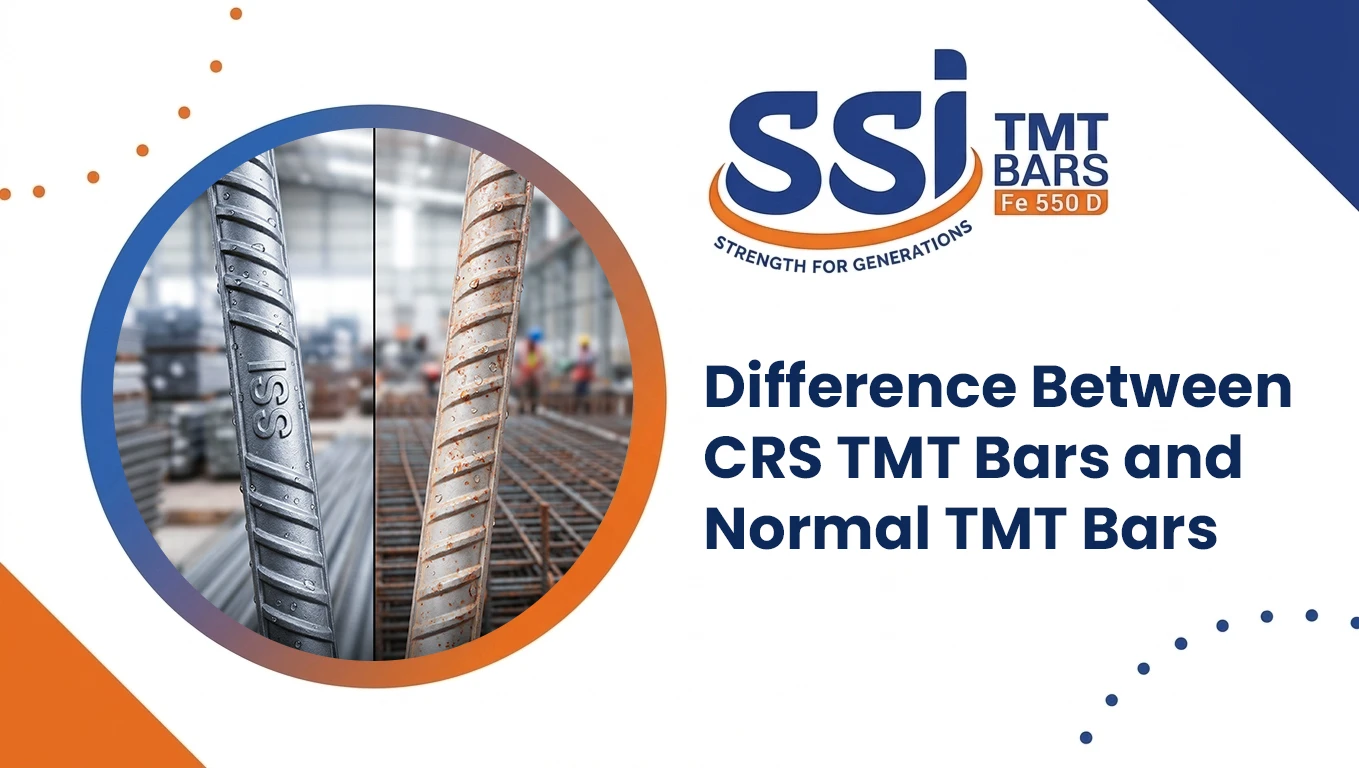
Steel is the backbone of every home, bridge, and building, and the type of steel you choose will decide the quality of the structure. In the world of reinforcement steel, TMT bars are the gold standard. But there is a growing and important question every buyer must now ask: are all TMT bars truly the same? The answer is no, and understanding the difference between CRS TMT Bars (Corrosion Resistant Steel) and Normal TMT Bars could be one of the most valuable decisions you make before construction begins. This guide explains exactly what sets them apart, who should choose which, and why corrosion resistance matters far more than most buyers realise, especially in India’s diverse and demanding climate conditions.
Not all TMT bars protect your home equally. Make sure you are choosing the one that truly does – SSI CRS Fe 550D TMT Bars!
Normal TMT Bars – A Brief Overview
Normal TMT bars, short for Thermo-Mechanically Treated bars, are produced by heating steel billets at high temperature and then rapidly quenching them with water. This process creates a tough, hard outer surface and a softer, ductile inner core, giving the bar its well-known combination of strength and flexibility. Made primarily from iron and carbon with minimal additives, normal TMT bars are manufactured in standard grades Fe500, Fe500D, Fe550550D and Fe and meet the IS 1786 quality standard. They are widely used across India for residential and commercial construction, and for most standard applications in low-humidity, inland environments, they perform reliably and cost-effectively. However, their composition leaves them susceptible to corrosion when exposed to moisture, humidity, salt-laden air, or chemical-rich environments over time.
Pros and Cons of Normal TMT Bars
When normal TMT bars are the right choice and when they may not be:
Pros:
- Cost-effective and widely available across India, easy to source from most suppliers and dealers
- Good tensile strength that meets standard structural requirements for residential and commercial buildings
- Reliable bonding with concrete, ensuring structural integrity in normal load conditions
- Available in all standard grades, giving flexibility for different structural requirements
- Well-established quality standards under IS 1786, ensuring consistent mechanical performance
Cons:
- Susceptible to corrosion in humid, coastal, or high-rainfall environments, rust can gradually weaken the bars from within concrete
- Requires periodic maintenance, protective coatings, or treatments to prevent deterioration in exposed or damp conditions
- Structural longevity may reduce over time if moisture or chemicals seep into the concrete and reach the steel
- Not ideal for construction near the sea, in basements, water tanks, or flood-prone areas where corrosion is a consistent threat
CRS TMT Bars – A Brief Overview
CRS TMT Bars, Corrosion Resistant Steel TMT Bars, are an advanced evolution of the standard TMT bar, made specifically to resist the rust. Unlike normal TMT bars, CRS bars are produced using a refined low-carbon steel alloy that incorporates additional elements such as chromium, copper, and nickel into the composition. These elements act as a natural shield that actively prevents further corrosion from penetrating the bar. With a Corrosion Resistance Equivalent (CRE) of 0.5% minimum, CRS TMT bars are designed to perform reliably even in the harshest conditions: coastal zones, high-rainfall regions, areas with high groundwater salinity, and structures like bridges, basements, and water tanks that face constant moisture exposure.
Pros and Cons of CRS TMT Bars
Here is the full, honest picture of what CRS TMT bars offer and where to keep expectations realistic:
Pros:
- Superior corrosion resistance: The chromium, copper, and nickel alloy forms a self-protecting oxide layer that actively prevents rust.
- Significantly longer structural lifespan: Ideal for buildings that need to stand strong for 50 to 100 years without costly repairs
- Lower long-term maintenance costs: Less need for protective coatings, treatments, or structural remediation over the life of the building
- Better tensile strength and improved ductility compared to standard TMT bars .
- Higher fire resistance due to the refined alloying process, an added safety advantage in critical structures
- Superior bonding with concrete, the bar’s surface properties ensure strong grip and load transfer within the structure
- Ideal for coastal areas, basements, bridges, water tanks, and flood-prone zones where moisture and salinity are constant challenges
- Eco-friendly choice, longer durability means fewer replacements and less steel consumed over the life of the structure
Cons:
- Slightly higher upfront cost compared to normal TMT bars, though this is typically offset by the savings in long-term maintenance and durability
- May not be necessary for every construction type, in dry, inland, low-humidity environments, the additional corrosion protection may not be the priority
Key Differences Between CRS TMT Bars and Normal TMT Bars – What Every Buyer Should Know
Use this comparison to evaluate which type of TMT bar truly matches your construction needs, location, and long-term goals:
Aspect | Normal TMT Bars | CRS TMT Bars |
Composition | Iron + carbon, minimal additives | Iron + carbon + chromium, copper & nickel for protection |
Corrosion Resistance | Low – prone to rust in moisture & humidity | High – forms a protective oxide layer that fights rust |
Durability | Moderate – needs periodic coating or treatment | Superior – longer structural lifespan with less upkeep |
Coastal Suitability | Not ideal – salt air accelerates rusting | Highly suitable – designed for high-salinity environments |
Maintenance Cost | Higher over time due to corrosion damage | Lower over the long run – minimal intervention needed |
Tensile Strength | Good – meets IS 1786 standards | Better – enhanced alloy composition improves performance |
Ductility | Good flexibility and earthquake resistance | Improved ductility and superior bonding with concrete |
Fire Resistance | Standard | Higher fire resistance due to refined alloying process |
Best Used For | Inland, urban, low-humidity constructions | Coastal areas, basements, bridges, water tanks, flood zones |
Cost | Lower initial cost | Slightly higher upfront – but more economical long-term |
IS Standard | IS 1786 compliant | IS 1786 compliant with enhanced CRE of 0.5% minimum |
The difference is clear – and for anyone building near the coast, in high-rainfall regions, or simply building to last, CRS TMT Bars are the smarter, safer investment.
Still confused? Read our detailed guide on how to choose the TMT Bars for your construction purposes!
Which One Is the Right Choice for Construction?
The honest answer is: it depends on where you are building and how long you want your structure to last.
- If you are constructing a home in a dry, inland city , with low humidity, no proximity to the sea, and no special structural requirements like basements or water tanks, high-grade normal TMT bars from a reputed manufacturer, properly specified and installed, will serve you well.
- But if you are building anywhere near the coast – in cities like Chennai, Mumbai, Kochi, or Visakhapatnam – or in high-rainfall regions, flood-prone zones, or for critical structures like bridges, hospital foundations, or retaining walls, CRS TMT Bars are not just the better choice, they are the responsible one.
Be among those who truly care about their construction, choose the best: SSI CRS Fe 550D TMT Bars!
FAQs
I What is the main difference between CRS TMT bars and normal TMT bars?
CRS TMT bars contain alloying elements like chromium, copper, and nickel that resist corrosion, while normal TMT bars are more prone to rust in moisture-rich environments. This makes CRS bars more durable in harsh conditions.
Are CRS TMT bars better than normal TMT bars?
CRS TMT bars are better in coastal, humid, and high-rainfall areas due to their corrosion resistance. However, normal TMT bars are sufficient for dry, inland construction projects.
Where should CRS TMT bars be used?
CRS TMT bars are ideal for coastal regions, basements, bridges, water tanks, and flood-prone areas where exposure to moisture and salt is high.
Do CRS TMT bars last longer than normal TMT bars?
Yes, CRS TMT bars have a longer lifespan because they resist rust and reduce structural damage over time. This results in lower maintenance and repair costs.
Are CRS TMT bars more expensive than normal TMT bars?
CRS TMT bars have a slightly higher initial cost, but they are more economical in the long run due to reduced maintenance and longer durability.
Can normal TMT bars be used in coastal areas?
Normal TMT bars are not recommended for coastal areas as salt and humidity can cause faster corrosion. CRS TMT bars are a safer and more reliable choice in such conditions.