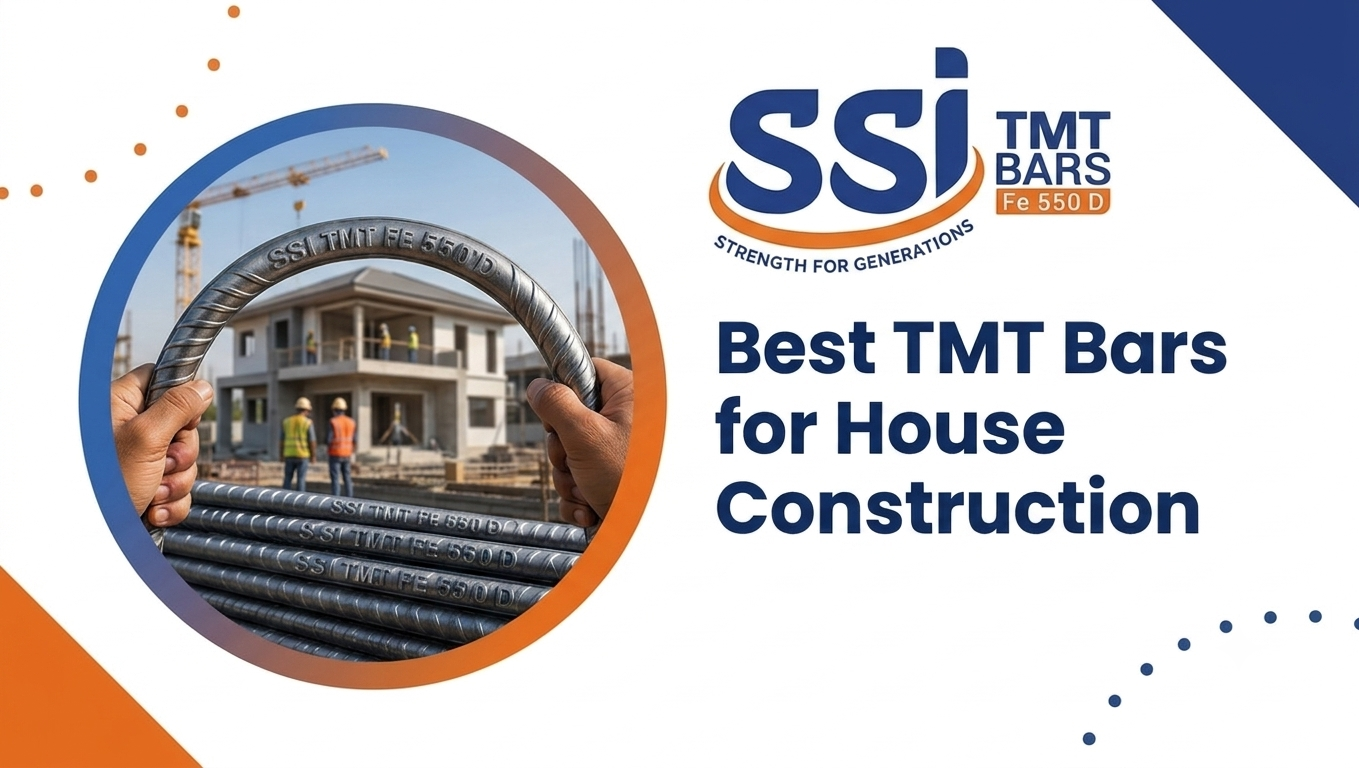
“At last, we are going to build our own house” – there is no feeling quite like this one. For most Indian families, building a home is not just a construction project; it is the result of years of savings, sacrifices, and dreams held close to the heart. But after that joyful moment of deciding to build, the real work begins – and it begins with making the right choices. Every brick, every beam, and most importantly, every TMT bar you choose will determine how safe and strong your home stands for generations. So before you begin, take a deep breath and make sure you are choosing wisely, because your family deserves nothing less than the best.
Why TMT Bars Significant for House Construction?
TMT bars – short for Thermo-Mechanically Treated bars – are the invisible backbone of your home. They are the steel rods that run through your columns, beams, and slabs, holding everything together when the weight of your life rests upon them. Unlike ordinary steel rods, TMT bars go through a controlled cooling process that gives them a tough outer layer and a softer inner core – a combination that makes them both strong enough to bear heavy loads and flexible enough to withstand earthquakes. In a country like India, where seismic zones, monsoon flooding, and load-bearing requirements vary greatly from state to state, choosing the right TMT bar is not a technical detail you can leave to chance. It is one of the most important decisions you will make for the safety of everyone who will live under that roof.
6 Things to Consider When Choosing TMT Bars for House Construction
Do not let anyone rush this decision. Here are six things every homebuilder must carefully think through before buying TMT bars:
1. Grade of the TMT Bar
TMT bars are graded based on their yield strength Fe550, and Fe600 are the most common grades available in India. For a typical two or three-storey house, Fe550D is the most recommended grade because it combines high strength with superior ductility. The “D” in Fe550D stands for ductile, which means the bar can bend and absorb energy during an earthquake without snapping. If you are building in a seismic zone – which includes large parts of northern and northeastern India – please do not compromise on this. A higher grade does not always mean better for every application, so consult your structural engineer before deciding.
2. BIS Certification (IS 1786 Standard)
Always look for the BIS (Bureau of Indian Standards) hallmark on the TMT bars you purchase. The IS 1786 standard is the benchmark that every quality TMT bar in India must meet. Bars without this certification may look identical on the outside, but their chemical composition and mechanical properties may be completely unreliable. Unfortunately, the Indian market has seen counterfeit and sub-standard steel sold to unsuspecting homebuilders. Protect your family by purchasing only from reputed, certified manufacturers and always asking your supplier for the test certificate. This one check can make all the difference.
3. Corrosion Resistance
Steel and moisture are lifelong enemies. In coastal areas like Chennai, Mumbai, Kochi, or Visakhapatnam, the air carries salt particles that can slowly corrode unprotected steel from the inside of your walls – without you ever seeing it until serious structural damage has already occurred. Look for TMT bars with a low carbon and sulphur content, which improves corrosion resistance naturally. Some premium brands also offer CRS (Corrosion-Resistant Steel) TMT bars designed specifically for coastal and humid climates. If you are building near the sea or in a high-rainfall zone, this is not a feature to skip – it is a necessity.
4. Ductility and Bendability
A TMT bar that is strong but brittle is not truly safe. When an earthquake strikes or when a structure bears unexpected loads, the bars need to bend slightly and absorb that energy rather than crack. This property is called ductility, and it is measured by something called the elongation percentage. A good quality Fe550D TMT bar should have a minimum elongation of 16%, meaning it can stretch significantly before it breaks. Ductility also matters when your construction team is bending bars on site to create stirrups and hooks – a bar that cracks during bending is a sign of poor quality and should be rejected immediately.
5. Brand Reputation and Traceability
In India, established brands like TATA Tiscon, JSW Neo Steel, SAIL, Kamdhenu, and Vizag Steel have built their reputation over decades by consistently delivering quality. While their bars may cost a little more than unknown local alternatives, the peace of mind they offer is priceless. Reputed brands also provide traceability – each bundle of bars comes with a mill test certificate that tells you exactly what the steel is made of and how it was tested. When a contractor offers you a cheaper, unknown brand, ask yourself honestly: is the saving worth the risk to the people you love most?
6. Weight and Rib Pattern Verification
A simple but often overlooked check – weigh a sample of the TMT bars before accepting the full delivery. Each TMT bar has a standard weight per metre based on its diameter, and any significant deviation is a red flag for under-weight or hollow bars that will not perform as expected. Also examine the rib pattern: the diagonal ribs on the bar’s surface are not just cosmetic – they provide grip within the concrete, called bond strength. Clear, well-defined ribs indicate proper manufacturing. Flat or poorly formed ribs suggest cost-cutting in the production process. These small checks on site can save you from major structural problems in the future.
Understand the best TMT bars for every type of construction to select the right TMT bars for your all projects!
Recommended TMT Bar Diameter for Your House
Different parts of your home need different TMT bar sizes. Here is a simple guide to help you and your engineer plan the right diameter for each structural element:
- 8 mm bars: Commonly used for slab reinforcement, wall ties, and lateral ties in columns. A go-to size for most residential slabs in India.
- 10 mm bars: Ideal for floor slabs, staircases, and secondary beams in a ground-plus-one or ground-plus-two storey home.
- 12 mm bars: Widely used for main reinforcement in beams, columns, and load-bearing walls in standard residential construction.
- 16 mm bars: Recommended for primary columns and beams in multi-storey homes or wherever the structural load is significant.
- 20 mm bars: Used in heavily loaded columns, raft foundations, and pile caps in larger or multi-floor constructions. Also used in earthquake-prone zones for critical structural members.
- 25 mm and above: Reserved for large commercial structures or deep foundations. Rarely needed for standard residential homes but may be specified by your structural engineer for special conditions.
Choose Quality TMT Bars for Your House – Make the Right Call Now!
You have worked too hard and waited too long to cut corners on something as fundamental as your home’s structure. The TMT bars you choose today will quietly carry the weight of your family’s safety for the next 50 to 100 years. Every rupee saved on inferior steel is a risk that is simply not worth taking. Talk to a certified structural engineer, insist on BIS-certified bars from a reputed brand, verify your delivery, and do not let anyone pressure you into compromising on quality. Your dream home deserves a foundation as strong as the love and effort you have put into making it real.
Speak to Our Expert Today – Build Safe, Build Strong, Build with Confidence.
Frequently Asked Questions (FAQs)
1. Which TMT bar grade is best for a typical two-storey house in India?
Fe550D is generally ideal for most two-storey homes as it offers high strength and good ductility. Always follow your structural engineer’s recommendation based on site conditions.
2. How do I check if the TMT bars I am buying are genuine and not counterfeit?
Buy only from authorised dealers and ask for the Mill Test Certificate (MTC). Check for BIS marking and brand embossing on the bars.
3. Is it okay to use different grades of TMT bars in different parts of the same house?
Yes, different grades can be used for different structural elements if specified. Follow your structural drawings and engineer’s guidance strictly.
4. How much TMT steel will I need for building a 1,000 square foot house?
Typically, you’ll need around 3.5-4.5 kg per sq. ft., which is about 3.5-4.5 tonnes for 1,000 sq. ft. Get an exact estimate from your engineer’s Bar Bending Schedule (BBS).
5. Can we reuse old or scrap TMT bars from another site to save costs?
No, reused bars may be weakened or corroded and unsafe for construction. Always use new, certified TMT bars for structural reliability.