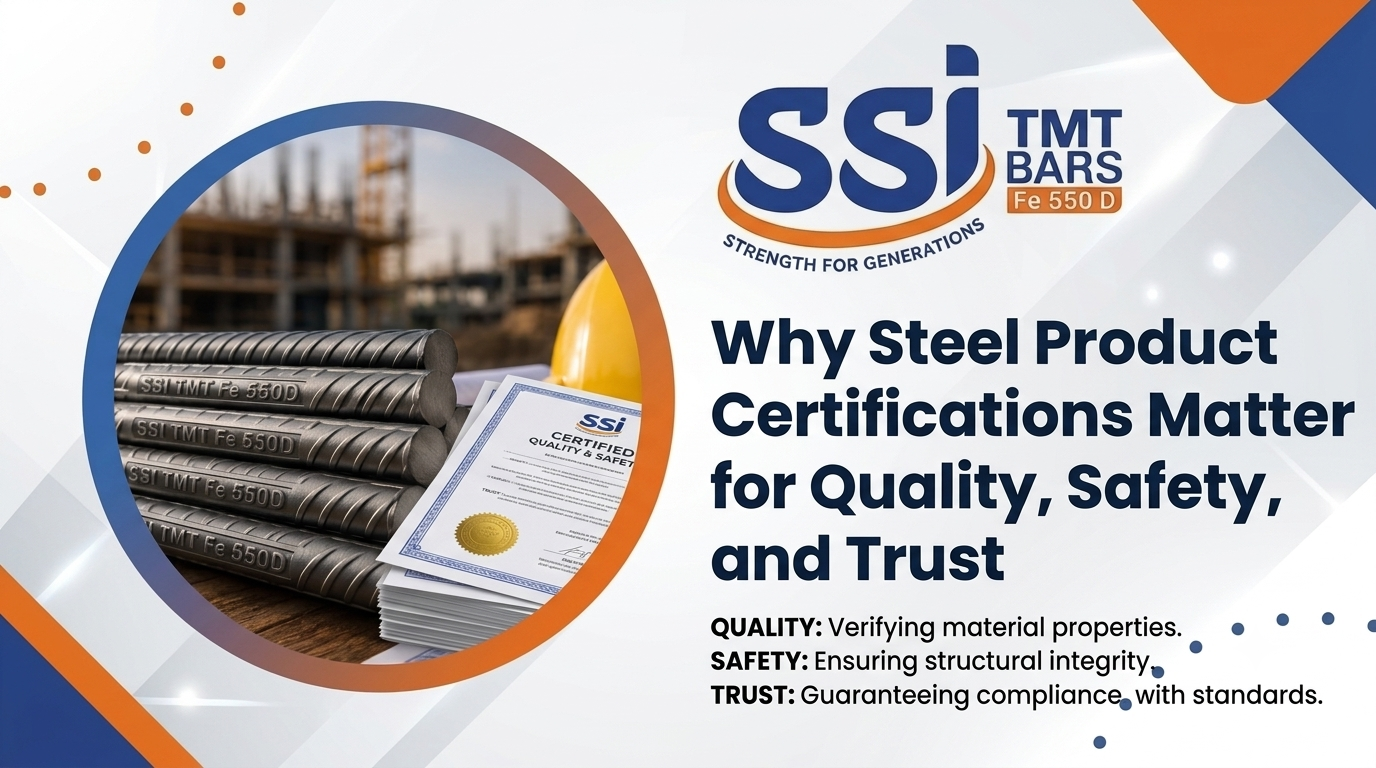
Why Steel Product Certifications Matter for Quality, Safety, and Trust
When you are building a home, a commercial tower, or a public infrastructure project, every material decision carries weight literally. Steel reinforcement bars sit at the core of every structure you construct, and the quality of those bars determines how long that structure will stand and how safely it will perform under stress, load, and seismic forces.
Yet not all steel is equal. Not all manufacturers hold themselves to the same standards. This is exactly where certifications for steel products become essential not as paperwork, but as verified proof that the steel you are placing inside concrete meets defined and testable benchmarks.
This blog explains what certifications mean in the context of TMT bar manufacturing, why they matter to builders, contractors, and project owners, and how SSI TMT’s certified products give you a dependable foundation for every project.
Why Certifications Matter in Steel Products
Steel is a material where quality is invisible to the naked eye. You cannot judge a TMT bar’s yield strength, elongation, or chemical composition by looking at it on-site. This is the fundamental problem that certifications solve.
Steel quality certifications are formal validations issued by independent and government-authorised bodies confirming that a product and the manufacturing process behind it consistently meets defined technical requirements. For TMT bars used in reinforced concrete construction, these requirements cover:
- Chemical composition controlling elements such as carbon, sulfur, and phosphorus to ensure weldability and structural integrity
- Yield strength and tensile strength confirming load-bearing capacity under real structural conditions
- Elongation and ductility measuring the bar’s ability to bend and absorb stress without fracture
Without certifications, there is no independent verification that the steel reaching your site matches the specifications on the invoice. Certifications close that gap.
How Certifications Ensure Consistent Steel Quality
Quality in steel manufacturing is not a one-time achievement, it is a continuous discipline. A certification is not awarded once and forgotten. It requires a manufacturer to maintain documented quality systems, submit to periodic third-party audits, and test each production batch against fixed standards.
BIS Certification Under IS 1786:2008
The Bureau of Indian Standards (BIS) certification under IS 1786:2008 is the most important mark of quality assurance for TMT bars used in India. This standard specifies the full set of requirements for high-strength deformed steel bars used in concrete reinforcement covering everything from chemical composition to mechanical properties to dimensional tolerances.
BIS-certified steel means that every batch produced has been validated against these requirements. It is not a self-declaration. It is a third-party-verified mark that regulators, government procurement teams, and institutional buyers rely on when evaluating suppliers.
For a builder or contractor, BIS certification under IS 1786:2008 means:
- The steel’s yield strength, tensile strength, and elongation properties are independently verified
- Production is subject to ongoing BIS surveillance and audit
- The manufacturer is accountable to a regulatory framework not just market reputation
This is the baseline of quality assurance in steel that every serious buyer should demand.
GreenPro Eco-Label Accreditation
Beyond structural performance, responsible construction today also demands environmental accountability. The GreenPro eco-label, accredited by the CII Green Product Certification Programme, recognises products that are manufactured with responsible environmental practices.
For projects targeting green building ratings or LEED compliance, working with GreenPro-accredited steel products is a material advantage. It demonstrates that steel contributes to a project’s sustainability goals, not just its structural ones.
Together, BIS certification and GreenPro accreditation give buyers two independent validations: one for structural quality, one for environmental credibility.
How Certifications Protect Safety in Construction
Structural failures do not happen overnight. They are often the result of accumulated material that compromises steel that falls slightly short on yield strength, bars that crack under seismic stress, or reinforcement that corrodes prematurely because sulfur and phosphorus content was not properly controlled.
Steel safety standards exist to prevent exactly this. When steel is certified to IS 1786:2008, the structural engineer designing your building can rely on tested data not manufacturer claims when calculating load requirements, seismic resistance, and column or beam dimensions.
Consider three real-world safety scenarios where certified TMT bars make a measurable difference:
- Seismic zones Certified Fe 550D TMT bars carry verified elongation values that confirm the bar’s ability to deform under seismic loads without sudden fracture. For buildings in seismic zones 3, 4, and 5, this is not a preference, it is a structural necessity.
- Coastal and humid environments IS 1786:2008 controls sulfur and phosphorus levels to prevent premature corrosion. In coastal construction where chloride exposure is high, certified chemical composition is the difference between a 50-year structure and one that begins deteriorating within a decade.
- High-load commercial and infrastructure projects Bridges, flyovers, and multi-storey commercial buildings are designed to exact load tolerances. If the reinforcement steel does not meet the certified yield and tensile strength values specified by the structural engineer, the safety margin built into the design is compromised.
Construction steel certifications are not Official overhead. They are the engineering foundation on which structural safety calculations are built.
How Certifications Build Customer Trust
For builders evaluating suppliers, for project owners approving material vendors, and for government procurement agencies clearing contractor bids, steel product trust is not assumed it is demonstrated.
Certified steel products bring transparency to the buyer-supplier relationship in several important ways:
- Traceability: Certified manufacturers maintain batch records linking each production run to its test results. If a question arises on-site, the answer is documentable.
- Accountability: A manufacturer operating under BIS certification is subject to surveillance. Non-compliance can result in licence suspension. This creates a level of accountability that non-certified manufacturers do not face.
- Comparability: When evaluating competing steel brands, certifications give buyers a common benchmark. Two certified products can be compared on specification sheets. An uncertified product cannot be compared at all there is nothing verified to compare.
- Compliance with project requirements: Government projects, institutional builders, and real estate developers increasingly mandate certified steel as a procurement condition. Specifying a certified brand protects the project owner’s liability position.
For dealers and distributors, certified TMT bars also mean stronger customer conversations. A dealer stocking BIS-certified, GreenPro-accredited steel is not competing on price alone they are offering credibility and reduced project risk.
Why SSI TMT Stands for Reliability
SSI TMT, manufactured under the Sakthi Group, an industrial group with a track record in South India spanning more than four decades brings both manufacturing discipline and verified quality credentials Safety constructions and Customers Trust to every project it serves.
Certifications held by SSI TMT:
- BIS Certification under IS 1786:2008 : Bureau of Indian Standards certificate covering Fe 550D TMT bars, the highest standard grade for deformed steel bars in reinforced concrete construction
- BIS 2018 & BIS 2021 : two separate Bureau of Indian Standards certificates (one per manufacturing plant each factory holds its own independent BIS licence)
- GreenPro Eco-Label Accreditation :recognising SSI TMT’s commitment to environmentally responsible manufacturing
These are not self-declared quality claims. They are independently verified credentials that SSI TMT maintains through ongoing compliance, third-party testing, and documented quality systems at its manufacturing facilities in Kanchipuram (Tamil Nadu) and Andhra Pradesh.
Every batch of SSI TMT bars undergoes an 8-stage manufacturing and quality control process from spectrometric analysis of molten steel to tensile and bend testing of finished bars before leaving the plant. The Belgian Tempcore quenching technology used in production creates the hard martensite outer layer and ductile ferrite-pearlite core that gives Fe 550D bars their verified strength and flexibility.
When you choose SSI TMT, you are not relying on a brand promise. You are purchasing certified performance backed by documentation, verified by independent bodies, and built into every bar.
Conclusion
Certifications for steel products are the bridge between what a manufacturer claims and what independent standards bodies verify. In an industry where material quality directly determines structural safety and service life, that difference is significant.
BIS certification under IS 1786:2008 confirms that the steel’s mechanical and chemical properties meet India’s national standards. GreenPro accreditation confirms that the manufacturing process meets environmental benchmarks. Together, they give builders, contractors, architects, and institutional buyers a clear and reliable basis for procurement decisions.
SSI TMT’s portfolio of certifications reflects a manufacturing culture built on discipline, testing, and accountability. For anyone who takes the long-term performance of their structures seriously, these are the credentials that matter.
Build with confidence. Build with certified SSI TMT bars.
Frequently Asked Questions
What are certifications for steel products and why are they important?
Certifications for steel products are formal validations issued by authorised bodies confirming that a product meets defined technical standards for chemical composition, mechanical strength, dimensional accuracy, and other quality parameters. They are important because they provide independent verification that steel performs as specified — which directly affects structural safety, project compliance, and long-term durability.
What is BIS certification for TMT bars?
BIS (Bureau of Indian Standards) certification for TMT bars is a mandatory quality mark issued under IS 1786:2008. It confirms that a manufacturer’s TMT bars meet India’s national standards for yield strength, tensile strength, elongation, and chemical composition. BIS-certified TMT bars are subject to ongoing surveillance and batch testing, making them the benchmark for verified quality in Indian construction.
What is IS 1786:2008 and why does it matter?
IS 1786:2008 is the Indian Standard specification for high-strength deformed steel bars used in reinforced concrete construction. It sets minimum requirements for yield strength, ultimate tensile strength, elongation, and chemical composition across all TMT bar grades from Fe 415 to Fe 600. For structural engineers, IS 1786:2008 compliance is the technical foundation on which load calculations and safety margins are designed.
What is GreenPro certification for steel?
GreenPro is an eco-label accreditation issued by the CII Green Product Certification Programme. For steel manufacturers, it recognises responsible environmental practices in production. GreenPro-accredited steel is particularly relevant for projects targeting LEED ratings or green building compliance, where material sustainability credentials are evaluated as part of the certification scorecard.
Is BIS-certified steel mandatory for government construction projects in India?
For most government and public infrastructure projects in India, BIS-certified steel meeting IS 1786 standards is a standard procurement requirement. Institutional buyers, PSUs, and government agencies routinely mandate certified steel products to ensure regulatory compliance and reduce material-related liability.
How do I verify that a TMT bar is BIS-certified?
You can verify BIS certification by checking the BIS licence number marked on the bar or in the manufacturer’s documentation. The BIS website also maintains a searchable database of licence holders. For SSI TMT, certification details and documentation are available directly from the company.
Why should I choose certified TMT bars over non-certified alternatives?
Non-certified TMT bars have no independent verification of their mechanical or chemical properties. A certified TMT bar comes with tested and documented performance data, manufacturer accountability under regulatory surveillance, and traceability of each production batch. For any structure intended to stand safely for decades, certified steel eliminates the uncertainty that non-certified alternatives introduce.
Does SSI TMT hold steel quality certifications?
Yes. SSI TMT holds BIS certification under IS 1786:2008 for its Fe 550D TMT bars, as well as GreenPro eco-label accreditation. These certifications are maintained through ongoing compliance, third-party batch testing, and documented quality control processes at SSI TMT’s manufacturing facilities in Tamil Nadu and Andhra Pradesh.