
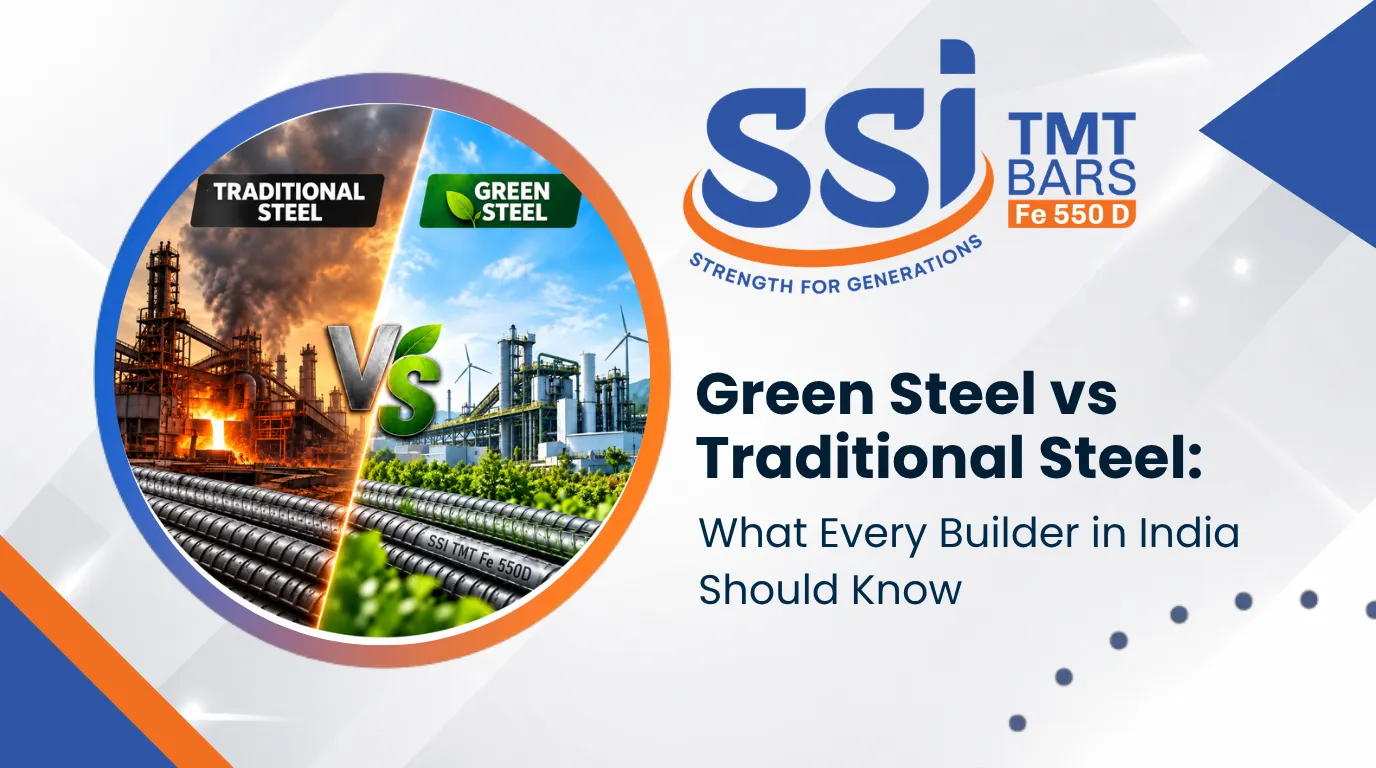
Every building starts with a material choice, and few choices carry as much weight as the steel inside the concrete. Reinforcement bars hold up every column, beam and slab, and the way those bars are made is now part of the conversation as much as how strong they are. Builders, engineers and homeowners are asking a new question: should the steel be traditional, or green?
Traditional steel is made in coal-fired blast furnaces and has built nearly every flyover, apartment and bridge in the country. Green steel is made with cleaner methods such as recycled scrap melted in electric arc furnaces, renewable power and hydrogen, and it promises far lower carbon emissions. Tenders now ask for carbon data, banks ask about ESG, and buyers ask about green certification, so the difference matters for your next project.
In this guide, we compare green steel and traditional steel on emissions, cost, strength and availability, explain what it means for TMT bars used in Indian construction, and show how to make a confident choice without compromising structural safety.
What Is Traditional Steel?
Traditional steel is produced mainly through the blast furnace and basic oxygen furnace route, usually shortened to Blast Furnace (BF) – Blast Oxygen Furnace (BOF). It has powered Indian construction for decades, and it is still the most widely available route.
How the Blast Furnace Route Works
Iron ore is combined with coking coal and heated to extreme temperatures. The coal acts as both fuel and the chemical agent that strips oxygen from the ore, producing molten iron. This iron is converted into steel, rolled into bars and thermo-mechanically treated to give TMT bars their hard outer layer and ductile core.
This route depends on three things: freshly mined iron ore, coal and coke, and fossil-fuel energy for high-temperature operations.
The Carbon Cost
The strength of the finished bar is not the problem. The process behind it is. Steelmaking is widely reported to account for roughly 7 to 9 percent of global CO2 emissions, and the blast furnace route releases close to two tonnes of CO2 for every tonne of steel produced. That is why steel sits at the centre of every conversation about low-carbon construction.
What Is Green Steel?
Green steel is steel made with technologies that significantly cut greenhouse gas emissions while keeping the same quality as conventional steel. There is no single recipe. Several routes are grouped under the name.
Electric Arc Furnaces and Recycled Scrap
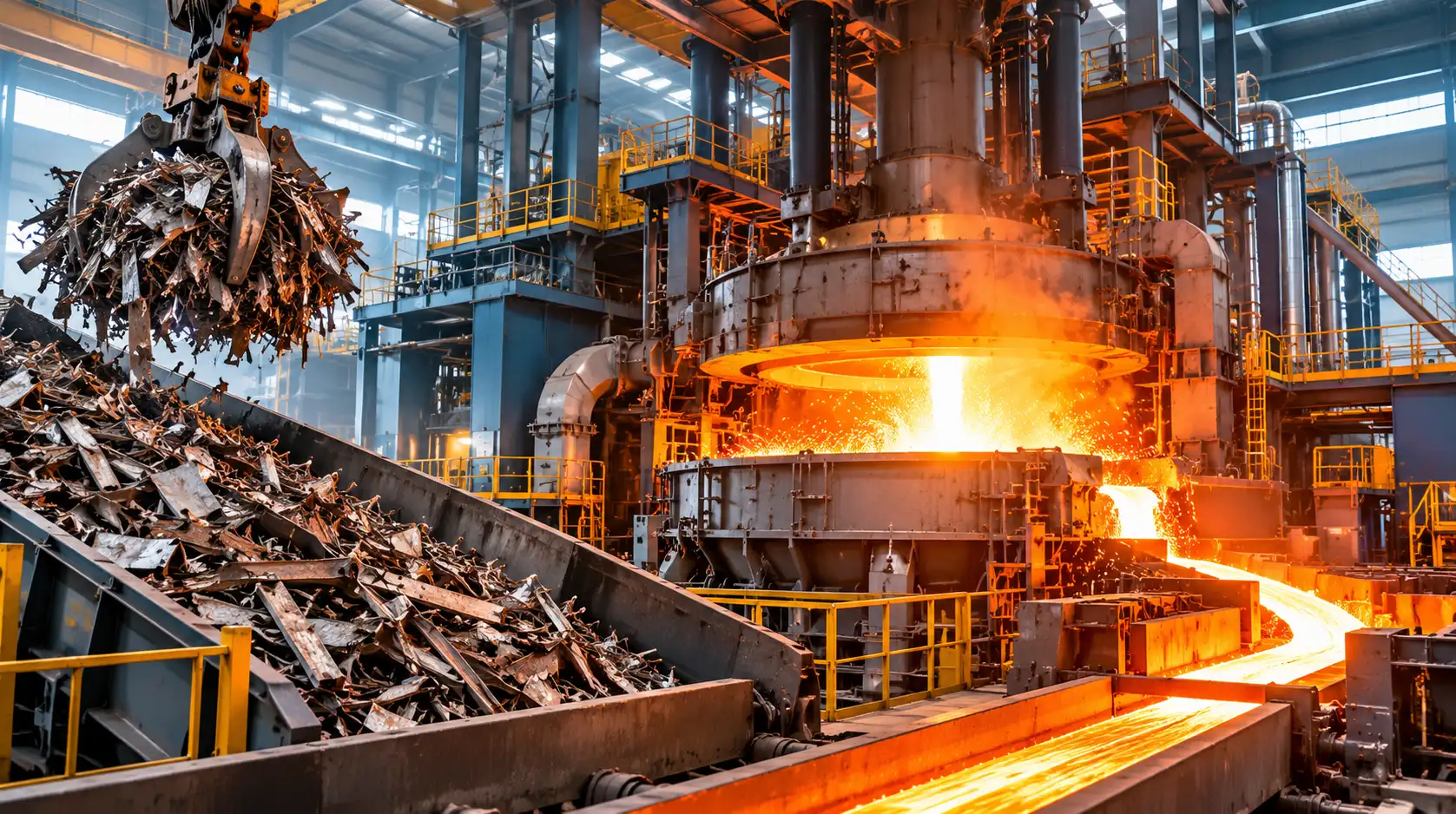
Electric arc furnaces (EAF) melt recycled scrap steel using electricity. Steel can be recycled again and again without losing its properties, so scrap is a valuable raw material. When the electricity comes from renewable sources, the emissions of this route fall sharply.
Hydrogen-Based Steelmaking
In this route, hydrogen replaces coal to remove oxygen from iron ore. The by-product is water vapour instead of CO2. It is the most promising path to near-zero emission steel, but green hydrogen is still expensive and limited in supply.
Renewable Energy and Carbon Capture
Some plants run on solar or wind power, and others add carbon capture technology to trap the CO2 that is still produced. Together, these methods can cut emissions by roughly 50 to 90 percent compared with the blast furnace route, depending on the technology used.
Why You Should Verify “Green” Claims
There is no single legal definition of green steel in India yet. When a supplier calls a bar green or low-carbon, ask for proof such as an Environmental Product Declaration (EPD), third-party verified emission data, or the exact production route used. A genuine claim comes with numbers.
Green Steel vs Traditional Steel: Key Differences
The two routes differ sharply in how they make steel, and very little in how the finished bar performs once it is inside your concrete.
Factor | Green Steel | Traditional Steel |
Main production route | EAF, recycled scrap, hydrogen, renewable energy | Blast furnace and basic oxygen furnace |
Carbon emissions | Low to very low (roughly 50 to 90 percent lower) | High (close to 2 tonnes CO2 per tonne of steel) |
Energy source | Renewable or cleaner electricity | Fossil fuels |
Raw materials | Scrap, hydrogen, clean power | Fresh iron ore and coking coal |
Pollution | Lower air and water pollution | Higher pollutants |
Strength and ductility | Same when it meets IS 1786 | Same when it meets IS 1786 |
Price today | Higher | Lower |
Green certification support | Strong (IGBC, GRIHA, LEED, EPD) | Limited |
Future regulation risk | Lower | Higher |
Availability | Growing, limited at scale | Widely available |
Environmental Impact Compared
The real gap between the two routes shows up in what goes into the air, and in what is taken from the ground.
Carbon Emissions
Traditional steel releases CO2 from coal combustion, from the chemical reduction of iron ore, and from high-temperature furnace operations. Green routes attack each of these. EAF steel running on renewable power and scrap is low in carbon, and hydrogen-based steel is very low. For projects chasing IGBC, GRIHA or LEED points, this reduction is a clear advantage.
Energy and Resources
The traditional route burns coal and mines fresh ore. Green steel leans on scrap recycling, clean electricity and renewable hydrogen, which means less mining, less fuel burnt and less pressure on finite resources like coking coal.
Air and Water Pollution
Cleaner processes release fewer harmful pollutants, which matters for the communities that live around steel plants.
The Cost Question: What You Pay Today and Tomorrow
One of the first questions every builder asks is whether green steel costs more. Today, yes. The technology is new, hydrogen is not yet cheap, clean power infrastructure needs heavy investment, and production is still limited in scale. On price per kilogram, traditional bars win.
Cost factor | Green Steel | Traditional Steel |
Initial production cost | Higher | Lower |
Environmental compliance cost | Lower | Higher |
Long-term sustainability value | Higher | Moderate |
Exposure to future carbon pricing | Lower | Higher |
Why the Gap Is Closing
Production scale is growing every year, renewable electricity is getting cheaper, and carbon-related rules, such as carbon border adjustments on steel exported to some markets, are making high-emission steel costlier over time. Banks, investors and clients also increasingly prefer ESG-compliant projects.
A Practical Way to Think About It
Steel is a modest share of a total project budget compared with the value of the finished building. For a standard home, well-certified conventional bars still make the most economic sense today. For large commercial, institutional or export-linked projects, verified carbon data can be worth more than the price gap. Always compare current rates before you finalise your budget, and talk to the SSI TMT team for a quote.
Does Green Steel Perform Differently?
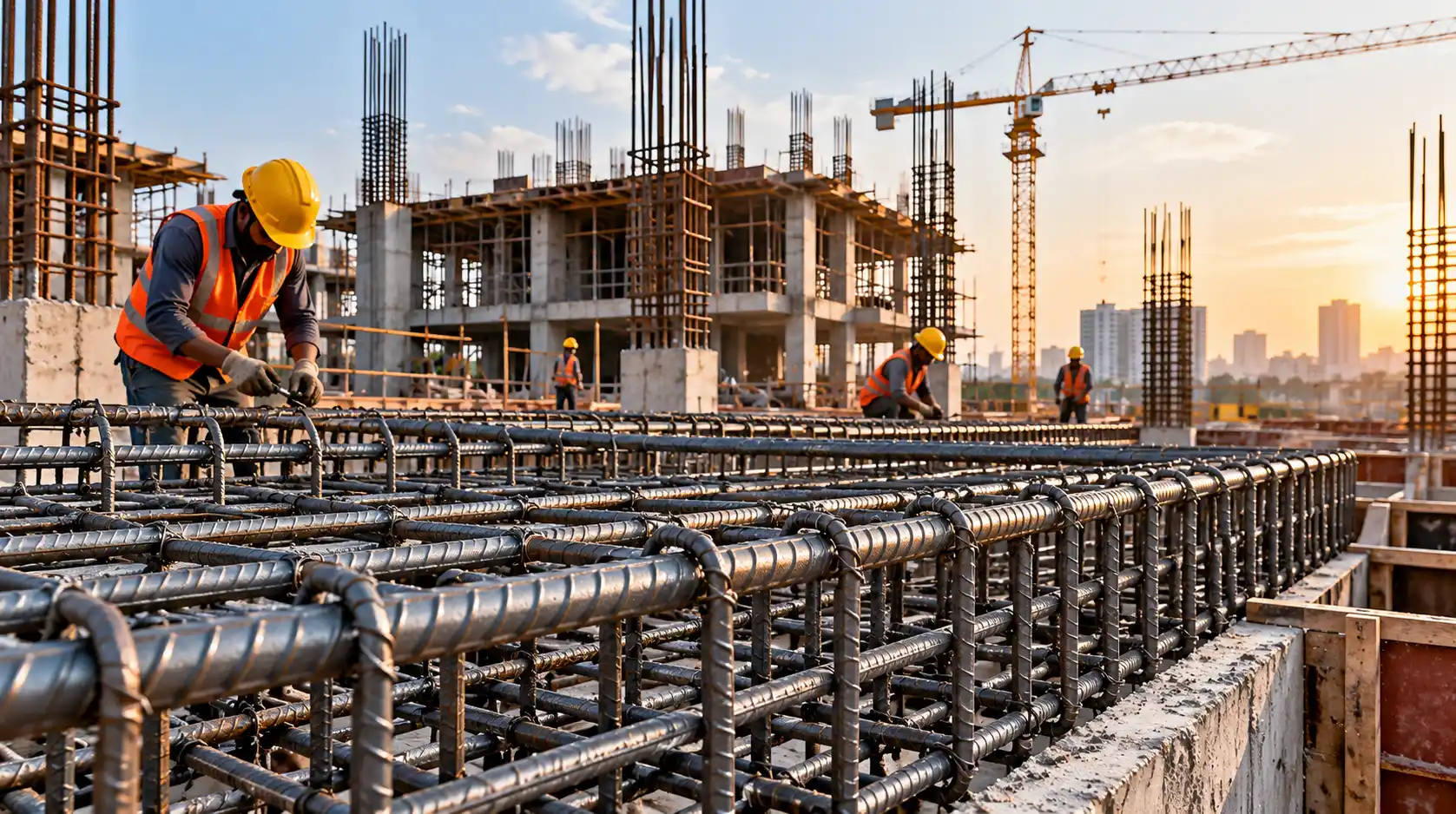
A common misconception is that sustainable steel must be weaker. It is not. Green steel is engineered to meet the same structural standards as any other reinforcement steel. A green Fe 550D bar still has to meet IS 1786:2008, with the same yield strength, the same ductility and the same bond with concrete. Your structural engineer does not change a single number in the design, and masons will not notice a difference on site.
Performance factor | Green Steel | Traditional Steel |
Strength | Comparable | Comparable |
Ductility | Comparable | Comparable |
Bond with concrete | Comparable | Comparable |
Weldability | Depends on grade and quality | Depends on grade and quality |
Corrosion resistance | Depends on grade | Depends on grade |
Lifespan | Long | Long |
The Grade Matters More Than the Label
Strength, ductility and weldability come from the grade and the quality of the thermo-mechanical treatment, not from the word green or traditional. Fe 550D, for example, belongs to the highest-performance category under IS 1786:2008, and the “D” stands for ductility, the ability to bend and absorb energy without snapping in an earthquake. Premium bars made with Belgian Tempcore technology, which uses quenching, self-tempering and controlled cooling to create a hard outer layer and a soft ductile core, show how process quality decides performance. To see this grade at work on real projects across South India, read our guide on how SSI TMT Fe 550D strengthens every project across India.
Where Green Steel Is Being Used and Why India Is Paying Attention
Green steel is moving from pilot projects into mainstream planning, and India has strong reasons to follow.
Green Buildings and Housing
Developers use low-carbon materials to earn ratings under IGBC, GRIHA and LEED and to meet corporate sustainability commitments. In group housing, schools and hospitals, the effect multiplies: if the reinforcement in every column of a township comes from a low-carbon route, the cumulative saving is large.
Infrastructure and Renewable Energy
Governments are giving growing priority to environmentally responsible materials for railways, metro lines, airports, bridges and public buildings. Green steel also supports the construction of wind farms, solar parks and transmission systems, where it makes sense to build clean energy with cleaner materials.
India’s Net-Zero Goal
India has committed to reaching net-zero emissions by 2070. Cities are heating up, monsoons are less predictable, and regulators, lenders and clients all want buildings that do not damage the planet. Steel is one of the easiest places to cut emissions without touching safety. Government programmes such as the National Green Hydrogen Mission aim to make clean hydrogen more available to heavy industry, including steelmaking.
Several forces are pushing adoption at the same time:
- ESG requirements from companies and investors
- Tightening environmental standards
- Tenders that ask for carbon data and EPD reports
- Developers who want faster approvals and stronger branding
Challenges Green Steel Still Faces
An honest comparison has to include the limits of green steel.
- Cost: hydrogen and new technology are expensive today.
- Infrastructure: new plants, renewable power and hydrogen supply chains need heavy investment.
- Scalability: meeting national demand will take years, not months.
- Scrap supply: EAF routes need a steady supply of quality scrap.
- Standardisation: there is no single definition of green steel yet, so claims must be verified.
- Availability: it may not be easy to find in every city or bar size.
These are the reasons traditional steel will stay in use during the transition. The practical path is steady improvement by manufacturers through cleaner energy, higher efficiency and more recycling, with quality never compromised.
How to Choose the Right TMT Bars for Your Project
Whether you are building an individual home or a high-rise, use this checklist.
- Start with the design grade. Follow your structural engineer’s specification, whether Fe 500D, Fe 550D or a corrosion-resistant grade. Never downgrade the grade to save money.
- Insist on IS 1786 and BIS marking. This is the baseline for safety, whatever the production route.
- Ask for test certificates. Check yield strength, tensile strength, elongation and chemical composition batch by batch.
- Ask about carbon data. Request an EPD or a documented emission figure per tonne of steel if sustainability is a project goal.
- Match the steel to the environment. Coastal and high-rainfall locations need corrosion-resistant grades, and seismic zones need high-ductility grades like Fe 550D.
- Plan certification early. If you are targeting IGBC, GRIHA or LEED points, decide on the steel before procurement begins.
- Balance budget and long-term value. For small homes, certified conventional bars may fit best today. For large projects, calculate the value of future compliance and funding.
- Buy from a trusted, certified manufacturer. Consistent quality from batch to batch is what keeps a structure safe for decades.
SSI TMT Fe 550D is available in sizes from 8mm to 32mm in standard 12-metre lengths, backed by the four-decade legacy of the Sakthi Group. Explore the SSI TMT range to match the right bar to your load.
Conclusion
Traditional steel built this country, and it will keep playing a major role while the industry changes. But coal cannot stay at the centre of steelmaking forever. Green steel keeps the strength and safety we depend on while dropping the emissions we do not want. It costs more today, but as scale grows, clean energy gets cheaper and rules tighten, that gap will narrow.
The bottom line is simple. On performance, the two are equal when standards are met. On the environment, green steel wins. On price today, traditional steel wins. On future readiness, green steel wins. Whichever route you choose, certified grade, consistent quality and BIS compliance are non-negotiable.
If your next project demands premium TMT bars built for long-term performance, talk to the SSI TMT team. Get a quote for SSI Fe 550D TMT bars and build your project on steel that has already proven itself across India.