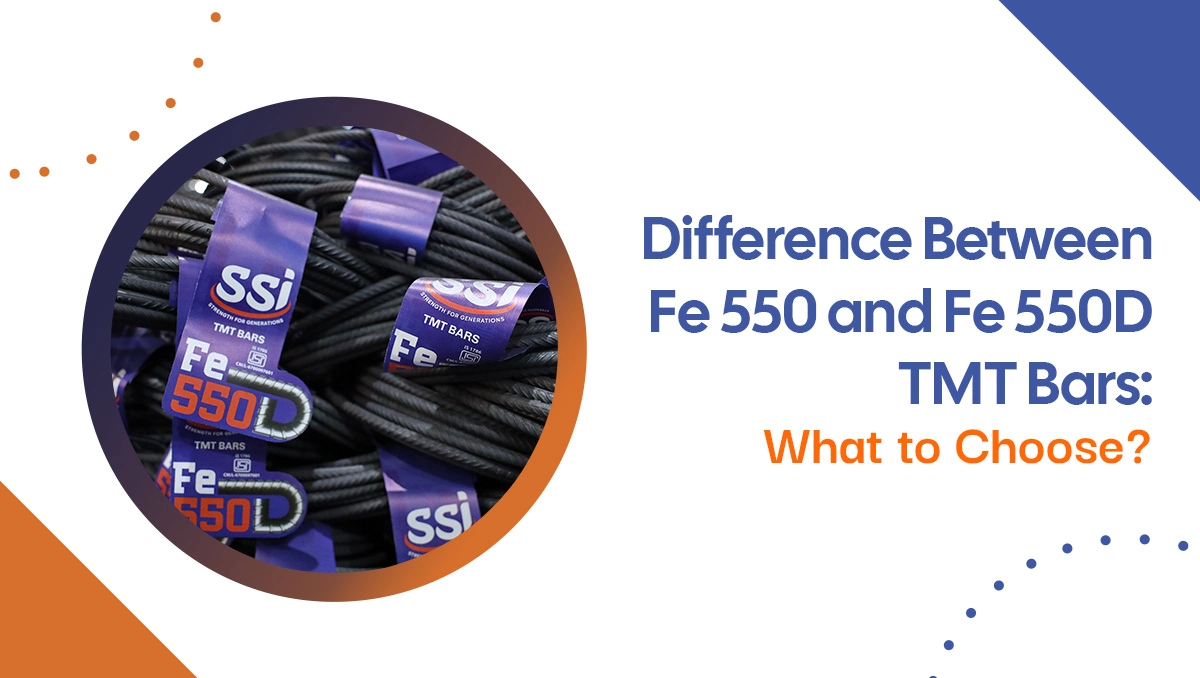
Both Fe 550 and Fe 550D TMT bars are high-strength steel reinforcements widely used in modern construction projects. They share similar yield strength characteristics and are manufactured using the Thermo-Mechanical Treatment process, making them superior to conventional steel bars. However, the core difference between Fe 550 and Fe 550D lies in their ductility levels – Fe 550D offers enhanced elongation properties, making it more suitable for earthquake-prone zones and structures requiring greater flexibility. In this article, we explore the difference between fe550 and fe550d in detail, covering their mechanical properties, applications, and helping you decide which grade suits your construction needs. For more information on TMT bars, visit our comprehensive guide
Confused about the grade in TMT bars? Want more clarity on what type of TMT bars suitable for your construction projects? Connect with our team members to clear your doubts!
A Quick Overview of Difference Between Fe 550 and Fe 550D TMT Bars
Understanding the difference between fe550 and fe550d helps builders and engineers select the right reinforcement for their projects. In the below table, we have provided the quick contrast between the two grade TMT bars.
| Aspect | Fe 550 TMT Bars | Fe 550D TMT Bars |
| Yield Strength | 550 N/mm² (minimum) | 550 N/mm² (minimum) |
| Elongation | 12% (minimum) | 14.5% (minimum) |
| Ductility | Standard | Enhanced |
| Bendability | Good | Excellent |
| Seismic Resistance | Moderate | High |
| Weldability | Good | Better |
| Application | General construction | Earthquake-prone zones, high-rise buildings |
| Cost | Comparatively lower | Slightly higher |
| IS Code | IS 1786:2008 | IS 1786:2008 |
What is the Fe 550 Grade TMT Bar?
Fe 550 grade TMT bar is a high-strength steel reinforcement with a minimum yield strength of 550 N/mm². The “Fe” stands for iron (ferrum in Latin), while “550” indicates the yield stress value. These bars are manufactured through the Thermo-Mechanical Treatment process, which involves rapid quenching of hot steel bars followed by self-tempering. This creates a tough outer layer and a ductile inner core, providing excellent strength and durability. Fe 550 TMT bars are commonly used in construction projects where high load-bearing capacity is required, including residential buildings, commercial complexes, and infrastructure projects.
Mechanical Properties of Fe 550 Grade TMT Bars
The mechanical properties of Fe 550 TMT bars make them suitable for demanding construction applications.
- Minimum Yield Strength: 550 N/mm² (provides excellent load-bearing capacity for structural applications)
- Minimum Tensile Strength: 585 N/mm² (ensures the bar can withstand pulling forces without breaking)
- Elongation: 12% minimum (offers adequate ductility for general construction needs)
- Bend Test: Should not show cracks when bent to 180 degrees (demonstrates good flexibility)
- Rebend Test: Must pass without failure (confirms the bar’s ability to be bent multiple times)
- Chemical Composition: Carbon content typically ranges from 0.25% to 0.30% (balanced for strength and weldability)
Applications of Fe 550 Grade TMT Bars
Fe 550 grade TMT bars are versatile and find use in various construction projects across different sectors.
- Multi-storey residential buildings: Fe 550 grade TMT bars provide the strength needed for load-bearing structures up to moderate heights.
- Commercial complexes and shopping malls: Supports large span structures and heavy floor loads.
- Industrial structures and warehouses: Handles the stress from heavy machinery and storage loads.
- Bridges and flyovers: Offers the tensile strength required for long-span constructions.
- Pre-stressed concrete structures: Works well in prestressed applications requiring high strength.
- General infrastructure projects: Suitable for roads, drainage systems, and public facilities.
Foundation works: Provides strong support for footings, piles, and raft foundations.
What is the Fe 550D Grade TMT Bar?
Fe 550D grade TMT bar is an advanced version of Fe 550, where “D” stands for ductility. These bars maintain the same high yield strength of 550 N/mm² but offer superior elongation properties compared to standard Fe 550 bars. The enhanced ductility makes Fe 550D TMT bars more flexible and better able to absorb energy during seismic events. This characteristic is particularly valuable in earthquake-prone regions where structures need to bend without breaking under sudden lateral forces. Fe 550D TMT bars are manufactured with controlled chemical composition and refined production processes to achieve the higher elongation values while maintaining strength, making them the preferred choice for critical structures and high-rise buildings.
Mechanical Properties of Fe 550D Grade TMT Bars
The mechanical properties of Fe 550D TMT bars reflect their superior performance in demanding construction environments.
- Minimum Yield Strength: 550 N/mm² – matches Fe 550 in load-bearing capacity.
- Minimum Tensile Strength: 600 N/mm² – ensures reliable performance under tension.
- Elongation: 14.5% minimum – significantly higher than Fe 550, providing enhanced ductility.
- Bend Test: Passes 180-degree bend without cracks – demonstrates excellent flexibility.
- Rebend Test: Superior performance with no failure – confirms exceptional bendability.
- Chemical Composition: Lower carbon equivalent (typically 0.42% or less) – improves weldability and ductility.
- Uniform Elongation: Better distribution of strain along the bar length – enhances seismic performance
In the following table, we have provided the quick overview of mechanical specifications of TMT bars manufactured by SSI TMT bars:
Properties | IS:1786–2008 | SSI TMT |
Yield Stress – N/mm² (Min.) | 550 | 570 |
Tensile Strength – N/mm² (Min.) | 600 | 640 |
TS/YS Ratio (Min.) | 1.08 | 1.11 |
Elongation % (Min.) | 14.5 | 17 |
Total Elongation % (Min.) | 5 | 6 |
Applications of Fe 550D Grade TMT Bars
Fe 550D grade TMT bars are specifically designed for projects where superior ductility and seismic resistance are essential.
- High-rise buildings and skyscrapers: Handles the complex stress patterns in tall structures effectively.
- Structures in seismic zones (III, IV, and V): Provides the flexibility needed to withstand earthquakes.
- Hospitals and emergency facilities: Ensures structural integrity during disasters when these buildings are most needed.
- Bridges in earthquake-prone areas: Absorbs seismic shocks while maintaining structural stability.
- Critical infrastructure projects: Used in power plants, airports, and metro stations requiring high safety standards.
- Educational institutions and public buildings: Protects large occupant loads with enhanced safety margins.
- Coastal structures: Combines strength with ductility for structures facing dynamic wave loads.
- Special structures requiring high weldability: The lower carbon content makes welding easier and more reliable.
Conclusion
The difference between Fe 550 and Fe 550D TMT bars primarily lies in their ductility characteristics, with Fe 550D offering superior elongation properties that make it ideal for seismic zones and critical structures. For general construction projects in non-seismic areas, Fe 550 TMT bars offer excellent strength and value. However, for high-rise buildings, structures in earthquake-prone regions, or projects where safety is paramount, Fe 550D is the better choice. The final decision should consider factors like location, building height, structural complexity, and local building codes to ensure both safety and cost-effectiveness.
FAQs
What is the major difference between Fe 550 and Fe 550D grade TMT bars?
The major difference between Fe 550 and Fe 550D is in ductility. Fe 550D has a minimum elongation of 14.5% compared to Fe 550’s 12%, making Fe 550D more flexible and better suited for earthquake-resistant construction. Both have the same yield strength of 550 N/mm².
What are the differences between Fe 415 and Fe 550D grade tmt bars?
Fe 550D has significantly higher yield strength (550 N/mm²) compared to Fe 415 (415 N/mm²), providing better load-bearing capacity. Fe 550D also offers enhanced ductility with 14.5% elongation, while Fe 415 typically has 14.5% elongation as well. Fe 550D allows for using fewer bars or smaller diameter bars in construction, reducing overall steel consumption.
What are the differences between Fe 500 and Fe 550D grade tmt bars?
Fe 550D has higher yield strength (550 N/mm²) compared to Fe 500 (500 N/mm²), allowing for stronger structural designs. Fe 550D provides superior ductility with 14.5% minimum elongation versus Fe 500’s 12%, making it better for seismic applications. The higher strength of Fe 550D can result in cost savings through reduced steel usage.
Which is better 550 or 550D?
Fe 550D is better for structures in earthquake-prone zones, high-rise buildings, and critical infrastructure due to its superior ductility and energy absorption capacity. Fe 550 is suitable for general construction in non-seismic areas where the enhanced ductility is not mandatory. If budget permits and safety is a priority, Fe 550D is the recommended choice.
What does the D stand for in 550D steel?
The “D” in Fe 550D stands for ductility. It indicates that the Fe 550D TMT bars have enhanced elongation properties, providing better flexibility and the ability to bend without breaking, which is especially important for earthquake-resistant construction.
Which Fe grade steel is best?
The best Fe grade depends on the project requirements. Fe 550D is best for high-rise buildings and seismic zones due to superior ductility. Fe 500D works well for most residential and commercial buildings. Fe 415 is suitable for smaller structures and general construction. Consider factors like location, building height, seismic zone, budget, and local building codes when choosing.
Which is the No. 1 TMT in South India?
SSI TMT Bars stands as the No.1 Premium TMT Bars manufacturer in Southern India. With advanced manufacturing plants and belgian tempcore technology process, this top TMT bars manufacturer produces the corrosion-resistant and long-lasting Fe 550D TMT Bars.