
When you start planning a house, one of the first things you think about is the design, budget and materials. But when it comes to the structure, there is one decision you cannot afford to overlook — choosing the right TMT bars.
You may have heard terms like Fe 500, Fe 500D, Fe 550 and Fe 550D while discussing steel with a contractor or engineer. At first, these numbers and letters can seem confusing. What do they actually mean? Is Fe 550 better than Fe 500? What does the “D” stand for? And which TMT bar grade is suitable for your construction?
Understanding these grades can help you make a better-informed decision instead of choosing reinforcement steel based only on price or strength.
In this guide, we will explain the different TMT bar grades in India, how they differ, and why Fe 550D TMT bars are considered for projects where high strength and enhanced ductility are required.
What Do TMT Bar Grades Mean?
The grade of a TMT bar indicates its mechanical properties, particularly its yield strength.
For example, the number 500 in Fe 500 refers to a specified minimum yield strength of 500 N/mm², while 550 in Fe 550 refers to 550 N/mm².
The letter D indicates a grade with enhanced elongation or ductility requirements compared with the corresponding non-D grade.
In simple terms:
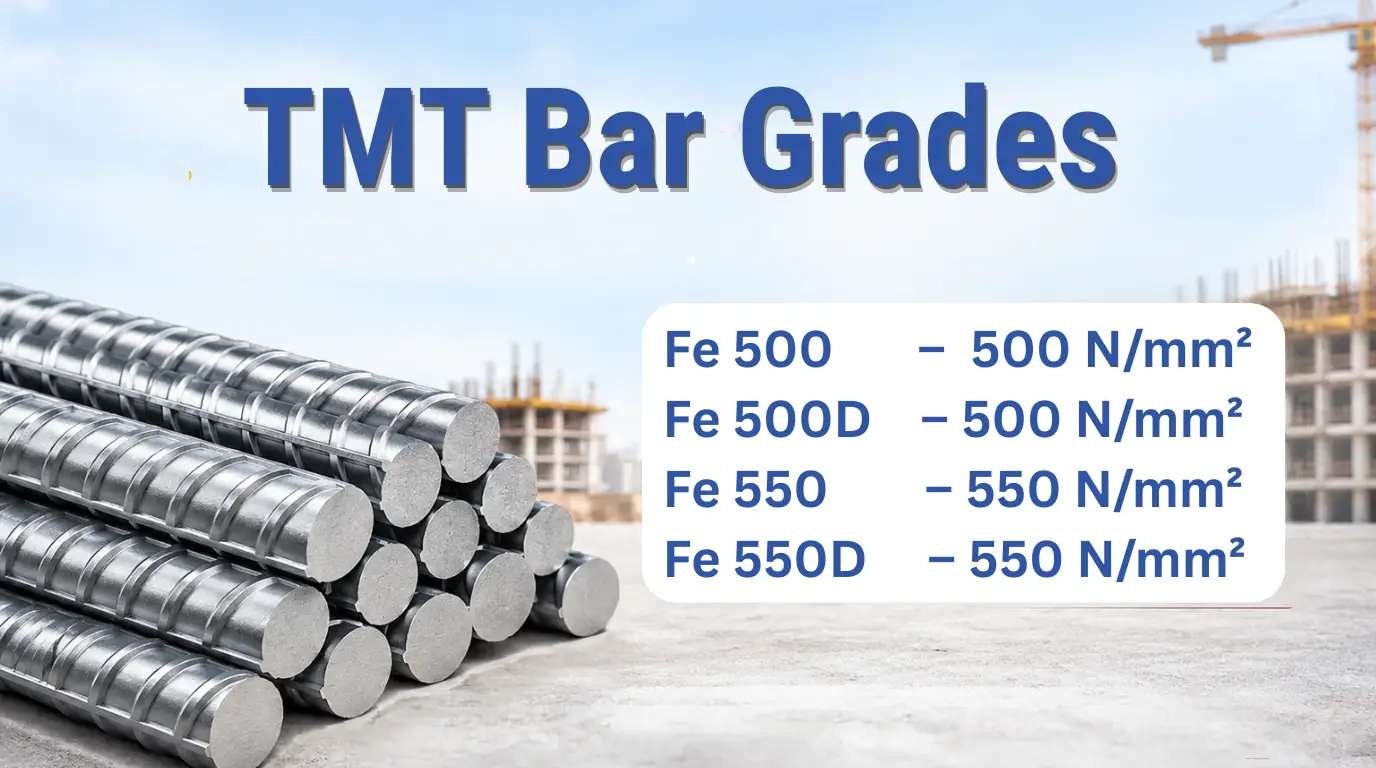
- Fe 500 – 500 N/mm² minimum yield strength
- Fe 500D – 500 N/mm² minimum yield strength with enhanced ductility
- Fe 550 – 550 N/mm² minimum yield strength
- Fe 550D – 550 N/mm² minimum yield strength with enhanced ductility
The right grade should always be selected according to the structural design and engineer’s specifications.
TMT Bar Grades in India: Quick Comparison
Grade | Minimum Yield Strength | Ductility | Typical Consideration |
Fe 500 | 500 N/mm² | Standard | General RCC construction |
Fe 500D | 500 N/mm² | Enhanced | Residential and structural applications |
Fe 550 | 550 N/mm² | Standard | Higher-strength applications |
Fe 550D | 550 N/mm² | Enhanced | High-strength structural applications |
The key point is that Fe 550D combines higher yield strength with enhanced ductility.
Fe 500 TMT Bars
Fe 500 is a high-strength reinforcement grade with a minimum yield strength of 500 N/mm².
It can be used in different RCC applications where the structural design specifies this grade. However, the selection should not be based on the grade number alone.
Fe 500D TMT Bars
Fe 500D TMT Bars have the same specified minimum yield strength as Fe 500 but have enhanced ductility requirements.
This makes the D grade useful when the structural design requires a combination of strength and improved deformation characteristics.
Fe 550 TMT Bars
Fe 550 offers a higher specified minimum yield strength of 550 N/mm² compared with Fe 500.
It can be considered where higher-strength reinforcement is required by the structural design. However, higher strength does not automatically mean that Fe 550 is the right choice for every project.
Fe 550D TMT Bars
Fe 550D combines 550 N/mm² minimum yield strength with enhanced ductility requirements.
This combination makes Fe 550D an important reinforcement grade for projects where both strength and ductility are required.
For structural applications, Fe 550D TMT Bars can be specified for buildings and other RCC structures based on factors such as structural loads, design requirements, reinforcement detailing and the engineer’s calculations.
For SSI TMT, Fe 550D is the key grade to consider when the project calls for high-strength reinforcement with enhanced ductility.
Fe 500D vs Fe 550D: What Is the Difference?
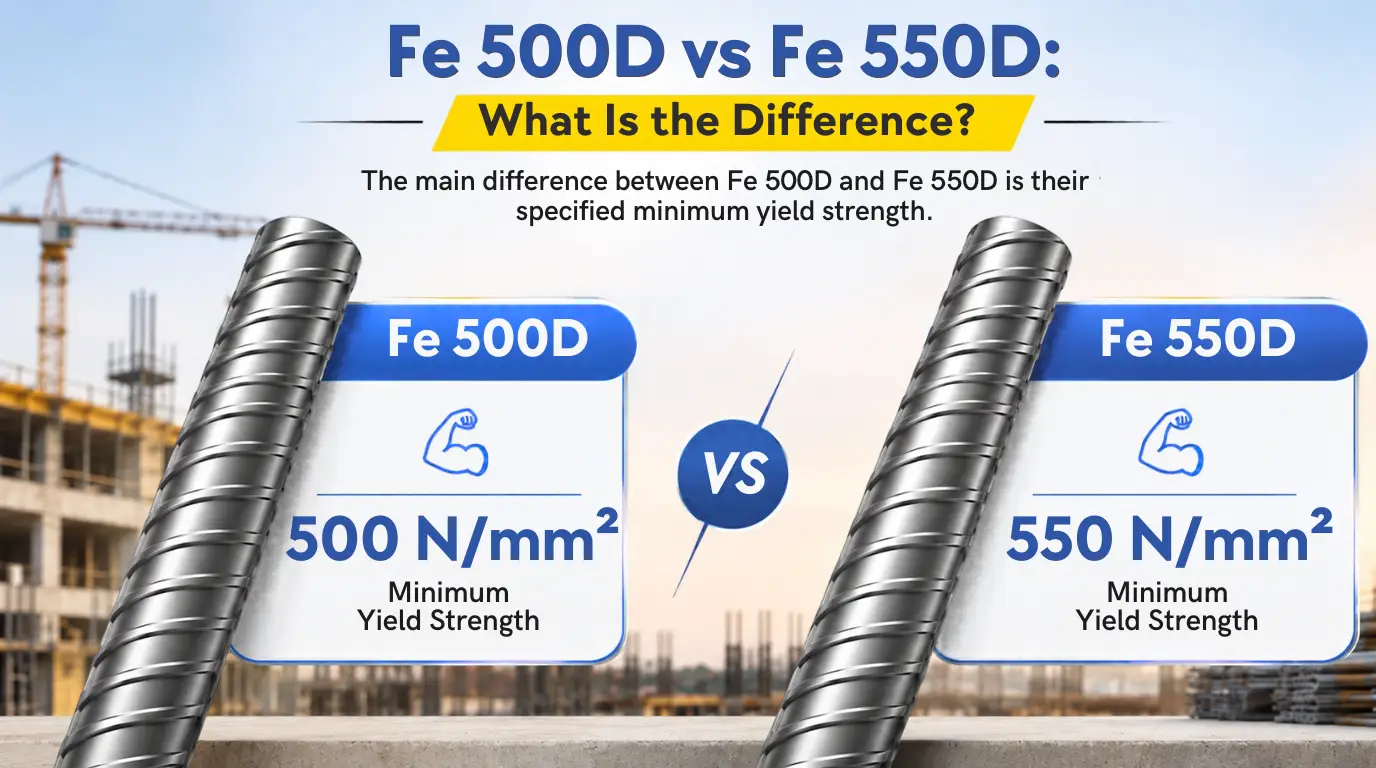
The main difference between Fe 500D and Fe 550D is their specified minimum yield strength.
- Fe 500D: 500 N/mm²
- Fe 550D: 550 N/mm²
Both are D grades, meaning they have enhanced ductility requirements compared with their corresponding non-D grades.
For a detailed comparison, see our Difference Between Fe 550 and Fe 550D TMT Bars blog.
Why Does Ductility Matter in TMT Bars?
Strength is important, but reinforcement also needs to deform appropriately under loading.
Ductility allows steel to undergo greater deformation before failure. This characteristic is particularly important in structural design where the reinforcement may be subjected to significant stresses.
This is one reason grades such as Fe 500D and Fe 550D are specified when enhanced ductility is required.
Which TMT Bar Grade Is Best for Your Project?
There is no single TMT grade that is automatically best for every construction project.
The appropriate grade depends on:
- Structural design
- Building height
- Design loads
- Soil conditions
- Seismic considerations
- Reinforcement detailing
- Structural engineer’s specifications
For this reason, homeowners and contractors should purchase the grade specified in the structural drawings rather than choosing a TMT bar only by price or strength number.
Fe 550D TMT Bars from SSI TMT
When a project requires higher-strength reinforcement with enhanced ductility, Fe 550D is a grade worth considering as specified by the structural design.
SSI TMT focuses on Fe 550D TMT bars, providing a reinforcement option for construction projects where this grade is specified.
The important point is simple: choose the grade your structure requires, and choose a manufacturer you can rely on for consistent quality.
Build Strong with the Right TMT Grade
The grade of TMT bar plays an important role in the performance of an RCC structure. Understanding the difference between Fe 500, Fe 500D, Fe 550 and Fe 550D helps you make a more informed purchasing decision.
For projects that specify Fe 550D, choosing a reliable manufacturer and ensuring the supplied reinforcement meets the required specifications are equally important.
Choose the right grade. Build with confidence.