
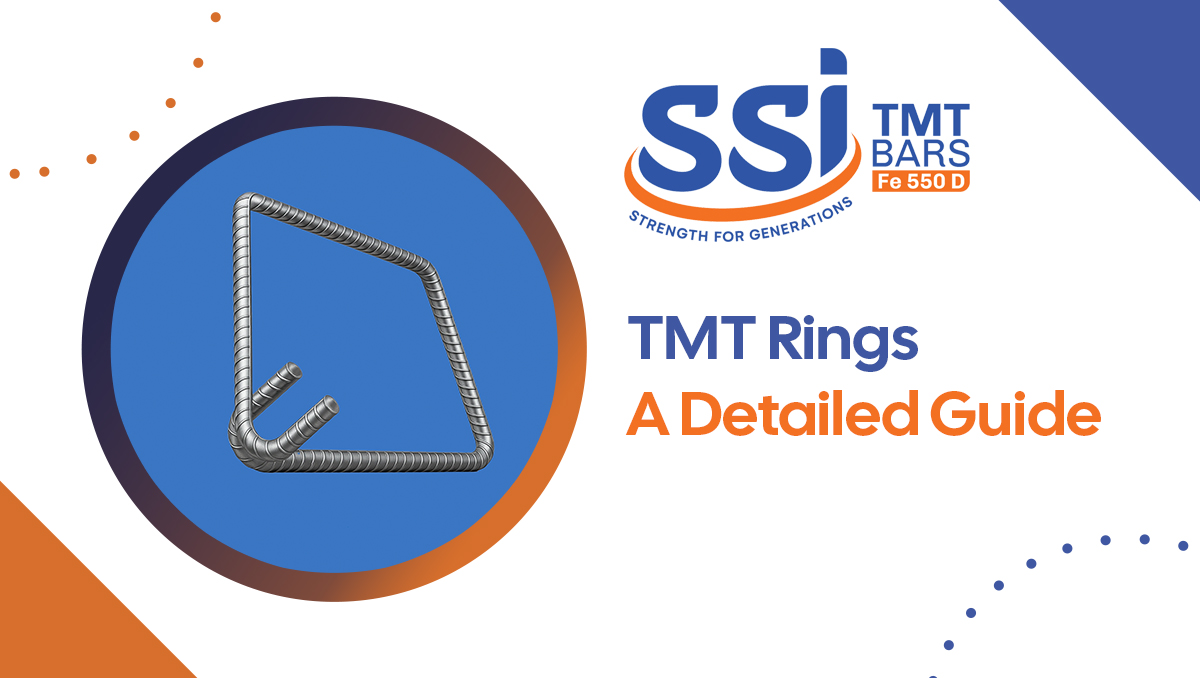
As you see in the above image, TMT rings are closed-loop reinforcement elements fabricated from Thermo-Mechanically Treated (TMT) steel bars, used primarily to confine and bind longitudinal rebars in reinforced concrete structures.
Civil engineers specify TMT rings in columns, beams, and pile foundations to resist forces, and maintain structural integrity under seismic and dynamic loads. TMT rings cut from high-grade TMT bars deliver superior ductility, corrosion resistance, and bendability compared to rings made from ordinary mild steel. Construction projects across India increasingly prefer Fe 550D grade TMT rings to meet Bureau of Indian Standards (BIS) requirements for earthquake-resistant structures. In this article, we are going to clearly explain about the TMT rings, its definition, benefits and applications.
SSI TMT Bars manufacture BIS-certified high-strength TMT rings engineered for columns, beams, and earthquake-resistant construction across India – Let’s speak to our team!
Benefits and Uses of TMT Rings
TMT rings made from quality TMT bars deliver structural, economic, and durability benefits for long-term performance of reinforced concrete buildings.
- High ductility: TMT rings bend up to 180° without cracking, allowing precise fabrication of stirrups and closed ties for column and beam cages
- Superior shear resistance: TMT rings absorb and redistribute shear forces in beams and columns, preventing diagonal tension failures under load
- Earthquake resistance: TMT rings provide the elongation for ductile detailing in seismic zones III, IV, and V
- Corrosion resistance: The hardened outer martensite layer of TMT rings resists moisture and chloride penetration, extending structural life by 30–50 years in coastal and humid environments
- Weldability: Low carbon equivalent values in TMT rings enable clean site welding without compromising tensile strength
- Cost efficiency: TMT rings reduce steel wastage by 8–12% compared to cold-twisted rings due to uniform cross-section and consistent mechanical properties
- BIS compliance: TMT rings produced from IS:1786-certified TMT bars meet mandatory quality benchmarks for government and private construction projects
Applications of TMT Rings
TMT rings serve as critical structural components across residential, commercial, infrastructure, and industrial construction segments in India.
- Column stirrups: TMT rings bind vertical longitudinal bars in RCC columns, confining the concrete core and preventing buckling under axial and lateral loads
- Beam stirrups: TMT rings placed at calculated spacing along beams resist diagonal shear cracks and torsional forces in floor and roof systems
- Pile cage reinforcement: TMT rings fabricated as helical spirals confine longitudinal bars in bored and driven piles for bridge and high-rise foundations
- Retaining wall reinforcement : TMT rings stabilize vertical rebars in retaining walls subjected to earth pressure and water table fluctuation
- Industrial structures: Factories, warehouses, and power plant structures use TMT rings in column and beam frames to meet heavy load and vibration resistance requirements
- Bridge construction: Pier columns and abutment walls in highway and railway bridges require closely spaced TMT rings for seismic ductility compliance
- Underground structures: Metro rail tunnels, basements, and underpasses specify TMT rings to handle hydrostatic pressure and ground movement
TMT Rings vs TMT Bars: Comparison and Uses
TMT rings and TMT bars originate from the same thermo-mechanical treatment process but serve distinct structural functions. Understanding the difference helps structural engineers and procurement teams specify the right product for each application.
| Feature | TMT Rings | TMT Bars |
| Form | Closed loops / stirrups | Straight rebars in standard lengths |
| Primary function | Shear and confinement reinforcement | Longitudinal tensile reinforcement |
| Structural role | Binds and confines longitudinal bars | Carries axial tension and compression |
| Common grades | Fe 500, Fe 500D | Fe 500, Fe 500D |
| Fabrication | Bent on-site or pre-fabricated from TMT bars | Used straight or cut to length |
| Applications | Columns, beams, piles, stirrups | Slabs, walls, footings, frames |
| IS standard | IS:1786 (source bar), IS:13920 (detailing) | IS:1786 |
| Seismic importance | Critical – provides ductile confinement | Essential – resists tensile forces |
Learn more: What is TMT Bars? – Detailed Guide
Seeking to Buy TMT Rings and TMT Bars?
SSI TMT Bars delivers certified TMT rings and TMT bars engineered for high-performance reinforced concrete construction across India. Every TMT ring and TMT bar from SSI TMT undergoes rigorous quality checks for yield strength, ultimate tensile strength, and elongation percentage before leaving the plant. Contractors who source TMT rings from SSI TMT reduce procurement complexity, ensure grade consistency across the structural frame, and meet BIS compliance requirements without sourcing from multiple vendors.
Whether the project involves a multi-storey residential tower in a seismic zone, a highway bridge, or an industrial facility, SSI TMT Bars supplies TMT rings and TMT bars that perform under the most demanding load conditions.
Frequently Asked Questions: TMT Rings
1. What are TMT rings used for in construction?
TMT rings function as stirrups and closed ties in reinforced concrete columns, beams, and pile cages. TMT rings confine longitudinal rebars, resist shear forces, and prevent structural members from buckling or failing under seismic and dynamic loads.
2. What is the difference between TMT rings and TMT stirrups?
TMT rings and TMT stirrups refer to the same structural element. Engineers use the term stirrups specifically for shear reinforcement in beams, while rings or ties describe confinement reinforcement in columns. Both TMT rings and TMT stirrups are fabricated by bending TMT bars into closed loops at the required diameter and spacing.
3. Which TMT grade is best for TMT rings in earthquake-prone areas?
Fe 500D grade TMT bars produce the best TMT rings for earthquake-resistant construction. Fe 500D delivers a minimum elongation of 16% and a higher ultimate tensile strength to yield strength ratio (UTS/YS ≥ 1.15), meeting IS:13920 ductile detailing requirements for seismic zones III, IV, and V across India.
4. How do TMT rings improve column strength?
TMT rings placed as lateral ties around longitudinal bars in RCC columns confine the concrete core under compressive loads. Closely spaced TMT rings increase column ductility by 40–60%, delay concrete crushing, and prevent longitudinal bar buckling – directly improving load-carrying capacity and post-yield deformation behavior.
5. Why should contractors source TMT rings from SSI TMT Bars?
SSI TMT Bars supplies IS:1786-certified TMT rings fabricated from consistently graded Fe 500D steel, ensuring every stirrup meets the mechanical property benchmarks that structural designs specify. Contractors who procure TMT rings from SSI TMT Bars eliminate grade inconsistency risks, reduce rejection rates at quality inspections, and receive reliable supply schedules that keep construction timelines on track.
SSI TMT Bars combines manufacturing quality control with competitive pricing – making SSI TMT the preferred TMT ring and TMT bar supplier for construction projects across Tamilnadu and India.